

Close Menu

    Subscribe to Updates

    Get the latest creative news from FooBar about art, design and business.

    What's Hot

    How to Build an Emergency Fund in Canada as a Newcomer

    May 16, 2026

    GST/HST Credit in Canada: What It Is and How Newcomers Can Claim It

    May 12, 2026

    Understanding Your Employee Benefits Package in Canada

    May 8, 2026
    Facebook X (Twitter) Instagram
    Facebook X (Twitter) Instagram
    Arrive Then ThriveArrive Then Thrive
    Subscribe
    • Home
    • Budget & Savings
      • Student Finance
      • Family Finance
    • Investing
    • Money Guide
      • Work & Income
      • Insurance
      • Banking
      • Building Credit
      • Taxes
    • Housing & Mortgages
    • News & Updates
    Arrive Then ThriveArrive Then Thrive
    Home»Featured»GST/HST Credit in Canada: What It Is and How Newcomers Can Claim It
    Featured

    GST/HST Credit in Canada: What It Is and How Newcomers Can Claim It

    Grace ValdezBy Grace ValdezMay 12, 2026No Comments13 Mins Read2 Views
    Facebook Twitter Pinterest LinkedIn Tumblr Email
    A smiling newcomer couple reviewing financial documents at a table in their Canadian home
    Share
    Facebook Twitter LinkedIn Pinterest WhatsApp Email

    Moving to a new country is expensive. Between settling into a new home, navigating unfamiliar systems, and building your life from scratch, every dollar matters. That’s why one of the first things newcomers to Canada should know about is the GST/HST credit — a tax-free quarterly payment from the federal government designed to help low- and modest-income Canadians offset the cost of goods and services taxes they pay every day.

    The good news? As a newcomer, you don’t have to wait until you file your first tax return to start receiving this benefit. You can apply right away — in some cases, within weeks of arriving in Canada.

    In this guide, we’ll break down everything you need to know about the GST/HST credit: what it is, who qualifies, exactly how much you can receive, and the simple steps to claim it as a new resident of Canada. Whether you arrived last month or are preparing to arrive, this article is your go-to resource.


    What Is the GST/HST Credit?

    The Goods and Services Tax/Harmonized Sales Tax (GST/HST) credit is a tax-free payment issued by the Canada Revenue Agency (CRA) to help individuals and families with low to modest incomes. Its purpose is simple: to offset some of the GST or HST they pay throughout the year when buying everyday goods and services — groceries, clothing, household items, and more.

    Canada charges a federal Goods and Services Tax (GST) of 5% on most goods and services. In provinces that have merged their provincial sales tax with the federal GST — Ontario, Nova Scotia, New Brunswick, Prince Edward Island, and Newfoundland and Labrador — the combined rate is called the Harmonized Sales Tax (HST), ranging from 13% to 15%. Over a year, these taxes add up significantly for working families, especially those with modest incomes.

    The GST/HST credit is the federal government’s way of returning a portion of that money to people who need it most. Payments are made four times a year (quarterly) and are completely tax-free — meaning you don’t have to report them as income or pay any tax on them.

    The GST/HST credit payment dates for 2026 are: January 5, April 3, July 3, and October 5. Payments are issued on the 5th of each month, or the last business day before the 5th if it falls on a weekend or holiday.

    💡 QUICK FACT

    Who Qualifies for the GST/HST Credit in Canada?

    To be eligible for the GST/HST credit, you must meet all of the following criteria:

    • Be a resident of Canada for income tax purposes
    • Be at least 19 years old — OR — have (or had) a spouse or common-law partner, OR be (or previously were) a parent living with your child
    • Have a Social Insurance Number (SIN)
    • Have filed a Canadian income tax return (even if you had zero income)


    What About Newcomers and Immigrants?

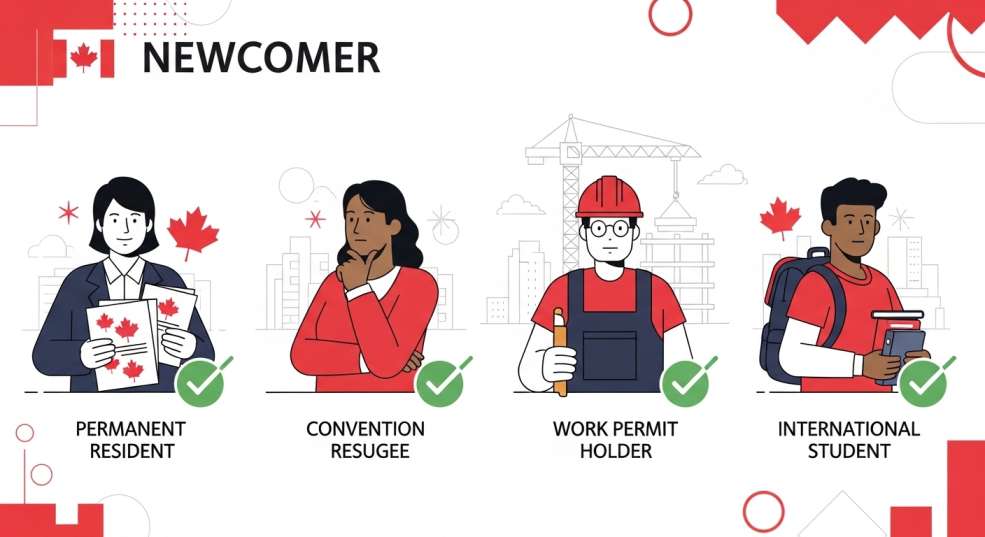
    This is where it gets especially interesting for new arrivals. Permanent residents, refugees, and even certain temporary residents with valid immigration permits may be eligible. According to the CRA, you become a resident of Canada for income tax purposes when you establish significant residential ties here — for most newcomers, this begins on your first day in Canada.

    Here’s the part that surprises many newcomers: you do NOT need to file your first Canadian tax return before you can apply for the GST/HST credit. You can apply using a special form as soon as you arrive and establish residency.

    Temporary residents need to have had a valid immigration permit for at least 18 consecutive months to qualify for the GST/HST credit.

    💡 IMPORTANT
    Illustration showing four types of eligible newcomers: permanent resident, refugee, work permit holder, student
    Illustration showing four types of eligible newcomers: permanent resident, refugee, work permit holder, student.

    How Much Can You Receive? GST/HST Credit Amounts for 2025–2026

    The amount you receive depends on your family situation and your adjusted family net income. For the 2025–2026 benefit year (based on your 2024 tax return), the CRA increased payment amounts by 2.7% to keep pace with inflation. Here are the maximum amounts:

    TABLE 1: GST/HST Credit Maximum Annual Amounts by Household Type (2025–2026 Benefit Year)

    Source: Canada Revenue Agency — canada.ca/gst-hst-credit  |  Based on 2024 tax return (July 2025 to June 2026)

    Household Situation

    Max Annual Credit

    Per Quarter

    Single, no children

    $533/year

    $133.25/quarter

    Married / common-law (no children)

    $698/year

    $174.50/quarter

    Single with 1 child

    $717/year

    $179.25/quarter

    Married with 1 child

    $882/year

    $220.50/quarter

    Married with 2 children

    $1,066/year

    $266.50/quarter

    It’s important to note that these are maximum amounts. Your actual payment may be lower if your family net income exceeds certain thresholds. The phase-out begins at approximately $45,521 in adjusted family net income, meaning the credit gradually reduces as income increases above that amount.

    Income Thresholds: The Phase-Out

    The GST/HST credit is designed for low- to modest-income Canadians, so it phases out as income rises. For example, as a single individual with no children, you would receive the full credit if your net income falls between roughly $11,337 and $45,521. For incomes above that, the credit reduces gradually and eventually reaches zero around $56,181 for a single person, or $66,841 for a married couple with two children.

    As a newcomer, especially in your first year, your Canadian income is often lower — which actually means you may receive the maximum credit amount. This is a significant financial advantage worth taking full advantage of right from the start.

    How Newcomers Apply for the GST/HST Credit

    This is where newcomers’ experience differs from long-term Canadian residents. For most Canadians, there’s no application — the CRA automatically determines eligibility when they file their annual tax return. But for newcomers in their first year of residency, a separate application is required before that first tax return is filed.

    Step-by-Step: Claiming the GST/HST Credit as a New Resident

    1. Get your Social Insurance Number (SIN) — Visit a Service Canada office and apply in person. You’ll receive your SIN the same day. This is mandatory for receiving any CRA benefits.
    2. Determine which form applies to you — The form you need depends on whether or not you have children under 19.
    3. Complete and submit your application — Details in the table below.
    4. Receive your confirmation notice — The CRA will send you a GST/HST credit notice once your application is processed, showing your payment amount.
    5. After year one, just file your taxes — Once you’ve filed your first Canadian income tax return, the CRA will automatically reassess your eligibility every year. No additional application is needed.

    TABLE 2: Which Form Do Newcomers Need to Apply for the GST/HST Credit?

    Source: Canada Revenue Agency — canada.ca/newcomers  |  Form RC151 available at canada.ca/rc151

    Situation

    Answer

    What to Do

    Do you have children?

    No

    Form RC151 (online or paper)

    Do you have children?

    Yes

    Form RC66 + RC66SCH (paper/mail)

    Already filed first tax return?

    Yes

    CRA auto-assesses — no extra form needed

    Child under 19 in your care?

    Yes

    Register via CRA My Account or by phone

    How to Submit Form RC151

    The CRA has made this process fairly straightforward for newcomers:

    • Online (recommended for those without children): Use the CRA Web Form for RC151 — it’s quick, digital, and eliminates the need to mail anything.
    • By mail (required for those with children): Download and print Form RC151, complete it, and mail it to your local CRA tax centre along with proof of birth for any children you are claiming.
    • Via CRA My Account: If you already have a CRA account set up, you can manage your information and verify your application status online at canada.ca/my-cra-account.

    Real-Life Scenarios: How the GST/HST Credit Helps Newcomers

    Sometimes numbers on a page don’t tell the whole story. Here are three realistic newcomer scenarios to show how the GST/HST credit works in practice.

    Scenario 1 — Aarav, Single Software Engineer from India

    Aarav arrived in Toronto on a work permit in March 2025. He’s single, has no children, and earns $65,000 per year. Because his income exceeds the phase-out threshold, his GST/HST credit is reduced — but he still qualifies for a partial credit. After filing Form RC151, Aarav begins receiving quarterly payments within a few months of applying. He uses the funds to cover quarterly utility bills.

    Scenario 2 — Maria and Carlos, Family from Colombia

    Maria and Carlos arrived as permanent residents in September 2025 with two children aged 5 and 9. Carlos will not start working until the following year. With low initial family income, they qualify for the maximum credit for a family of four: $1,066 per year, paid in $266.50 quarterly instalments. They apply using Form RC66 along with the RC66SCH. Their payments begin in January 2026. Maria notes the credit helps cover the family’s grocery costs for the quarter.

    Scenario 3 — Mei, International Student Turned Permanent Resident

    Mei arrived in Canada as an international student in 2022. In 2024, she transitioned to permanent resident status. She had previously applied for the credit as a student after 18 months of residency, receiving smaller payments due to her study permit status. Now as a PR, she files her annual tax return and her credit is automatically recalculated, resulting in a higher quarterly payment going forward.

    Provincial and Territorial Top-Up Credits

    The federal GST/HST credit is just the starting point. Many Canadian provinces and territories offer their own sales tax credits or benefits that the CRA administers alongside the federal credit. In some cases, you’ll receive these provincial credits automatically along with your federal GST/HST credit — often in the same quarterly payment.

    For example, Ontario residents may also qualify for the Ontario Trillium Benefit (OTB), which includes the Ontario Sales Tax Credit component. New residents of Ontario who apply for the federal GST/HST credit may also be assessed for provincial top-ups.

    Common Mistakes Newcomers Make (and How to Avoid Them)

    The GST/HST credit is straightforward, but there are a few common stumbling blocks that cause newcomers to miss payments or face delays:

    Mistake #1: Not Applying in Year One

    Because the CRA automatically handles the GST/HST credit for existing Canadian residents, many newcomers assume it’s also automatic for them. It’s not — in your first year, you must proactively apply using Form RC151 or RC66. Missing this step means missing months of payments you were entitled to.

    Mistake #2: Not Filing a Tax Return Even With No Income

    Even if you earned zero Canadian income in your first year, you should still file a Canadian tax return. Many newcomers skip this because they think ‘I didn’t earn anything in Canada, so I have nothing to report.’ But the CRA uses your return to determine your eligibility for multiple benefits. Filing ensures you receive every dollar you’re entitled to.

    Mistake #3: Outdated CRA Information

    If you get married, separate, have a child, or change your address after arriving in Canada, you must notify the CRA promptly. Your GST/HST credit is calculated based on your current family situation. Failing to update your information can lead to either missed payments (underpayments) or overpayments that you’ll have to repay later.

    Mistake #4: Not Setting Up Direct Deposit

    The CRA strongly recommends setting up direct deposit through CRA My Account. Cheques take longer and can get lost in the mail — especially for newcomers who may have recently changed addresses. Direct deposit ensures your quarterly payments arrive on time, every time.

    Newcomer setting up CRA My Account on a smartphone to receive GST/HST credit payments by direct deposit.

    Other Benefits Newcomers Can Claim Alongside the GST/HST Credit

    Once you’ve applied for the GST/HST credit, you’ll be assessed for several other federal and provincial benefits at the same time. Think of Form RC151 and RC66 as opening the door to Canada’s entire benefit system for newcomers. Here are the key programs to know:

    Canada Child Benefit (CCB)

    If you have children under 18, the Canada Child Benefit is one of the most valuable programs available to newcomers. Eligible families can receive up to $7,997 per year for each child under 6, and up to $6,748 per year for each child aged 6 to 17. This is a monthly, tax-free payment administered by the CRA. Apply using Form RC66.

    Ontario Trillium Benefit (OTB) — Ontario Residents

    If you live in Ontario, you may be eligible for the Ontario Trillium Benefit, which combines three provincial tax credits including the Ontario Sales Tax Credit, Ontario Energy and Property Tax Credit, and Northern Ontario Energy Credit. This benefit is assessed when you file your Ontario tax return.

    GST/HST Credit for Turning 19

    If you have a child who will turn 19 during the year, they will need to file their own tax return for the first time to receive their own GST/HST credit payments going forward. The CRA will automatically determine their eligibility when the return is filed.

    Key Dates and Payment Schedule for 2026

    Once you’re receiving the GST/HST credit, staying on top of payment dates helps you plan your finances. The CRA issues payments on the 5th of January, April, July, and October — or the last business day before the 5th if it falls on a weekend or holiday. For 2026, mark these dates:

    • January 5, 2026
    • April 3, 2026
    • July 3, 2026
    • October 5, 2026

    Your payment amount for a given period is based on your tax return from the previous year. For example, the July 2025 to June 2026 period was calculated using your 2024 tax return. If your income or family situation changed significantly, the credit will be recalculated when your new return is filed.

    If your total annual GST/HST credit is less than $50 per quarter (under $200 per year), the CRA will issue your entire annual credit in a single lump-sum payment in July rather than splitting it into quarterly payments.

    💡 PRO TIP

    Official CRA Resources for Newcomers

    Always rely on official government sources for the most accurate and up-to-date information. Here are the key links:

    • CRA Newcomers to Canada
    • Form RC151 (no children)
    • Form RC66 (with children)
    • GST/HST Credit overview
    • CRA My Account
    • Child and Family Benefits Calculator


    Conclusion: Don’t Leave Money on the Table

    The GST/HST credit may not make you wealthy — but it’s tax-free money you’re entitled to, and for newcomers managing tight budgets in those first months and years in Canada, every quarterly payment matters. Whether you’re a recent permanent resident, a refugee, or a work permit holder who has been here long enough to qualify, the process to claim this credit is simpler than many people expect.

    Here’s your quick action checklist:

    • Get your SIN at Service Canada as soon as possible after arriving
    • Determine if you have children under 19 to choose the right form (RC151 or RC66)
    • Submit your application — online or by mail
    • Set up direct deposit via CRA My Account for faster, reliable payments
    • File your Canadian tax return every year, even with zero income
    • Notify the CRA promptly when your family situation changes

    Canada’s tax and benefit system is one of the most generous in the world for people who engage with it. The GST/HST credit is just the beginning — applying for it opens the door to a range of other provincial and federal programs that can meaningfully improve your financial footing as you build your new life here.


    Welcome to Canada. Now let’s make sure you’re getting everything you deserve. 🍁


    DISCLAIMER

    The information provided in this article is for general informational and educational purposes only and does not constitute tax, legal, or financial advice. Tax laws, CRA benefit amounts, eligibility criteria, and program rules are subject to change. While every effort has been made to ensure accuracy as of the publication date, ArriveThenThrive.ca makes no guarantees regarding the completeness or current accuracy of this information. Always consult the official Canada Revenue Agency website at canada.ca or speak with a qualified tax professional or immigration adviser for advice specific to your personal situation. ArriveThenThrive.ca is not affiliated with the Government of Canada or the Canada Revenue Agency.

    ArriveThenThrive Canada Revenue Agency Canadian tax credits CRA benefits Form RC151 GST/HST credit immigration finances new immigrant taxes newcomers to Canada tax-free payments
    Share. Facebook Twitter Pinterest LinkedIn Tumblr Email
    Previous ArticleUnderstanding Your Employee Benefits Package in Canada
    Next Article How to Build an Emergency Fund in Canada as a Newcomer
    Grace Valdez
    • Pinterest
    • Instagram

    Grace Valdez is a Toronto-based blogger dedicated to helping and navigating life in Canada. She writes practical, easy-to-follow guides on everything from frugal living, settling into Canadian banking and budgeting, to understanding visa pathways, PR applications, and provincial settlement resources. Grace's warm, no-jargon writing style has made her a trusted online resource for thousands of readers building in Canada.

    Related Posts

    How to Build an Emergency Fund in Canada as a Newcomer

    May 16, 2026

    Understanding Your Employee Benefits Package in Canada

    May 8, 2026

    Understanding Canadian Banking Fees: What They Are and How to Avoid Them

    May 5, 2026
    Leave A Reply Cancel Reply

    Demo
    Latest Posts

    How to Build an Emergency Fund in Canada as a Newcomer

    May 16, 20260 Views

    GST/HST Credit in Canada: What It Is and How Newcomers Can Claim It

    May 12, 20262 Views

    Understanding Your Employee Benefits Package in Canada

    May 8, 20263 Views

    Understanding Canadian Banking Fees: What They Are and How to Avoid Them

    May 5, 20263 Views
    Stay In Touch
    • Facebook
    • Twitter
    • Pinterest
    • Instagram
    • YouTube
    • Vimeo
    Don't Miss

    Cost of Living in Canada by City in 2026: Toronto vs Vancouver vs Calgary vs Ottawa

    By Grace ValdezMarch 12, 2026

    If you’re planning a move to Canada — or you’re already here trying to figure…

    Best No-Fee Bank Accounts for Newcomers to Canada in 2026

    February 27, 2026

    Health Insurance for Newcomers Before Provincial Coverage Kicks In

    February 27, 2026

    Subscribe to Updates

    Get the latest creative news from SmartMag about art & design.

    Demo
    About Us
    About Us

    You Arrived. Now Let's Make Your Money Work in Canada.

    Email Us: admin@arrivethenthrive.ca

    Facebook X (Twitter) Pinterest YouTube WhatsApp
    Our Picks

    How to Build an Emergency Fund in Canada as a Newcomer

    May 16, 2026

    GST/HST Credit in Canada: What It Is and How Newcomers Can Claim It

    May 12, 2026

    Understanding Your Employee Benefits Package in Canada

    May 8, 2026
    Most Popular

    Cost of Living in Canada by City in 2026: Toronto vs Vancouver vs Calgary vs Ottawa

    March 12, 202694 Views

    Best No-Fee Bank Accounts for Newcomers to Canada in 2026

    February 27, 202692 Views

    Health Insurance for Newcomers Before Provincial Coverage Kicks In

    February 27, 202662 Views
    © 2026 ThemeSphere. Designed by ThemeSphere.
    • Home
    • About Us
    • Privacy Policy
    • Disclaimer
    • Contact Us

    Type above and press Enter to search. Press Esc to cancel.

    Powered by
    ►
    Necessary cookies enable essential site features like secure log-ins and consent preference adjustments. They do not store personal data.
    None
    ►
    Functional cookies support features like content sharing on social media, collecting feedback, and enabling third-party tools.
    None
    ►
    Analytical cookies track visitor interactions, providing insights on metrics like visitor count, bounce rate, and traffic sources.
    None
    ►
    Advertisement cookies deliver personalized ads based on your previous visits and analyze the effectiveness of ad campaigns.
    None
    ►
    Unclassified cookies are cookies that we are in the process of classifying, together with the providers of individual cookies.
    None
    Powered by