


Here is a number that might surprise you: the average Canadian pays between $150 and $250 every single year in bank fees — and many people have no idea it is happening. That money quietly exits your account in small amounts: a $16.95 monthly fee here, a $5 ATM charge there, and a brutal $45 non-sufficient funds (NSF) penalty when payday is a day late. Over a decade, those small charges can add up to well over $2,000 gone — not spent on anything meaningful, just handed to your bank.
Canada has one of the most concentrated banking sectors in the world. The Big Six banks — RBC, TD, Scotiabank, BMO, CIBC, and National Bank — control approximately 93% of all banking assets in the country. With that kind of market dominance, there has historically been little incentive for banks to compete aggressively on fees. The result? Canadians have consistently overpaid for basic banking services compared to their counterparts in the UK and Australia, according to a 2024 report by research firm North Economics.
The good news is that things are changing — and fast. The federal government has passed new rules capping NSF fees, mandated low-cost and no-cost banking options, and signalled that more fee transparency is on the way. Meanwhile, digital banks and credit unions now offer genuinely competitive alternatives that can save you hundreds annually.
This guide breaks down exactly which Canadian banking fees you are likely paying, how much they really cost, and — most importantly — the practical strategies you can use to avoid them, starting today.
What Are Canadian Banking Fees? A Complete Breakdown
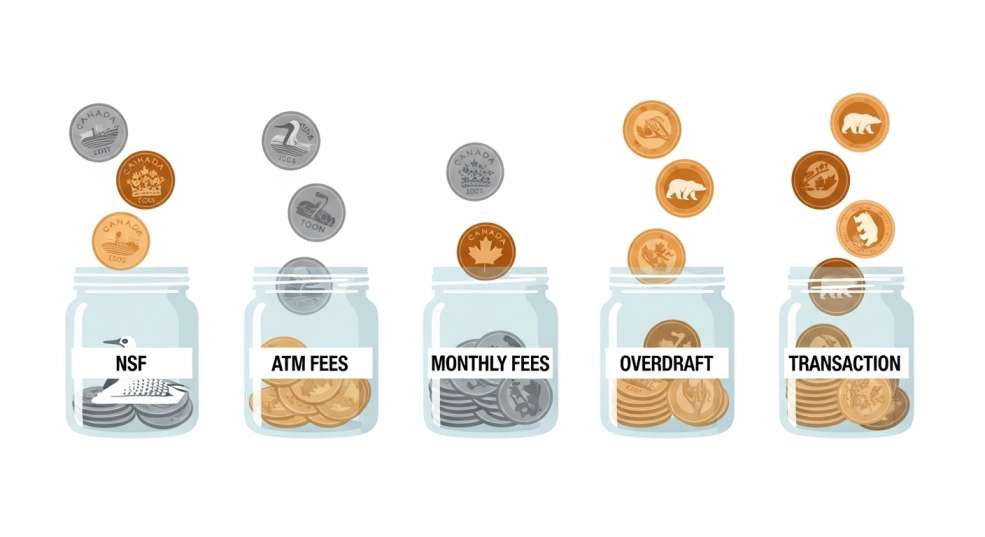
Before you can avoid fees, you need to know what you are dealing with. Canadian banks charge fees in several distinct categories. Understanding each one is the first step toward eliminating them.
1. Monthly Account Maintenance Fees
This is the most common fee Canadians pay — a flat monthly charge just for having a chequing account. At the Big Six banks, standard personal chequing accounts typically range from $10.95 to $30.95 per month, depending on the plan tier. Premium “unlimited” accounts can push past that. Since December 1, 2025, however, all 14 federally regulated financial institutions (including the Big Six) are now required to offer at least one chequing account capped at $4 per month, with up to 50% more debit transactions than the old low-cost account minimum. Free accounts — $0 per month — are available to students, seniors receiving the Guaranteed Income Supplement, youth under 18, registered disability savings plan beneficiaries, and newcomers to Canada in their first year.
2. Non-Sufficient Funds (NSF) Fees
This one stings the most. An NSF fee is charged when a payment (like a pre-authorized bill payment) bounces because your account doesn’t have enough money. Until very recently, Canadian banks were charging $45 to $48 per NSF event — among the highest in the world. As of March 12, 2026, new federal regulations now cap NSF fees at $10. Banks are also prohibited from charging more than one NSF fee within a two-business-day window, and cannot charge an NSF fee when the shortfall is less than $10. This change alone is estimated to put $600 million back into Canadians’ pockets annually. According to the Department of Finance, roughly 34% of Canadians incur at least one NSF fee in any given year, so this reform is genuinely significant.
3. ATM and Out-of-Network Fees
Using an ATM that doesn’t belong to your bank typically triggers two charges: one from your own bank (usually $1.50 to $2.00) and one from the ATM owner (often $1.50 to $3.00). Combined, a single “foreign” ATM withdrawal can cost you $3.00 to $5.00. If you do this even twice a week, that’s roughly $300 to $500 a year in ATM fees alone. International ATM withdrawals can cost even more, adding foreign exchange markups on top.
4. Overdraft Protection Fees
Overdraft protection is a feature that covers you when your balance goes below zero — but it is not free. Banks typically charge a flat monthly fee of $4 to $5 to have overdraft protection enabled, plus interest on any overdrawn balance (often 19 to 22% annually). Some banks also charge a per-use fee every time the protection is actually triggered. While overdraft is cheaper than an NSF fee, it’s worth noting that digital alternatives often provide similar coverage at no cost.
5. Transaction Fees
Many chequing account plans include a set number of free transactions per month — often 10 to 25 — after which you pay $0.50 to $1.50 per additional transaction. These add up quickly for active accounts. Interac e-Transfers may or may not be included depending on your plan, and international wire transfers can cost $15 to $40 each.
6. Other Common Fees
Canadian banks also charge for bank drafts or certified cheques ($7 to $10 each), stop payments ($12 to $20), paper statement delivery ($2 to $4 per month), and currency exchange on cross-border transactions (typically a 2.5% to 3% markup over the exchange rate). These may seem minor individually, but they can pile up without you noticing.
TABLE 1: Common Canadian Banking Fees at a Glance (2026)
Fee Type | Typical Range (Big Six) | Avoidable? | Best Alternative |
Monthly Maintenance | $10.95 – $30.95/mo | Yes | No-fee digital banks |
NSF Fee | Capped at $10 (from $45–$48) | Yes | Balance alerts + overdraft |
ATM (Out-of-Network) | $3.00 – $5.00/use | Yes | Bank’s own ATMs / no-fee banks |
Overdraft Protection | $4 – $5/mo + 19–22% interest | Partly | EQ Bank, Koho, Wealthsimple Cash |
Transaction (Over Limit) | $0.50 – $1.50/transaction | Yes | Unlimited plan or digital bank |
Interac e-Transfer | $0 – $1.50 each | Yes | Tangerine, Simplii, EQ Bank |
International Wire | $15 – $40/transfer | Yes | Wise, Simplii, EQ Bank |
Paper Statement | $2 – $4/month | Yes | Switch to eStatements |
Bank Draft/Certified Cheque | $7 – $10 each | Partly | Use e-Transfers where possible |
Sources: WealthNorth (March 2026), Ratehub.ca, Financial Consumer Agency of Canada (FCAC), Canada.ca
Why Are Canadian Banking Fees So High?
This is a fair question — and an important one. Canada’s banking system is widely praised for its stability, but that stability has come at a cost to consumers. The Big Six control roughly 93% of all banking assets in the country, according to the Fraser Institute. When a handful of institutions dominate a market with few truly competitive alternatives, the incentive to lower fees for ordinary customers is weak.
A 2024 report by research firm North Economics found that Canada’s largest five banks charge significantly more in fees — relative to their deposit base — than comparable banks in the United Kingdom. The report estimated that Canadians collectively overpay “billions of dollars per year.” Meanwhile, service charges on retail and commercial deposit accounts have grown 267% since 1996 (in dollar terms), rising to nearly $6 billion in Q3 2025 alone, according to data from the Office of the Superintendent of Financial Institutions.
It is not that Canadian banks are reckless or unprofessional — they are consistently ranked among the most stable financial institutions in the G7. But stability and affordability are not the same thing. Nearly 48% of Canadian bank revenue in 2022 came from non-interest income, which includes everyday banking charges. Fees are a core part of the business model, and without meaningful competition, there has been little reason to shrink them voluntarily.
This is why the federal government’s recent interventions — capping NSF fees, requiring low-cost accounts, and mandating more transparency — represent such a significant shift. Ottawa is essentially stepping in to create through regulation what competition has not delivered organically.
If you arrived in Canada within the last 12 months, you are entitled to a FREE bank account (no monthly fee) at any of the 14 participating federally regulated financial institutions — including all Big Six banks. This newcomer benefit applies for your first full year and is a right, not a promotional offer. Ask for it by name when you open your account. Source: Canada.ca / FCAC (March 2026)
💡 Key Insight for Newcomers to Canada
How to Avoid Canadian Banking Fees: 7 Proven Strategies
Understanding fees is half the battle. Here are seven concrete strategies Canadians are using right now to eliminate or significantly reduce their banking costs:
Strategy 1: Switch to a No-Fee Digital Bank
This is the single most impactful change you can make. Digital-first banks like EQ Bank, Tangerine (owned by Scotiabank), Simplii Financial (owned by CIBC), and Wealthsimple Cash offer unlimited transactions, free Interac e-Transfers, and zero monthly fees. These aren’t fly-by-night operations — Tangerine and Simplii are backed by Big Six institutions, which means your deposits are CDIC insured. EQ Bank in particular has gained a strong reputation for pairing no monthly fees with competitive interest rates on everyday balances.
WealthNorth estimates that switching from a premium Big Six chequing account to a no-fee digital bank can save $1,500 to $2,200 over a decade — before accounting for interest earned on savings accounts.
Strategy 2: Maintain a Minimum Balance
If you prefer to stay with a Big Six bank, check whether your account offers a monthly fee waiver when you maintain a minimum balance. For example, many mid-tier chequing plans waive the monthly fee if you keep $3,000 to $5,000 in the account. This is not free money — you are giving up the interest you could earn elsewhere — but if you naturally keep a higher balance anyway, it is an easy win.
Strategy 3: Set Up Balance Alerts Immediately
NSF fees are almost entirely preventable with a little technology. Every major Canadian bank and digital bank offers free push notifications or SMS alerts when your balance falls below a threshold you set. Configure yours to fire at $100 or $200, giving you time to transfer funds before a pre-authorized payment causes an NSF event. This one setting can save you $10 to $48 per incident — and it takes about 90 seconds to set up in your banking app.
Strategy 4: Use Your Bank’s Own ATMs (Or Choose a Bank That Piggybacks)
Plan ahead and only use ATMs that belong to your bank’s network. Better yet, choose a bank that gives you access to a large partner network. Simplii Financial customers can withdraw for free at over 3,400 CIBC ATMs across Canada. Tangerine customers have free access to 3,500+ Scotiabank ATMs. Credit union members can tap into THE EXCHANGE network of over 3,700 ATMs nationwide. If you are with a digital bank that has no physical ATM network, withdraw larger amounts less frequently to minimize per-transaction charges.
Strategy 5: Switch to eStatements
This is a small but effortless saving. Most Canadian banks charge $2 to $4 per month for paper statements. Switching to electronic statements in your online banking portal takes two minutes and eliminates this fee immediately. It also reduces clutter and helps the environment — a genuine win-win.
Strategy 6: Review and Downgrade Your Account Plan
Many Canadians are paying for account tiers they no longer need. If you set up your account years ago and chose a premium unlimited plan, check whether you actually use the features you’re paying for. If you do most banking digitally and only make a modest number of transactions, a basic or mid-tier plan — or better yet, a no-fee digital account — may serve you just as well at a fraction of the cost.
Strategy 7: Take Advantage of Your Eligibility for Free Accounts
As of December 1, 2025, free or reduced-cost accounts are available to several groups at all participating institutions. Check whether you qualify:
- Students (post-secondary)
- Youth under 18
- Seniors receiving the Guaranteed Income Supplement (GIS)
- Registered Disability Savings Plan (RDSP) beneficiaries
- Newcomers to Canada (free account in their first year)
- Indigenous peoples (at participating institutions)
- Recipients of certain provincial social assistance benefits
If you fall into any of these categories, walk into your branch or call your bank and request the appropriate account. It is your right, and banks are legally required to provide it.
TABLE 2: Big Six vs. No-Fee Digital Banks — Monthly Cost Comparison (2026)
Institution | Account Type | Monthly Fee | Free Transactions | NSF Fee | ATM Network |
RBC | Signature No Limit Banking | $16.95 | Unlimited | $10 (capped) | RBC ATMs |
TD Bank | All-Inclusive Banking | $29.95 | Unlimited | $10 (capped) | TD ATMs |
Scotiabank | Preferred Package | $16.95 | Unlimited | $10 (capped) | Scotiabank ATMs |
BMO | Premium Plan Chequing | $30.00 | Unlimited | $10 (capped) | BMO ATMs |
CIBC | Smart Account | $16.95 | Unlimited | $10 (capped) | CIBC ATMs |
National Bank | The Total Chequing Account | $14.95 | Unlimited | $10 (capped) | National ATMs |
Tangerine | No-Fee Daily Chequing | $0 | Unlimited | N/A (no NSF prog.) | 3,500+ Scotiabank ATMs |
Simplii Financial | No-Fee Chequing | $0 | Unlimited | N/A | 3,400+ CIBC ATMs |
EQ Bank | Personal Account | $0 | Unlimited | N/A | No physical ATMs |
Wealthsimple Cash | Spending Account | $0 | Unlimited | N/A | Use any ATM (fee reimbursements may apply) |
Note: Monthly fees shown are standard rates. Waivers may apply for minimum balance requirements or eligible account types. Always verify current rates directly with the financial institution. Sources: NerdWallet Canada, Ratehub.ca, WealthNorth (2026).
Real-World Scenario: What Sarah Saves by Switching
To make this concrete, consider Sarah — a 31-year-old marketing coordinator in Toronto who has been with the same Big Six bank since university. She has a standard unlimited chequing account at $16.95 per month, gets hit with an NSF fee about three times per year when bills auto-debit before her paycheque arrives, and uses out-of-network ATMs roughly twice a month.
Here is what Sarah’s banking is actually costing her annually:
- Monthly account fee: $16.95 x 12 = $203.40
- NSF fees (3x at old rate): $45 x 3 = $135.00
- ATM fees (2x/month at $4/use): $4 x 24 = $96.00
- Paper statements: $3 x 12 = $36.00
Total: approximately $470.40 per year.
If Sarah switches to Simplii Financial (a CIBC subsidiary with no monthly fees and access to 3,400+ CIBC ATMs), enables balance alerts to prevent NSF situations, and switches to eStatements, her banking cost becomes $0 per year. That’s roughly $470 she can redirect toward an RRSP, TFSA, or simply into a high-interest savings account. Over 10 years — assuming she invests the savings — the compounded difference could easily exceed $6,000.
This is not a special case. This is a typical Canadian household’s banking math. The potential savings are real, and the switch is less complicated than most people assume.
1. Log into your online banking and identify every fee charged in the last 3 months. 2. Set up a low-balance alert for $100 or $200 in your banking app. 3. Switch your statements to electronic delivery (saves $2–$4/month instantly). 4. Compare your current account plan with no-fee alternatives at Tangerine, Simplii, or EQ Bank. 5. If you qualify (student, senior, newcomer, etc.), contact your bank about a free account option.
📋 Quick Action Checklist: 5 Things to Do This Week
What Canada’s New Banking Regulations Mean for You (2025–2026)
The pace of regulatory change in Canadian banking has accelerated significantly over the past two years, and consumers stand to benefit meaningfully. Here is a summary of the key changes and what they mean in practice:
NSF Fee Cap — Effective March 12, 2026
The most impactful recent change: federal regulations now cap NSF fees at $10, down from the previous industry standard of $45 to $48. Banks are also banned from charging more than one NSF fee within a two-business-day period, and cannot charge an NSF fee when the overdrawn amount is less than $10. The government estimates this will save Canadians approximately $600 million per year and reduce the number of NSF events by roughly 1.9 million annually.
Low-Cost and No-Cost Accounts — Effective December 1, 2025
All 14 federally regulated financial institutions, including the Big Six, are now required to offer a chequing account capped at $4 per month to any Canadian — no eligibility requirements. Free accounts (at $0 per month, with the same features) are available to youth, students, GIS seniors, RDSP beneficiaries, and newcomers in their first year. These accounts include up to 50% more free debit transactions than the previous low-cost account standard.
Cheque Hold Rule Updates — Bill C-15
Modernized cheque hold rules will increase the amount of immediately available deposited funds from $100 to $250. The government is also developing regulations to shorten the overall cheque hold period, so Canadians will have faster access to their money when they deposit a cheque.
FCAC Fee Transparency Report — Coming in 2026
The Financial Consumer Agency of Canada (FCAC) has been tasked by the government with preparing a comprehensive report on the structure, level, and transparency of fees charged by Canadian banks. This report is expected to be published later in 2026 and could form the basis for additional regulatory action. It is a signal that Ottawa’s scrutiny of banking fees is far from over.
These changes represent a meaningful shift in the relationship between Canadian banks and their customers — and for consumers, the most important takeaway is this: you have more rights and more options than ever before. The question is whether you act on them.
Credit Unions and Fintechs: The Underrated Alternatives
When people think about alternatives to the Big Six, they often jump straight to digital banks. But Canada’s credit union sector deserves equal attention. Credit unions are member-owned financial cooperatives that often charge lower fees, offer better savings rates, and provide a more personalized service experience than the large chartered banks.
While credit unions are provincially regulated (unlike federally regulated chartered banks), they offer comparable deposit protection through provincial equivalents of CDIC. In many cases, credit union deposit limits are actually higher than the $100,000 CDIC limit per depositor per category.
The EXCHANGE network — available to most credit union members — provides fee-free access to over 3,700 ATMs across Canada. For Canadians who do not travel internationally often, this is entirely sufficient for everyday cash needs.
On the fintech side, apps like Koho, Wealthsimple Cash, and Neo Financial offer spending accounts with no monthly fees, real-time transaction notifications, and in some cases, cash-back rewards. These are particularly attractive for younger Canadians or newcomers who are comfortable managing their finances entirely through a mobile app.
None of these alternatives are perfect for everyone — but the point is that the days of having only one or two realistic banking choices are genuinely over. The Canadian financial landscape has diversified substantially, and consumers who explore their options consistently come out ahead.
Conclusion: Your Money Deserves Better
Canadian banking fees are not just a minor inconvenience — for millions of Canadians, they represent hundreds of dollars a year leaving their wallets without them fully realizing it. The Big Six banks have benefited from market concentration, consumer inertia, and a lack of transparency for decades. But the landscape is shifting.
The federal government’s new regulations — particularly the NSF fee cap and the mandated low-cost account framework — are concrete steps in the right direction. But regulation alone won’t fix your personal banking situation. The strategies outlined in this article will.
To summarize the key takeaways:
- The average Canadian pays $150–$250/year in unnecessary bank fees
- NSF fees are now capped at $10 (down from up to $48) as of March 2026
- No-fee chequing accounts are available at digital banks like Simplii, Tangerine, and EQ Bank
- Free accounts are legally required to be offered to students, seniors, newcomers, and other eligible groups
- Setting up a balance alert costs nothing and prevents the most expensive fee events
- Switching banks is less complicated than it feels — most Canadians can complete the process in under an hour
At ArriveThenThrive.ca, we believe that understanding the financial system is one of the most powerful things you can do for your future in Canada — whether you were born here or arrived yesterday. Banking fees are a small but telling window into how money works in this country. Take control of yours.
Further Reading & Sources
- Financial Consumer Agency of Canada (FCAC) — New NSF Fee Regulations: canada.ca/FCAC
- Department of Finance Canada — NSF Fee Cap Announcement (March 2026): canada.ca/finance
- Ratehub.ca — Bank Fees and How to Avoid Them: ratehub.ca
- WealthNorth — Bank Fees Comparison Canada 2026: wealthnorth.ca
- The Logic — Canada’s Big Banks Slashing Account Fees (December 2025): thelogic.co
- NerdWallet Canada — Best Chequing Accounts 2026: nerdwallet.com/ca
- Tangerine — Top Things to Know About Bank Fees in Canada: tangerine.ca
DISCLAIMER
The information provided in this article is for general informational and educational purposes only. It does not constitute financial, legal, or professional advice. While every effort has been made to ensure the accuracy of the information presented, bank fee structures, government regulations, and financial products change frequently. Always verify current fee schedules, terms, and conditions directly with your financial institution or a licensed financial advisor before making any banking decisions. ArriveThenThrive.ca is not affiliated with, endorsed by, or compensated by any of the financial institutions mentioned in this article. All brand names and trademarks are the property of their respective owners. This article was last reviewed in April 2026.
