


You’ve landed in Canada. You’ve sorted out your study permit, found a place to live, and started classes. But when you try to rent an apartment on your own, get a phone plan, or even apply for a part-time job, you keep hitting the same wall: “Sorry, we need to check your credit history.”
Here’s the thing — you probably have an excellent financial track record back home. You’ve paid bills on time for years. But none of that follows you to Canada. Your Canadian credit story starts at zero the day you arrive.
The fastest, most effective way to fix that? Getting the right student credit card and using it wisely. Not just any card — the right card for someone who is new to Canada, building from scratch, and navigating a financial system that wasn’t originally designed with you in mind.
This guide breaks down the best student credit cards in Canada for 2026, specifically chosen for newcomers and international students. We’ll cover what to look for, which cards are genuinely newcomer-friendly, how to actually get approved, and how to use your first card to build the kind of credit score that opens doors — literally, to better apartments — within a year.
Why Getting a Credit Card Matters More Than You Think in Canada
In many countries, cash is still king, and credit history doesn’t follow you everywhere. Canada works differently. Your credit score — a three-digit number assigned by credit bureaus Equifax and TransUnion — affects almost every major financial decision you’ll make here.
A strong credit score (generally 660 and above is considered good; 750+ is excellent) means:
- Landlords will rent to you without requiring a large security deposit
- Telecom companies will give you a postpaid phone plan instead of a prepaid one
- Banks will offer you higher credit limits and better mortgage rates
- Car dealerships will finance you at reasonable interest rates
- Employers in some industries run credit checks as part of hiring
And the single most important factor in building your credit score? Consistent, on-time credit card payments. Not debit card use. Not e-transfers. Credit cards — used responsibly and paid in full every month.
According to Equifax Canada (equifax.ca), payment history accounts for approximately 35% of your credit score — making it the single largest factor. Credit utilization (how much of your limit you use) accounts for another 30%. Together, these two behaviours — paying on time and keeping balances low — explain why getting a student credit card early and using it wisely is so transformative for newcomers.
What Makes a Credit Card “Newcomer-Friendly” or “International Student-Friendly”?
Not every credit card is suitable for someone who just arrived in Canada. Many premium cards require a minimum credit score of 660 or even 725 — a score you haven’t had time to build yet. Here’s what to look for when evaluating cards as a newcomer or international student:
No Prior Canadian Credit History Required
This is the most critical feature. Several major Canadian banks have dedicated newcomer programs or student programs that waive the typical credit score requirement. Instead, they verify your identity, immigration status, and sometimes your income or savings. The key is to apply early — most of these programs have eligibility windows tied to when you arrived in Canada.
No Annual Fee
As a student, every dollar counts. Fortunately, most of the best cards in this category are no-annual-fee cards. The rewards may be more modest than premium cards, but you’re not paying to build credit. That’s a win.
Low or No Income Requirements
International students are often limited in how many hours they can work per week (currently 24 hours off-campus during academic sessions as of 2024 policy updates — check IRCC.gc.ca for the most current rules). Cards with low or no income requirements remove a common approval barrier.
Rewards on Everyday Spending
Groceries, transit, and phone bills are your biggest everyday expenses as a student. Cards that reward these categories mean you’re earning something back while building credit. Cash back is generally simpler and more flexible than travel points for newcomers who aren’t sure of their future travel plans.
Reports to Both Equifax and TransUnion
Always confirm that your card reports to both major Canadian credit bureaus. Most bank-issued cards do, but some prepaid and store cards do not — meaning they won’t actually build your credit score at all.
Top Student Credit Cards in Canada for Newcomers: 2026 Comparison
The following table compares the best options available to international students and newcomers in 2026. Cards are selected based on approval accessibility with no or limited Canadian credit history, fee structure, rewards relevance to student spending, and overall first-year value.
TABLE 1: Best Student Credit Cards in Canada for Newcomers & International Students (2026)
Card | Annual Fee | Key Rewards | Income Req. | Newcomer-Friendly | Credit Limit (Intl. Students) | Best For |
CIBC Aventura® Visa* for Students | $0 | 1 pt/$1 on most; bonus on travel | None stated | ✅ Yes (online bundle) | Up to $2,000 | Travel-minded students |
CIBC Adapta Mastercard® for Students | $0 | 1% cash back on select categories | None stated | ✅ Yes (online bundle) | Up to $2,000 | Simple cash back |
Scotiabank Scene+ Visa* (StartRight) | $0 | 2x Scene+ pts on Sobeys, IGA, FreshCo | None stated | ✅ Yes (StartRight Program) | Varies | Grocery spenders |
RBC Cash Back Mastercard® (Newcomer) | $0 | Up to 2% on groceries; 1% other | None stated | ✅ Yes (within 12 mo. arrival) | Varies | Grocery + cash back |
TD Cash Back Visa* Card (Newcomer) | $0 | 1% on groceries, gas, transit, bills | None stated | ✅ Yes | Varies | Everyday bills + transit |
BMO CashBack® Mastercard®* | $0 | 3% groceries, 1% recurring bills, 0.5% other | None stated | ✅ Yes (newcomer eligible) | Varies | Groceries + bills |
Home Trust Secured Visa | $0–$59 | N/A (credit building focus) | None | ✅ Guaranteed approval | $500–$10,000 (deposit) | No SIN workaround option |
Neo Secured Mastercard | $0 | Up to 1% on gas & groceries; up to 15% at partners | None | ✅ Easy approval, $50 deposit | Equal to deposit | Low-deposit credit build |
Sources: Official bank websites verified March 2026. Always confirm current terms at cibc.com, scotiabank.com, rbc.com, td.com, bmo.com, hometrust.ca, and neofinancial.com before applying.
In-Depth Look: The Best Cards for Different Student Profiles
Best Overall: CIBC Student Credit Card Bundle (Aventura® or Adapta™)
For international students specifically, CIBC stands out because it allows you to apply for a student banking bundle — a chequing account plus credit card — all in one online application. You don’t need a prior Canadian credit score, you don’t need a security deposit, and you can start building credit from your first month in Canada.
The CIBC Aventura® Visa* for Students earns Aventura points that can be redeemed for travel, making it appealing for students who plan to fly home or travel. The card also includes a free Skip+ membership for a year and access to SPC+ discounts at over 450 brands — real value for students watching every dollar. Credit limits reach up to $2,000 for international students and $5,000 for Canadian students. (Source: cibc.com/en/student/credit-cards.html)
If rewards complexity isn’t your thing, the CIBC Adapta Mastercard® for Students offers straightforward cash back with the same easy approval process.
Best for Groceries: Scotiabank Scene+ Visa (via StartRight® Program)
The Scotiabank StartRight® Program is one of the most well-known newcomer programs in Canada, and for good reason. It lets you apply for a credit card without Canadian credit history, and now also partners with Nova Credit to allow you to use your credit score from select countries (including India, Mexico, the Philippines, and others) to potentially access a higher credit limit.
The Scene+ Visa earns double points at Sobeys, IGA, FreshCo, Safeway, and other participating grocery stores — exactly where most students spend heavily. Points are also redeemable for Cineplex movies, which feels like a reasonable student perk.
Best Cash Back on Groceries: BMO CashBack® Mastercard®
If you want the highest grocery cash back rate among no-fee cards, the BMO CashBack® Mastercard® delivers 3% on groceries — the best rate in its class without an annual fee. It also earns 1% on recurring bill payments and 0.5% on everything else. For newcomers, BMO’s first-year value is estimated at $388 based on standard newcomer spending patterns. (Source: rates.ca)
Best for No Credit History at All: Secured Credit Cards
If you can’t qualify for an unsecured card, or if you want to build credit faster with a higher limit you control, a secured credit card is your best move. You deposit cash (as little as $50 with the Neo Secured Mastercard, or typically $500 with Home Trust Secured Visa) as collateral, and that deposit becomes your credit limit.
The card reports your payment history to both Equifax and TransUnion exactly like a regular card. After 6–12 months of responsible use, most issuers will either upgrade you to an unsecured card or you can apply elsewhere with your newly established credit file.
The Neo Secured Mastercard is particularly popular because it requires only a $50 minimum deposit, offers cash back at Neo’s partner retailers (sometimes as high as 15%), and has a digital-first application process. (Source: ratehub.ca/blog/best-credit-cards-in-canada)
What International Students Need to Apply for a Credit Card in Canada
Getting a credit card as an international student is very doable, but you need to have your paperwork in order. Here’s exactly what you’ll typically need:
- A valid Social Insurance Number (SIN) — Apply at Service Canada (canada.ca/en/employment-social-development/services/sin) as soon as you arrive. International students authorized to work can get a SIN, and most study permit holders qualify.
- Valid government-issued ID — Your passport is the standard.
- Proof of enrollment — A student ID card or enrollment letter from your Canadian institution.
- Canadian bank account — Most banks require you to hold a chequing account with them to approve a student credit card. Open the account first.
- Study permit — Your current, valid study permit.
One important note on the SIN: according to NerdWallet Canada (nerdwallet.com/ca), international students who do NOT have permission to work in Canada — and therefore cannot obtain a SIN — will face more difficulty qualifying for standard credit cards. In this case, a secured credit card with a cash deposit may be your only option until your status allows you to work.
For the most current rules around work authorization for international students, always check IRCC’s official page at canada.ca/en/immigration-refugees-citizenship/services/study-canada.
How to Actually Build Credit With Your First Card: A Practical Guide
Getting approved is step one. Using the card correctly is what actually builds your score. Here’s the framework we’ve seen work consistently for newcomers and international students:
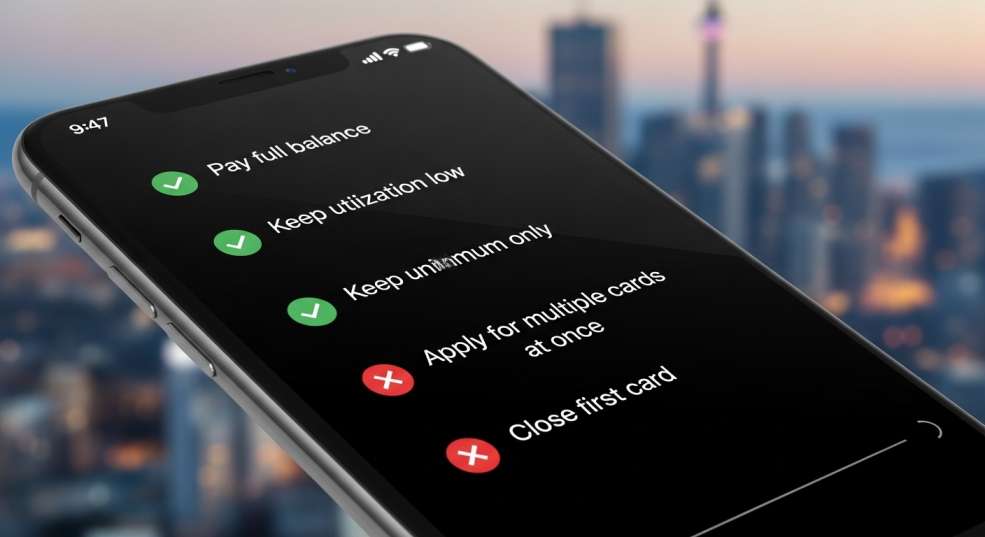
The Three Golden Rules of Credit Building
- Pay your full balance every month — not just the minimum.
Paying only the minimum keeps you in debt and accumulates expensive interest (most student cards charge 19.99%–20.99% APR). More importantly, paying in full signals to the credit bureaus that you’re a reliable borrower.
- Keep your credit utilization below 30%.
If your credit limit is $1,000, try not to carry a balance above $300. Higher utilization signals financial stress to lenders, even if you pay on time. Many credit experts recommend keeping utilization below 10% for maximum score impact.
- Never miss a payment date.
Set up autopay for at least the minimum payment (though paying in full is better). One missed payment can stay on your credit file for up to six years and significantly damage a score you’ve worked hard to build.

A Real-World Example: How Priya Built a 722 Credit Score in 14 Months
Priya arrived in Toronto from India in September 2023 as a master’s student. Within two weeks, she applied for her SIN at Service Canada. The same week, she opened a newcomer chequing account at Scotiabank and was approved for the StartRight Visa card with a $1,000 limit.
She set up autopay to pay her full credit card balance each month and spent roughly $200–$300 per month on the card — groceries, textbooks, and transit — paying it off completely each billing cycle. She also opened a post-paid phone plan to diversify her credit mix.
By November 2024 — 14 months after arriving — her Equifax score had reached 722. Her landlord didn’t require a deposit for her next apartment. When she applied for a rewards card with a higher limit in early 2025, she was approved instantly.
This story reflects a realistic but achievable timeline when the right card is used correctly from day one.
Credit Score Milestones: What to Expect Over Your First Two Years
Understanding the timeline helps you set expectations and stay motivated. The following chart specification shows a realistic credit score growth trajectory for an international student who opens a credit card within their first month in Canada and uses it responsibly.
Big 5 Bank Newcomer Programs: A Head-to-Head Comparison
Canada’s five largest banks — RBC, TD, Scotiabank, BMO, and CIBC — all offer programs that allow newcomers to bypass the typical credit history requirement. Here’s how they compare specifically for international students and recent newcomers:
TABLE 2: Big 5 Bank Newcomer Credit Card Programs Compared (2026)
Bank | Program Name | Eligibility Window | Credit History Req. | No-Fee Card Available? | International Students? | Foreign Credit Transfer? |
RBC | RBC Newcomer Advantage | Within 12 months of arrival (intl. students) | ❌ Not required | ✅ Yes (Cash Back MC) | ✅ Yes | ✅ Via Nova Credit (select countries) |
TD | TD New to Canada | No strict window stated | ❌ Not required | ✅ Yes (Cash Back Visa) | ✅ Yes | ❌ Not listed |
Scotiabank | StartRight® Program | Within 5 years of arrival | ❌ Not required | ✅ Yes (Scene+ Visa) | ✅ Yes | ✅ Via Nova Credit |
BMO | BMO Newcomer Program | Not explicitly capped | ❌ Not required | ✅ Yes (CashBack MC) | ✅ Yes | ❌ Not listed |
CIBC | CIBC International Student Bundle | No stated window | ❌ Not required | ✅ Yes (Aventura/Adapta) | ✅ Yes — dedicated bundle | ❌ Not listed |
Sources: rbc.com, td.com, scotiabank.com/startright, bmo.com, cibc.com — Verified March 2026. Eligibility terms change; confirm current requirements directly with each institution.
Common Mistakes Newcomers Make With Their First Credit Card
Even with the right card, it’s easy to make mistakes that slow your credit-building progress. Here are the most common ones to avoid:
Paying only the minimum payment.
The minimum payment keeps the account active but costs you significantly in interest (19.99%+ APR) and barely dents your principal. Always pay in full if at all possible.
Applying for multiple credit cards at once.
Each new application triggers a “hard inquiry” on your credit file, which temporarily lowers your score by a few points. Multiple inquiries in a short period signal financial desperation to lenders. Start with one card and wait at least six months before applying for another.
Closing your first credit card.
The age of your oldest credit account is a factor in your score. Closing your first card eliminates that history and can lower your score — especially in the early years. Keep it open, even if you’re not actively using it.
Using a prepaid card thinking it builds credit.
Prepaid cards do not report to credit bureaus. They’re convenient for spending, but they do nothing for your credit score. Make sure your card is a true credit card issued by a bank, and confirm that it reports to Equifax and TransUnion.
Missing your first payment.
This is the most damaging single mistake a new credit file holder can make. Set up autopay immediately after your card is activated. Even one missed payment can set your credit-building back by months.
Frequently Asked Questions: Student Credit Cards for Newcomers in Canada
Can I get a credit card in Canada without a Social Insurance Number?
It’s very difficult. Most bank-issued credit cards require a SIN as part of their Know Your Client (KYC) verification process. If you cannot yet obtain a SIN (because you don’t have work authorization), a secured credit card may be your only option — and even then, some providers require a SIN. Getting your SIN sorted is one of the most important early steps after arriving in Canada.
Will my credit history from my home country transfer to Canada?
In most cases, no — your Canadian credit file starts fresh when you arrive. However, Scotiabank and RBC have both integrated with Nova Credit, a service that can translate your credit history from select countries (currently including India, Mexico, the Philippines, the Dominican Republic, Australia, and others) into a Canadian-equivalent report. If your home country is supported, this can help you qualify for a higher credit limit from day one. Check nova-credit.com/partners for the current list of supported countries.
How long does it take to build a good credit score from zero in Canada?
With responsible use of a single credit card (paying in full monthly, keeping utilization under 30%), most newcomers reach the “fair to good” range (620–660) within 6–9 months and a “good” score (660–700) within 12–18 months. Reaching 700+ typically takes 12–24 months. These timelines can be accelerated by diversifying your credit mix (adding a phone plan, a small secured loan, or rent reporting through services like Borrowell).
Can I use a student credit card after graduation?
Yes. Student credit cards don’t expire when you graduate. Most banks will either automatically transition you to an adult credit card or invite you to upgrade. In the meantime, keeping your student card open (even with minimal use) preserves the credit history you’ve built.
What is the best credit card for international students who don’t have any income?
The CIBC Adapta Mastercard® for Students and the Scotiabank StartRight® Visa have no stated income requirements. The Home Trust Secured Visa and Neo Secured Mastercard also require no income — just a cash deposit. If you receive student loans, grants, or scholarships, many banks will count these as income for application purposes.
Conclusion: Your Credit Story in Canada Starts Today
For newcomers and international students, a student credit card isn’t just a payment method — it’s the foundation of your financial life in Canada. The credit score you build in your first year will follow you to every apartment application, every car loan, and eventually, every mortgage.
The best card for you depends on where you bank and what rewards matter most to you. But the most important thing isn’t which card you choose — it’s that you choose one early, use it consistently, and pay it in full every month without fail.
Start with a no-annual-fee newcomer or student card from one of the Big 5 banks. Set up autopay. Spend only what you can pay off. Check your score every 90 days (Borrowell and Mogo both offer free Equifax score checks). And within 12–18 months, you’ll have built the kind of credit foundation that makes Canadian life significantly easier.
DISCLAIMER
The information in this article is provided for general informational and educational purposes only and does not constitute financial, legal, or immigration advice. Credit card terms, eligibility requirements, interest rates, rewards structures, and bank program details are subject to change at any time without notice. All information reflects publicly available details as of March 2026 and may have since been updated.
ArriveThenThrive.ca is not affiliated with, endorsed by, or sponsored by any of the financial institutions mentioned in this article, including RBC, TD, Scotiabank, BMO, CIBC, Neo Financial, or Home Trust. Any product mentions are editorial in nature and are not paid placements.
Readers are strongly encouraged to verify all product details directly with the relevant financial institution before applying. Individual credit outcomes vary based on personal financial behaviour, spending habits, income, credit bureau factors, and other circumstances. The illustrative scenarios in this article are not guarantees of outcomes.
© 2026 ArriveThenThrive.ca — Your Canadian Newcomer Resource
