
Close Menu

    Subscribe to Updates

    Get the latest creative news from FooBar about art, design and business.

    What's Hot

    How to Open a TFSA Online in Canada: 5 Easy Steps for Newcomers

    August 30, 2026

    What is the Basic Personal Amount in Canada and How Does It Help You?

    August 25, 2026

    How to Open a Business Bank Account in Canada as a Newcomer

    August 20, 2026
    Facebook X (Twitter) Instagram
    Facebook X (Twitter) Instagram
    Arrive Then ThriveArrive Then Thrive
    Subscribe
    • Home
    • Budget & Savings
      • Student Finance
      • Family Finance
    • Investing
    • Money Guide
      • Work & Income
      • Insurance
      • Banking
      • Building Credit
      • Taxes
    • Housing & Mortgages
    • News & Updates
    Arrive Then ThriveArrive Then Thrive
    Home»Editor's Picks»What is the RRSP Tax Deduction and How Does It Work?
    Editor's Picks

    What is the RRSP Tax Deduction and How Does It Work?

    Grace ValdezBy Grace ValdezAugust 15, 2026No Comments12 Mins Read3 Views
    Facebook Twitter Pinterest LinkedIn Tumblr Email
    Canadian professional reviewing RRSP tax deduction paperwork at home office
    Share
    Facebook Twitter LinkedIn Pinterest WhatsApp Email

    Every year, millions of Canadians rush to make their RRSP contribution before the deadline — and for good reason. The RRSP tax deduction is one of the most powerful, accessible tax-saving tools the Canadian government offers. Yet a surprising number of people contribute to their RRSP without fully understanding how the deduction actually works, or how to use it strategically to get the most out of every dollar.

    If you’ve ever wondered why your tax refund jumped after making an RRSP contribution, or why your coworker keeps raving about their RRSP strategy, this guide is for you. We’ll break down exactly what the RRSP tax deduction is, how it’s calculated, when it makes sense to use it, and how to avoid the costly mistakes that trip up even experienced investors.

    By the end of this article, you’ll understand not just the mechanics — but the strategy.


    What Is the RRSP Tax Deduction?

    Let’s start with the basics. A Registered Retirement Savings Plan (RRSP) is a government-registered account designed to help Canadians save for retirement. When you contribute money to an RRSP, you’re allowed to deduct that contribution from your taxable income — this is the RRSP tax deduction.

    Here’s a simple way to think about it: the government is essentially letting you delay paying taxes on a portion of your income. Instead of paying income tax on your full salary today, you can shelter a chunk of it inside an RRSP, pay no tax on it now, watch it grow tax-free, and only pay tax when you withdraw it — presumably in retirement, when you’re in a lower tax bracket.

    That’s the core of how the RRSP works, and it’s genuinely powerful when used correctly.

    The Difference Between an RRSP Contribution and an RRSP Deduction

    These two terms are often used interchangeably, but they’re not exactly the same thing — and understanding the difference can save you money.

    • RRSP contribution = the money you put into your RRSP account
    • RRSP deduction = the amount you claim on your tax return to reduce your taxable income

    You can contribute to your RRSP and choose not to deduct it in the same year. This is actually a strategy some Canadians use intentionally (more on that below). The key point: contributing doesn’t automatically mean deducting. You have to claim it on your return.


    How the RRSP Tax Deduction Works: A Step-by-Step Explanation

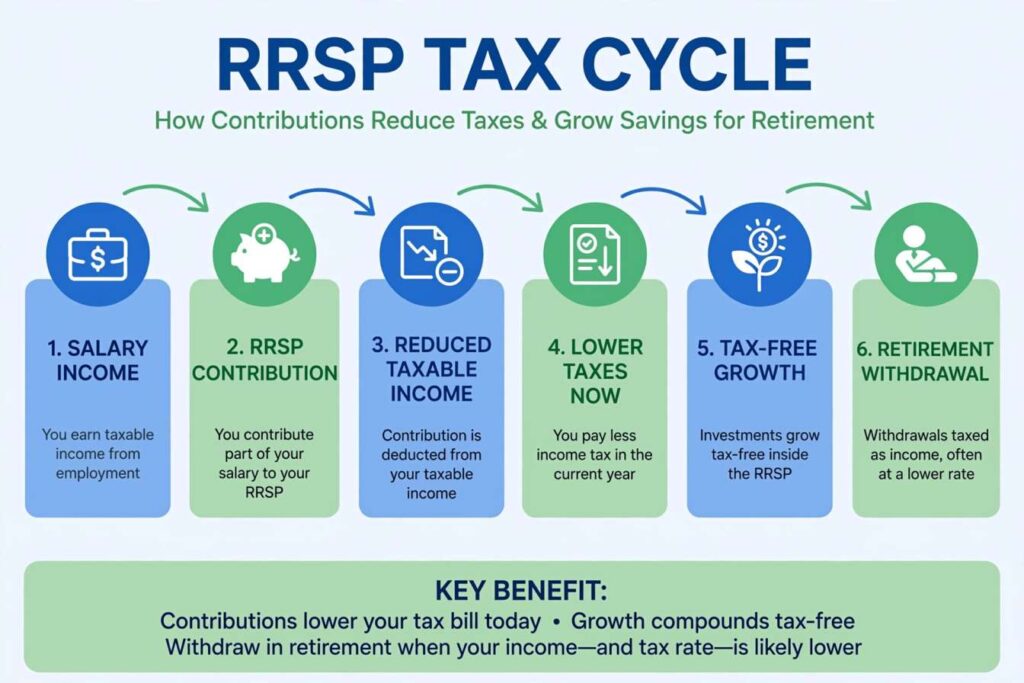
    Infographic showing how RRSP tax deduction reduces taxable income and defers tax to retirement
    Infographic showing how RRSP tax deduction reduces taxable income and defers tax to retirement.

    Step 1: You Earn Income and Calculate Your Contribution Room

    Each year you file a tax return with earned income, the Canada Revenue Agency (CRA) calculates how much RRSP contribution room you’ve accumulated. The formula is straightforward: 18% of your previous year’s earned income, up to the annual maximum — minus any pension adjustments if you belong to a workplace pension plan.

    For the 2025 tax year, the RRSP contribution limit is $32,490. For 2026, it rises to $33,810. [Source: Canada Revenue Agency]

    One of the most valuable features of the RRSP system is that unused contribution room carries forward indefinitely. If you didn’t contribute the maximum in previous years, that unused room is still available to you.

    Step 2: You Make a Contribution

    You deposit money into your RRSP account — which can hold a wide range of eligible investments including GICs, mutual funds, ETFs, stocks, bonds, and cash.

    The contribution deadline for the 2025 tax year is March 2, 2026. Contributions made in the first 60 days of a new calendar year can be applied to either the previous or current tax year — whichever is more beneficial to you.

    Step 3: You Claim the Deduction on Your Tax Return

    When you file your taxes, you enter your RRSP contribution on Line 20800 of your T1 return (Schedule 7 may also need to be completed in some situations). This amount is subtracted from your total income, reducing your taxable income — and therefore your tax bill.

    Step 4: You (Often) Receive a Refund

    If your employer withheld taxes from your paycheque based on your full gross income, and your RRSP deduction reduces what you actually owe, the CRA will refund the difference. This is why so many Canadians associate RRSP season with tax refunds.


    How Much Can the RRSP Deduction Actually Save You?

    This is where things get interesting. The value of your RRSP tax deduction depends entirely on your marginal tax rate — the rate at which your next dollar of income is taxed.

    In Canada, income taxes are progressive. The more you earn, the higher the rate on each additional dollar. RRSP deductions reduce income from the top of your income stack — meaning they eliminate your highest-taxed dollars first. That’s what makes them so effective.


    TABLE 1: Estimated Tax Savings from a $10,000 RRSP Contribution by Province (Ontario Example, 2025)

    Annual IncomeApprox. Marginal Tax Rate (Ontario)Estimated Tax Savings on $10,000 RRSP
    $50,000~29.65%~$2,965
    $75,000~33.89%~$3,389
    $100,000~43.41%~$4,341
    $150,000~46.41%~$4,641
    $220,000+~53.53%~$5,353

    Note: These are approximate combined federal + Ontario provincial marginal rates for 2025. Rates vary by province and individual tax situation. Consult the CRA or a tax professional for personalized calculations. Source: TurboTax Canada


    A Real-World Scenario: Meet Sarah

    Sarah is a project manager in Toronto earning $95,000 per year. Her marginal tax rate (combined federal + Ontario provincial) sits at roughly 43.41%.

    She contributes $12,000 to her RRSP before the March 2026 deadline and claims the full deduction on her 2025 return.

    • Tax savings: approximately $5,209
    • Her taxable income drops from $95,000 to $83,000
    • She receives a refund cheque in the spring

    That $5,209 in tax savings isn’t free money — it’s deferred. When Sarah eventually withdraws from her RRSP in retirement, she’ll pay tax on those funds. But if she’s earning $40,000–$50,000 per year in retirement, her marginal rate will be significantly lower — likely under 30%. The difference is her real gain.


    Understanding Your RRSP Deduction Limit

    Your RRSP deduction limit is the maximum amount you can claim as a deduction in a given year. This is sometimes different from your contribution limit, and the distinction matters.

    Here’s the CRA formula for calculating your annual RRSP deduction limit: [Source]

    RRSP Deduction Limit = Unused RRSP deduction room from prior years + 18% of prior year earned income (up to the annual cap) − Pension Adjustment ± Other adjustments

    You can find your personal deduction limit on your Notice of Assessment (NOA) from the CRA, or by logging into your CRA My Account at canada.ca.

    Spousal RRSP: A Strategy Many Couples Overlook

    If you’re in a partnership where one person earns significantly more than the other, a spousal RRSP can be a powerful income-splitting tool.

    Here’s how it works: the higher-income spouse contributes to an RRSP registered in the lower-income spouse’s name. The contributor still claims the tax deduction — but at their higher marginal rate — while the future withdrawals are taxed in the lower-income spouse’s hands at their lower rate.

    For example: if one partner earns $130,000 and the other earns $45,000, a spousal RRSP contribution allows the household to shift retirement income to the lower-tax bracket, reducing the family’s overall tax bill over time.

    There’s a 3-year attribution rule. If your spouse withdraws from a spousal RRSP within three calendar years of your last contribution, the withdrawal gets attributed back to you (the contributor) for tax purposes. Plan withdrawals accordingly.

    💡 IMPORTANT CAVEAT

    When Should You NOT Claim the RRSP Deduction Right Away?

    Here’s a counterintuitive insight: sometimes it’s smarter to contribute to your RRSP but delay claiming the deduction.

    This strategy works when:

    • You’re currently in a low tax bracket but expect significantly higher income in future years. By carrying the deduction forward and claiming it later, you get a bigger tax break when your marginal rate is higher.
    • You receive a large bonus or windfall in a future year that bumps you into a higher bracket temporarily.
    • You’re a student or recent graduate with modest income now but strong earning potential ahead.

    The CRA allows you to contribute now and claim the deduction in any future year — there’s no expiry on unused RRSP contributions. [Source: NerdWallet Canada]


    RRSP vs. TFSA: Which Is Better for Your Tax Situation?

    This is the question every Canadian investor eventually faces, and the honest answer is: it depends on your income and tax bracket — now and in the future.


    TABLE 2: RRSP vs. TFSA — Key Differences at a Glance

    FeatureRRSPTFSA
    ContributionsTax-deductible (reduces income now)Not tax-deductible
    Investment GrowthTax-deferredTax-free
    WithdrawalsTaxed as incomeCompletely tax-free
    Contribution Room18% of earned income (up to annual cap)Fixed annual limit ($7,000 for 2025)
    Unused RoomCarries forward indefinitelyCarries forward indefinitely
    Age LimitMust convert to RRIF by Dec 31 of year you turn 71No age limit
    Best ForHigher earners; those in lower tax bracket in retirementLower/moderate earners; those expecting higher future income

    Source: Canada Revenue Agency, NerdWallet Canada


    General rule of thumb:

    • RRSP is typically better if your current marginal rate is higher than what you expect to pay in retirement.
    • TFSA is typically better if you’re in a low bracket now and expect to be in a similar or higher bracket later.
    • Using both strategically is often the optimal approach.

    Special RRSP Programs: Home Buyers’ Plan and Lifelong Learning Plan

    Your RRSP isn’t just for retirement. The CRA allows two special programs that let you temporarily withdraw RRSP funds without paying immediate tax:

    Home Buyers’ Plan (HBP)

    First-time home buyers can withdraw up to $60,000 from their RRSP (as of 2024 budget changes) to put toward the purchase of a qualifying home. You have 15 years to repay the amount back into your RRSP, starting two years after the withdrawal. If you don’t repay, the annual repayment amount gets added to your taxable income for that year.

    Lifelong Learning Plan (LLP)

    If you’re going back to school full-time, you can withdraw up to $10,000 per year (maximum $20,000 total) from your RRSP to fund qualifying educational programs. Repayment is required within 10 years.

    Both programs are powerful tools that make RRSP contributions even more versatile — your retirement savings can double as a future down payment fund or an education fund, all while giving you the tax deduction today.


    Key Deadlines and Contribution Limits: Quick Reference

    <!– CHART SUGGESTION –> <!– 📊 Data Visualization: Line chart showing historical RRSP contribution limits from 2015 to 2026, illustrating the year-over-year increases. Values: 2015: $24,930 / 2018: $26,500 / 2020: $27,830 / 2022: $29,210 / 2023: $30,780 / 2024: $31,560 / 2025: $32,490 / 2026: $33,810. This visually demonstrates the growing tax-sheltering opportunity over time. –>

    Here’s a quick-reference summary of key facts every Canadian should know:

    • 2025 RRSP contribution limit: $32,490 (or 18% of 2024 earned income, whichever is lower)
    • 2026 RRSP contribution limit: $33,810 (or 18% of 2025 earned income, whichever is lower)
    • Contribution deadline for 2025 tax year: March 2, 2026
    • Age limit: You must convert your RRSP to a Registered Retirement Income Fund (RRIF) or annuity by December 31 of the year you turn 71
    • Over-contribution penalty: 1% per month on excess contributions over $2,000 above your limit
    • Where to find your limit: Your CRA Notice of Assessment, or CRA My Account at canada.ca

    [Source: TD Canada Trust]


    Common Mistakes to Avoid

    Even financially savvy Canadians make these errors:

    1. Over-contributing to your RRSP. There is a $2,000 lifetime buffer for accidental over-contributions, but anything beyond that is taxed at 1% per month. Always verify your limit before contributing.

    2. Withdrawing from your RRSP too early. RRSP withdrawals are added to your income in the year they’re made and taxed at your full marginal rate. Early withdrawals also permanently destroy contribution room — unlike a TFSA, you can’t re-contribute what you withdrew.

    3. Waiting until the last minute every year. Contributing monthly or quarterly (rather than in a lump sum before the deadline) lets your investments start compounding sooner. Even a few extra months of tax-deferred growth adds up significantly over decades.

    4. Ignoring the spousal RRSP. Many couples overlook this income-splitting strategy, which can save thousands of dollars in tax over a lifetime.

    5. Claiming the deduction in a low-income year. If you’re between jobs or had a low-income year, consider carrying the deduction forward to a year when you’ll be in a higher tax bracket.


    Actionable Steps to Maximize Your RRSP Tax Deduction

    Here’s what you can do right now:

    1. Log into CRA My Account (canada.ca) and confirm your current RRSP deduction limit and how much unused contribution room you have from past years.
    2. Calculate the tax impact of different contribution amounts using the EY RRSP savings calculator (https://www.eytaxcalculators.com/en/2025-rrsp-savings-calculator.html) or TurboTax’s RRSP calculator (https://turbotax.intuit.ca/tax-resources/canada-rrsp-calculator). This shows exactly how much your refund increases per dollar contributed.
    3. Consider automating monthly RRSP contributions instead of waiting for deadline season. Even $200/month adds up to $2,400 annually — and your investments get a head start on compounding.
    4. Talk to a fee-only financial planner if you’re deciding between RRSP and TFSA room, or if you’re planning to use the Home Buyers’ Plan. The right strategy depends on your specific income trajectory.
    5. Don’t forget to claim your receipt. RRSP contribution receipts (T4RSP/T4FHSA) are mailed or made available in your account. You need these when filing.

    Conclusion: The RRSP Deduction Is One of Canada’s Best Tax Tools — If You Use It Right

    The RRSP tax deduction isn’t complicated once you understand the underlying logic: you contribute pre-tax dollars, defer your tax bill to retirement, and ideally withdraw in a lower-tax environment. Done strategically, this can mean tens of thousands of dollars in lifetime tax savings.

    The key takeaways:

    • Your RRSP deduction reduces taxable income dollar-for-dollar, saving you money at your marginal tax rate
    • Your deduction limit is 18% of prior-year earned income, up to the annual cap ($32,490 for 2025; $33,810 for 2026)
    • Unused contribution room carries forward indefinitely — it’s never lost
    • You don’t have to claim the deduction in the same year you contribute — carry it forward to a high-income year for maximum benefit
    • Spousal RRSPs, the Home Buyers’ Plan, and the Lifelong Learning Plan add extra flexibility

    The RRSP is not a one-size-fits-all solution, but for the majority of working Canadians in moderate-to-high tax brackets, it remains one of the most effective legal ways to reduce the taxes you pay today — while building wealth for tomorrow.


    Disclaimer

    The information provided in this article is for general educational and informational purposes only. It does not constitute financial, tax, or legal advice. Tax laws, contribution limits, and CRA rules are subject to change. Every individual’s financial and tax situation is unique. Please consult with a qualified tax professional, Chartered Professional Accountant (CPA), or certified financial planner before making any financial decisions based on information in this article. The author and ArriveThenThrive.ca are not responsible for any financial decisions made based on the content of this article. Always verify current limits and rules directly with the Canada Revenue Agency at canada.ca.

     
    Canadian taxes CRA personal finance Canada reduce taxes Canada retirement savings RRSP RRSP 2026 RRSP contribution limit tax deduction tax planning Canada
    Share. Facebook Twitter Pinterest LinkedIn Tumblr Email
    Previous ArticleOSAP Explained for International Students: Can You Apply?
    Next Article How to Open a Business Bank Account in Canada as a Newcomer
    Grace Valdez
    • Pinterest
    • Instagram

    Grace Valdez is a Toronto-based blogger dedicated to helping and navigating life in Canada. She writes practical, easy-to-follow guides on everything from frugal living, settling into Canadian banking and budgeting, to understanding visa pathways, PR applications, and provincial settlement resources. Grace's warm, no-jargon writing style has made her a trusted online resource for thousands of readers building in Canada.

    Related Posts

    How to Open a TFSA Online in Canada: 5 Easy Steps for Newcomers

    August 30, 2026

    What is the Basic Personal Amount in Canada and How Does It Help You?

    August 25, 2026

    How to Open a Business Bank Account in Canada as a Newcomer

    August 20, 2026
    Leave A Reply Cancel Reply

    Demo
    Latest Posts

    How to Open a TFSA Online in Canada: 5 Easy Steps for Newcomers

    August 30, 20263 Views

    What is the Basic Personal Amount in Canada and How Does It Help You?

    August 25, 20264 Views

    How to Open a Business Bank Account in Canada as a Newcomer

    August 20, 202618 Views

    What is the RRSP Tax Deduction and How Does It Work?

    August 15, 20263 Views
    Stay In Touch
    • Facebook
    • Twitter
    • Pinterest
    • Instagram
    • YouTube
    • Vimeo
    Don't Miss

    How Long Is the OHIP Waiting Period for Newcomers in Ontario?

    By Grace ValdezMarch 30, 2026

    You’ve landed in Ontario. You’re unpacking boxes, enrolling the kids in school, and navigating a…

    Cost of Living in Canada by City in 2026: Toronto vs Vancouver vs Calgary vs Ottawa

    March 12, 2026

    Banking for International Students in Canada: Best Accounts in 2026

    March 21, 2026

    Subscribe to Updates

    Get the latest creative news from SmartMag about art & design.

    Demo
    About Us
    About Us

    You Arrived. Now Let's Make Your Money Work in Canada.

    Email Us: admin@arrivethenthrive.ca

    Facebook X (Twitter) Pinterest YouTube WhatsApp
    Our Picks

    How to Open a TFSA Online in Canada: 5 Easy Steps for Newcomers

    August 30, 2026

    What is the Basic Personal Amount in Canada and How Does It Help You?

    August 25, 2026

    How to Open a Business Bank Account in Canada as a Newcomer

    August 20, 2026
    Most Popular

    How Long Is the OHIP Waiting Period for Newcomers in Ontario?

    March 30, 2026368 Views

    Cost of Living in Canada by City in 2026: Toronto vs Vancouver vs Calgary vs Ottawa

    March 12, 2026283 Views

    Banking for International Students in Canada: Best Accounts in 2026

    March 21, 2026268 Views
    © 2026 ThemeSphere. Designed by ThemeSphere.
    • Home
    • About Us
    • Privacy Policy
    • Disclaimer
    • Contact Us

    Type above and press Enter to search. Press Esc to cancel.

    Powered by
    ►
    Necessary cookies enable essential site features like secure log-ins and consent preference adjustments. They do not store personal data.
    None
    ►
    Functional cookies support features like content sharing on social media, collecting feedback, and enabling third-party tools.
    None
    ►
    Analytical cookies track visitor interactions, providing insights on metrics like visitor count, bounce rate, and traffic sources.
    None
    ►
    Advertisement cookies deliver personalized ads based on your previous visits and analyze the effectiveness of ad campaigns.
    None
    ►
    Unclassified cookies are cookies that we are in the process of classifying, together with the providers of individual cookies.
    None
    Powered by