


You’ve landed in Canada, your paperwork is in order, and your business idea is finally ready to leave the notebook. Then reality hits: every invoice you send, every supplier you pay, and every dollar you earn is about to flow through your personal chequing account — the same one you use for rent and groceries.
That’s a problem. Not just for bookkeeping, but for how seriously banks, clients, and the Canada Revenue Agency (CRA) take your business.
Opening a business bank account in Canada as a newcomer is entirely doable — often within a single week — but it comes with a few wrinkles that don’t apply to someone who’s lived here their whole life. You may not have a Canadian credit history, a long address history, or a business number yet. The good news: Canada’s banks have seen thousands of newcomer entrepreneurs before you, and most of the Big Five now run dedicated newcomer programs to smooth the process.
This guide walks through exactly what you need, what to expect at each step, how the major banks compare, and the mistakes that cost new immigrant business owners real money in their first year.
Why Newcomers Need a Separate Business Bank Account
It’s tempting to just keep using your personal account “until things get going.” Resist that urge. Here’s why it matters more for newcomers specifically, not less:
- It builds a Canadian financial footprint for your business, not just for you. Lenders and landlords assess business credit separately from personal credit. Mixing the two delays that history from starting.
- It protects your immigration and tax paper trail. If you’re on a work permit or building toward permanent residency through entrepreneurship or self-employment streams, clean, separate business records are often exactly what immigration and tax authorities want to see.
- It simplifies CRA compliance. A CRA Business Number is commonly required when setting up a business account in Canada</cite>, and having transactions isolated in one account makes GST/HST filing and year-end taxes dramatically easier.
- It signals legitimacy. Operating through a business bank account sends a clear message that you’re running a serious, professionally managed enterprise, which builds trust with Canadian clients, suppliers, and partners.
Who Counts as a “Newcomer” for Business Banking Purposes?
Every bank sets its own window, so don’t assume you’re excluded. Generally:
- Permanent residents (including those with a Confirmation of Permanent Residence, or COPR, before their PR card arrives)
- Work permit holders (open or employer-specific)
- Study permit holders who are legally allowed to operate or register a business
- Refugees and protected persons with valid status documents
Most bank “newcomer” perks apply to people who arrived within the last 1 to 5 years, though the eligibility window varies by institution — some cut it off at 12 months, others extend to 48 months. Business banking eligibility itself, however, isn’t usually time-limited the way promotional perks are: if you have valid status and a registered business, you can open a business account regardless of how long you’ve been in Canada.
What You Need to Open a Business Bank Account as a Newcomer
Business banking requires more paperwork than a personal account because the bank needs to verify both you and your business. Expect two document categories.
1. Personal Identification & Immigration Status
- Two pieces of valid, original government-issued ID (passport plus a secondary document)
- Immigration document: PR card, COPR, work permit, or study permit
- Proof of Canadian address (utility bill, lease agreement, or an employer/settlement agency letter if you’re newly arrived)
- Social Insurance Number (SIN) — not always mandatory to open a basic account, but you’ll need it for tax reporting and interest-bearing accounts
2. Business Registration Documents
- Business registration or Master Business Licence (for sole proprietorships) or Certificate/Articles of Incorporation (for corporations) — <cite index=”18-1″>a business registration document such as articles of incorporation, a certificate of existence, or a master business licence is required</cite>
- CRA Business Number (BN) — required by most banks once you’re past the sole-proprietorship-under-your-own-name stage
- Partnership agreement, if applicable, outlining ownership and decision-making structure
- Government-issued photo ID for anyone who owns 25% or more of the business, per federal anti-money-laundering rules
TABLE 1: Documents Required by Business Structure
Document Sole Proprietorship (own name) Sole Proprietorship (registered trade name) Corporation Partnership Personal ID (2 pieces) + immigration status Required Required Required (per signing officer/owner ≥25%) Required (all partners) Proof of Canadian address Required Required Required Required SIN Often required Often required Required Required Business/trade name registration Not required Required N/A Registration required Certificate/Articles of Incorporation N/A N/A Required N/A Partnership agreement N/A N/A N/A Required CRA Business Number Sometimes Often required Required Required
(Formatted for direct use — verify current requirements with your chosen bank before your appointment, as policies vary and change.)

Step-by-Step: How to Open a Business Bank Account in Canada
Step 1: Register Your Business First
Most banks won’t open a business account until your business legally exists on paper — even a sole proprietorship needs a registered trade name if you’re not operating under your own legal name. Provincial online registries (like Ontario’s ServiceOntario or BC Registry Services) typically process this within a few business days.
Step 2: Get Your CRA Business Number
Once registered, apply for a Business Number through the CRA — it’s free and can usually be done online in under 20 minutes. Most banks ask for a CRA Business Number to identify the business for tax purposes.
Step 3: Choose the Right Bank and Account Tier
This is where most newcomers either save or lose money — more on this in the comparison section below.
Step 4: Book an Appointment (or Apply Online)
Some banks let sole proprietors apply fully online; corporations and partnerships more often require a branch visit or a call with a business banking specialist to verify signing officers. TD, for example, lets you choose how to bank — online, by phone, through the app, or in person — but multi-owner businesses typically still need identity verification in branch.
Step 5: Bring Originals, Not Copies
Bring every document listed above, plus a couple of extras — banks pull from what they need and having more on hand avoids a second appointment.
Step 6: Activate, Fund, and Set Up Digital Banking
Once approved, activate your business debit card, set up online/mobile banking, and — this step gets skipped constantly — turn on transaction alerts so you catch fraud or errors early.
Comparing Business Bank Accounts: What Newcomers Should Actually Look At
Every Big Five bank offers a version of a “newcomer” business program, but the differences that matter aren’t always the ones advertised loudest. Monthly fees, in-branch appointment wait times, and how the bank handles USD payments will affect your bottom line far more than a one-time sign-up bonus.
TABLE 2: Business Bank Account Comparison for Newcomers (Canada, 2026)
Bank Entry-Level Monthly Fee Newcomer Program Highlights Branch Requirement Best For RBC $6.00/month, no minimum balance, unlimited electronic debit/credit transactions Up to $300 back when registering/incorporating with Ownr; advisors available in up to 200 languages Application can start online, but ID verification may require a branch visit Newcomers wanting broad branch access and multilingual support TD Varies by plan Dedicated Account Manager Small Business (AMSB) for newcomers; support in multiple languages Sole proprietors can apply online; other structures need phone or in-person appointment Newcomers who want a dedicated advisor relationship Scotiabank Tiered by transaction volume Multiple account types by business type (retail, agriculture, professional, non-profit) Branch appointment typically required Businesses with industry-specific banking needs BMO Entry-level “Essential” tier for digital-first businesses Range of chequing and savings accounts sized to transaction volume Online or in-branch depending on structure Digital-first or online-only businesses CIBC Low flat fee + pay-per-use Basic Business Operating Account charges only for transactions used Branch appointment typically required Low-volume or variable-activity businesses EQ Bank Business No monthly fee High-interest, no monthly fees, but functions more like a savings account than a full chequing solution; not available in Quebec Fully online Businesses that hold cash reserves rather than transact heavily
(Fees and offers change frequently — always confirm current pricing directly with the bank before applying.)
A Newcomer-Specific Trap: “USD Accounts” Aren’t Always What They Seem
If your business will invoice U.S. clients, pay close attention here. Many newcomers assume a “USD account” from a Canadian bank works like a real U.S. bank account — but most are “USD-in-Canada” accounts that sit on Canadian infrastructure.Every incoming USD payment arrives via international wire (SWIFT) rather than a domestic U.S. transfer, which can trigger inbound wire fees of $15–25 even on a simple U.S.-to-U.S. payment, with settlement taking 1–3 business days instead of same-day. If cross-border payments will be a regular part of your business, it’s worth researching multi-currency platforms alongside your primary Canadian account before you commit.
Common Mistakes Newcomer Entrepreneurs Make
- Waiting for “perfect” paperwork before starting. You don’t need a fully built-out corporation to open a basic account under a registered trade name — starting simple and upgrading later is completely normal.
- Ignoring the fee schedule after the promo period ends. Newcomer fee waivers are temporary. Set a calendar reminder for 30 days before the promotion expires so you can renegotiate or switch tiers.
- Choosing a bank based only on the sign-up bonus. A $300 incentive doesn’t offset years of higher monthly fees or expensive wire transfers if you’re regularly paid in USD.
- Not asking about e-Transfer limits. Some entry-level business plans charge per outgoing Interac e-Transfer once you exceed a small free allotment — this adds up fast for service-based businesses invoicing frequently.
- Skipping a second banking relationship for cross-border payments. If a meaningful share of your revenue comes from outside Canada, a specialized multi-currency platform alongside your core Canadian account can save hundreds of dollars a year in wire and FX fees.
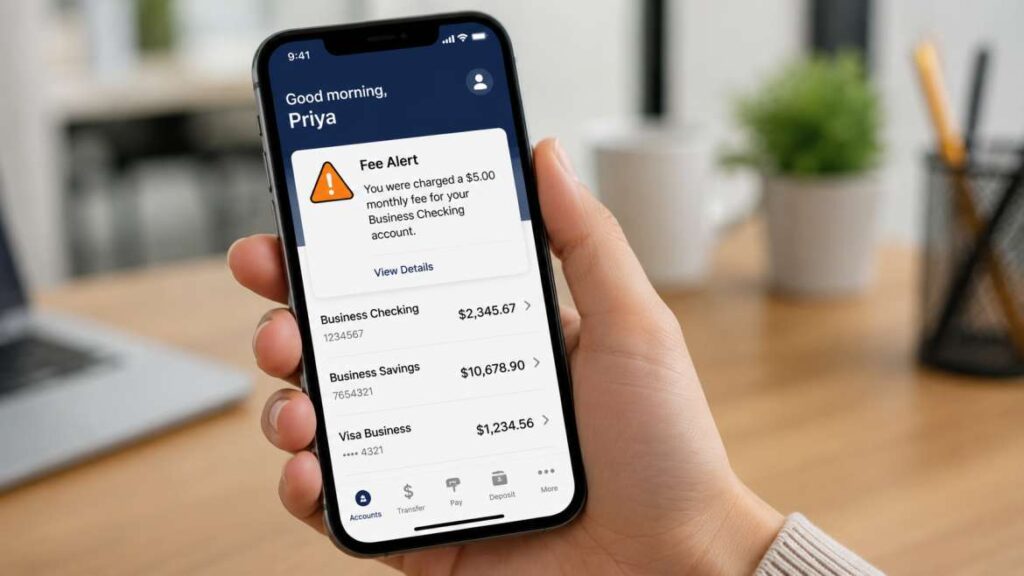
A Realistic Scenario: Priya’s First Six Weeks
Priya arrived in Toronto as a permanent resident and wanted to launch a freelance graphic design business within her first month. She registered a sole proprietorship under a trade name through ServiceOntario (2 business days), applied for a CRA Business Number online the same afternoon, and booked an RBC appointment using her PR card, passport, and a lease agreement as proof of address. Because most of her clients were still in the U.S., she also opened a multi-currency account with a specialized provider to avoid the SWIFT wire fees on incoming USD payments. Total time from landing to a fully functional business banking setup: five and a half weeks — most of it spent waiting on the trade name registration, not the bank itself.
The lesson: the bank appointment is rarely the bottleneck. Business registration and getting your BN are usually the longest steps, so start those first.
Frequently Asked Questions
Do I need a Social Insurance Number to open a business bank account? Not always for a basic account, but you’ll need one for tax reporting once your business earns interest or income, and most banks will ask for it during setup.
Can I open a business bank account before I arrive in Canada? Some banks allow newcomers to begin the personal account process before landing, but business accounts almost always require your business to be legally registered in Canada first, which typically means completing this step after arrival.
What if I don’t have a Canadian address yet? Many banks accept an employer letter, a settlement agency letter, or a temporary accommodation address to get started, then update your file once you have a permanent address.
Is a business bank account legally required for a sole proprietorship? Not always legally required if you’re operating strictly under your own name, but it’s strongly recommended for bookkeeping, tax filing, and credibility — and it becomes mandatory in practice once you incorporate or take on partners.
Key Takeaways
- Register your business and get your CRA Business Number before booking your bank appointment — these are usually the real bottleneck, not the bank.
- Bring original personal ID, immigration documents, proof of address, and business registration paperwork; corporations also need ownership and signing-officer details.
- Compare more than the sign-up bonus — monthly fees, e-Transfer limits, and how USD payments are handled will affect your costs far more over a year.
- If you invoice international clients, understand the difference between a true local account and a “USD-in-Canada” account before you commit.
- Mark your calendar before any newcomer fee waiver expires so you’re not surprised by a fee increase.
Opening a business bank account is one of the most concrete, practical steps you can take to make your entrepreneurial life in Canada feel real. Once it’s done, everything else — invoicing, tax filing, applying for credit — gets easier.
Sources & Citations to Include in Published Article
- RBC Newcomer Business Banking Offers
- RBC Small Business and Corporate Bank Accounts
- TD Small Business Banking for Newcomers
- Wealthsimple: Best Business Chequing Accounts in Canada
- Finder Canada: What You Need to Open a Business Bank Account
- Venn: Best Business Bank Account for New Immigrants 2026
- Canada.ca — Financial Consumer Agency of Canada, Opening a Bank Account
- Scotiabank — How to Open a Business Bank Account
Disclaimer
This article is for general informational purposes only and does not constitute financial, legal, immigration, or tax advice. Banking products, fees, eligibility windows, and newcomer program terms change frequently and vary by institution, province, and individual circumstances. Before opening a business bank account or making any financial decision, confirm current requirements, fees, and terms directly with the financial institution and consult a licensed accountant, lawyer, or immigration consultant where appropriate. ArriveThenThrive.ca is not affiliated with and does not receive compensation from the banks mentioned in this article unless otherwise disclosed.
