


You landed, found a job, and noticed something curious on your first paycheque: deductions for something called “C.P.P.” You didn’t sign up for it. Nobody asked your permission. And yet, a portion of every dollar you earn is quietly flowing somewhere — somewhere that will matter enormously decades from now.
That somewhere is the Canada Pension Plan (CPP) — one of the foundational pillars of retirement security in Canada. And the good news? Even if you arrived last year, those contributions are already working for you.
For newcomers navigating an entirely new financial system, CPP can feel like a black box. How does it actually work? Will you ever see that money? And how much can you realistically expect when retirement comes — especially if you didn’t spend your entire career in Canada?
This guide answers all of that, in plain language, with real numbers.
What Is the Canada Pension Plan (CPP)?
The Canada Pension Plan is a federal social insurance program that provides monthly income to Canadians when they retire, become disabled, or pass away (through survivor benefits). It was established in 1965 and today covers workers in every province and territory — except Quebec, which operates its own equivalent program called the Quebec Pension Plan (QPP).
Here’s the core idea: throughout your working life, a percentage of your employment income is automatically deducted from your paycheque and contributed to the CPP. Your employer matches that contribution dollar for dollar. When you retire (or face disability or death), CPP pays you back as a monthly benefit — for the rest of your life.
It’s not charity. It’s not welfare. It’s your money, earned through years of contributions, returned to you when you need it most.
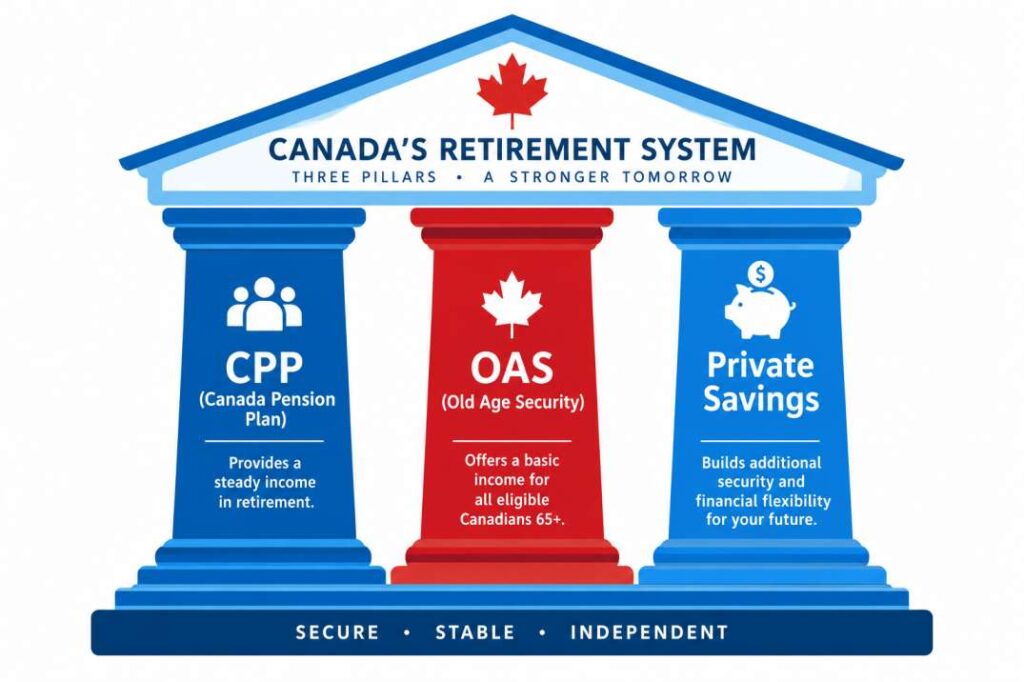
CPP sits alongside two other pillars of Canada’s retirement system:
- Old Age Security (OAS) — a federal benefit based on residency, not contributions
- Private savings — RRSPs, TFSAs, workplace pensions, and personal investments
CPP is the only one of these three that is directly tied to how much you worked and earned in Canada. For newcomers, that’s both a challenge and an opportunity.
How CPP Contributions Work (The Numbers)
Every time you receive a paycheque in Canada, two CPP deductions happen automatically — one from you and one matched by your employer. Here’s how it breaks down for 2026:
TABLE 1: CPP Contribution Rates and Limits (2026)
| Category | Rate | Maximum Pensionable Earnings | Maximum Annual Contribution |
|---|---|---|---|
| Employee (CPP1) | 5.95% | $74,600 | $4,230.45 |
| Employer (CPP1) | 5.95% (matched) | $74,600 | $4,230.45 |
| Self-Employed (CPP1) | 11.90% | $74,600 | $8,460.90 |
| Employee (CPP2 — high earners) | 4.00% | $74,600–$85,000 | $416.00 |
| Employer (CPP2 — high earners) | 4.00% (matched) | $74,600–$85,000 | $416.00 |
| Self-Employed (CPP2) | 8.00% | $74,600–$85,000 | $832.00 |
| Basic Exemption (no CPP on first) | — | $3,500 | — |
Source: Canada Revenue Agency, 2026 CPP Rates
What does this mean in practice? If you earn $60,000 a year as an employee, your CPP1 contribution is roughly $3,360 annually — and your employer quietly matches every dollar of that. You’re effectively doubling your contributions without spending a cent more.
What about CPP2? Starting in 2024, a second tier of contributions called CPP2 was introduced for higher earners. If your income exceeds $74,600, you contribute an additional 4% on earnings up to $85,000. This builds additional retirement benefits on top of your base CPP. For most newcomers in the early years of their Canadian career, CPP1 is what matters most.
Self-employed newcomers pay attention: If you run your own business or work as a contractor, you pay both the employee and employer portions — effectively 11.9% on your net business income. That’s a significant amount, but the upside is that half of it (the employer portion) is tax-deductible.
Who Qualifies for CPP? The Newcomer-Friendly Rules
Here’s where CPP gets genuinely welcoming for immigrants: you do not need to be a Canadian citizen to qualify.
As long as you have worked legally in Canada and made at least one valid CPP contribution, you are building eligibility for benefits. Permanent residents, temporary workers with valid work permits, and even international students with work authorization who have had CPP deducted are all covered.
The formal eligibility requirements to start receiving CPP retirement pension are:
- Be at least 60 years old (though waiting until 65 gets you the full standard amount)
- Have made at least one valid CPP contribution during your working life in Canada
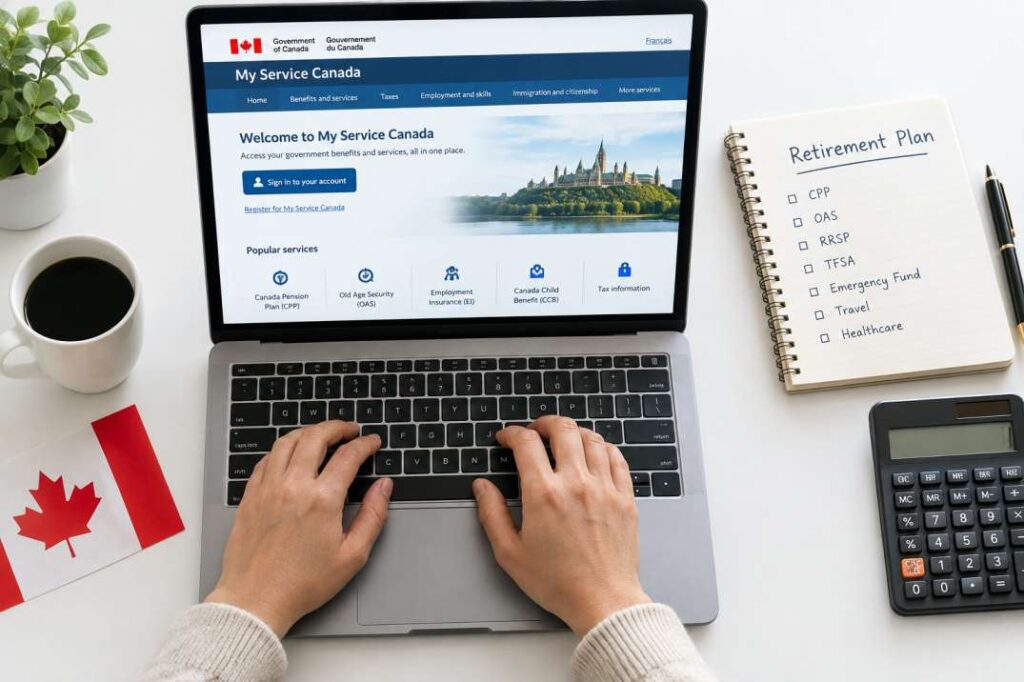
- Submit an application through My Service Canada Account
That’s it. One contribution. That’s the lowest bar you could imagine — and it means that even a short stint of work in Canada has long-term financial implications.
How Much CPP Will You Actually Receive?
This is the question every newcomer eventually asks — and the honest answer requires some nuance.
The Maximum vs. The Reality
To receive the maximum CPP retirement benefit, you would need to have contributed at the maximum rate for approximately 39 years in Canada. For most newcomers who arrive in their 30s or 40s, that’s simply not going to happen.
Here’s what the current numbers look like:
TABLE 2: CPP Retirement Benefit Amounts (2025–2026)
| Scenario | Monthly Benefit (approx.) |
|---|---|
| Maximum possible (age 65, max contributions for 39+ years) | $1,433/month |
| National average recipient (July 2025) | $848/month |
| Newcomer who worked 15 years in Canada (estimate) | $300–$500/month |
| Newcomer who worked 25 years in Canada (estimate) | $500–$850/month |
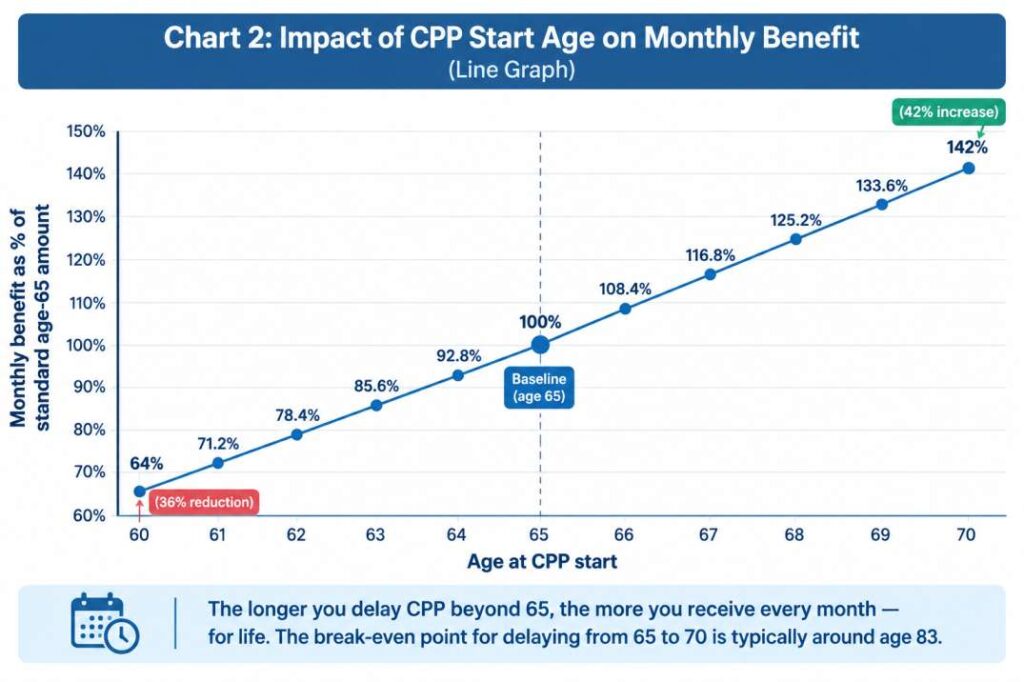
| Early start at age 60 (reduced by 0.6%/month early) | Up to 36% less |
| Delayed start at age 70 (increased by 0.7%/month late) | Up to 42% more |
Sources: Moving2Canada, Government of Canada CPP, ICC Immigration
Newcomer benefit estimates are approximations. Your actual amount depends on your specific earnings history, contribution years, and when you start collecting. Use the CPP retirement calculator on My Service Canada for a personalized estimate.
💡 PRO TIP
The “39-Year Rule” and Why Newcomers Are Disadvantaged (But Not Hopeless)
CPP calculates your benefit based on your best earning years over your contributory period (ages 18–65). It also automatically excludes your 8 lowest-earning years from the calculation, which is designed to protect people who had periods of low income.
However, if you only worked in Canada for 20 years, you don’t have 39 high-earning years to draw from — which means your CPP will naturally be lower than someone who spent their entire career here.
The silver lining: CPP is also indexed to inflation, meaning your benefit increases every year automatically. And there are several legal strategies to increase your payout, which we’ll cover below.
A Real-World Example: Maria’s CPP Journey
Let’s make this concrete. Meet Maria, a nurse from the Philippines who arrived in Canada at age 35 on a Temporary Foreign Worker permit, transitioned to permanent residency at 38, and plans to retire at 65.
- Years contributing to CPP: ~27 years (ages 38–65)
- Average annual earnings: $72,000 (well above average, good contributions)
- Estimated monthly CPP at 65: Approximately $700–$850/month
Maria won’t get the maximum CPP — but she’ll receive a meaningful benefit every month for the rest of her life. Combined with Old Age Security (which she’ll qualify for based on residency) and any personal savings, Maria’s retirement picture starts to look quite reasonable.
Now imagine if Maria delays her CPP to age 70 instead of taking it at 65. Her monthly payment increases by 0.7% for every month she waits past 65 — that’s a 42% larger payment for life if she waits the full five years. For someone who arrives younger and is in good health, this strategy can be financially transformative.
Smart Strategies to Maximize Your CPP as a Newcomer
You may not have started contributing at 18 like a Canadian-born worker — but you’re not without options. Here’s how to squeeze more out of CPP:
1. Delay Your CPP Start Date
The single most powerful lever available to you. For every month past age 65 that you delay collecting CPP (up to age 70), your monthly payment increases by 0.7%. That’s 8.4% more per year — or 42% more if you wait the full five years to age 70.
Starting early (as young as 60) has the opposite effect: a 0.6% reduction per month, or up to 36% less if you start at 60.
2. Keep Working and Contributing
Even after you start collecting CPP — if you’re under 70 and still employed — you can (and will) continue making CPP contributions. These generate what’s called Post-Retirement Benefits (PRB), which increase your monthly payment modestly each year.
3. Use the Child-Rearing Provision
If you stopped working or reduced your hours to care for a child under 7, you may be able to exclude those low-earning years from your CPP calculation. This is called the Child-Rearing Provision, and it can meaningfully increase your benefit amount by removing years that would otherwise drag down your average.
4. Explore International Social Security Agreements
Canada has social security agreements with many countries — including the Philippines, India, the UK, Germany, Italy, Mexico, South Korea, and over 60 others. These agreements can allow contributions made in your home country to count toward your CPP eligibility period, and can help you avoid being taxed twice on pension income.
Check the most current list of countries with agreements at Government of Canada – Social Security Agreements.
5. Apply on Time (Processing Takes Up to 4 Months)
CPP doesn’t start automatically. You must apply — ideally 6 months before you want to start receiving benefits, since processing can take up to four months. Apply through My Service Canada Account online or by mail.
CPP Benefits Beyond Retirement: What Newcomers Often Miss
CPP isn’t only about retirement income. There are three other types of benefits that newcomers sometimes don’t know about:
Disability Benefits: If you become severely and permanently disabled before retirement age and can no longer work, CPP provides monthly disability payments — provided you’ve made contributions for a minimum number of years.
Survivor’s Pension: If a CPP contributor dies, their legal spouse or common-law partner may receive a monthly survivor’s benefit. Children of the deceased contributor may also receive a monthly benefit.
Death Benefit: A one-time, lump-sum payment (currently up to $2,500) is paid to the estate of a deceased CPP contributor.
These benefits make CPP far more than a retirement program — it’s a comprehensive safety net that protects newcomers and their families from the financial shocks of disability and loss.
CPP vs. OAS: Understanding the Difference
Many newcomers confuse CPP with Old Age Security (OAS). They’re related but fundamentally different:
- CPP is based on how much you contributed during your working years. Newcomers who worked less in Canada receive less.
- OAS is based on how long you lived in Canada after age 18. To get the full OAS pension, you need 40 years of Canadian residency after 18. Partial OAS is available after 10 years of residency.
For newcomers arriving in their 30s or 40s, OAS may end up being a partial benefit at 65 — but it’s still something. And the Guaranteed Income Supplement (GIS) is available to low-income OAS recipients, providing an additional layer of support.
Actionable Takeaways for Newcomers
Before you close this article, here’s what you should actually do right now:
- Create a My Service Canada Account at canada.ca/en/employment-social-development/services/my-account.html and check your CPP contribution history.
- Request your Statement of Contributions to see exactly how much you’ve put in and get a personalized benefit estimate.
- Find out if your home country has a social security agreement with Canada — it could increase your entitlement.
- If you have children under 7 and reduced your work hours, look into the Child-Rearing Provision.
- Don’t start CPP too early just because you’re nervous about money. Every month you delay past 65 adds 0.7% permanently.
- Talk to a financial planner who understands both Canadian retirement programs and immigrant-specific financial planning challenges.
The Bottom Line: CPP Is Built for Workers, Not Just Lifelong Canadians
The Canada Pension Plan is not perfect for newcomers. If you arrive at 40 and retire at 65, you simply won’t accumulate as many contribution years as someone born and raised here. That’s a genuine disadvantage.
But here’s the reframe: CPP is still one of the best retirement guarantees available to you. It’s indexed to inflation. It pays for life. Your employer doubles your contributions automatically. And even modest contribution years — 15, 20, 25 — translate to meaningful monthly income in retirement.
The key is understanding the system early, making strategic decisions about when to start collecting, and building CPP into a broader retirement plan alongside OAS, TFSAs, and RRSPs.
You arrived in Canada. Now let’s make sure your retirement here is just as thoughtful as your decision to come.
Frequently Asked Questions
Can I receive CPP if I return to my home country?
Yes. CPP can be paid to recipients living outside Canada. You’ll need to inform Service Canada and may need to complete periodic life certificates to continue receiving payments.
What if I contributed to CPP while on a work permit but didn’t become a permanent resident?
Your CPP contributions are not lost. You can still claim them when you reach retirement age, even if you’re no longer in Canada — subject to any international agreements in place.
Is CPP taxable income?
Yes, CPP payments are considered taxable income in Canada. However, if you live abroad, taxation depends on the tax treaty between Canada and your country of residence.
What’s the difference between CPP and the QPP?
The Quebec Pension Plan (QPP) covers workers in Quebec and is structured very similarly to CPP. If you’ve worked in both Quebec and other provinces, your contributions to both plans are combined when calculating your benefit.
Sources and Further Reading
Disclaimer
The information provided in this article is for general informational and educational purposes only. It does not constitute financial, legal, or tax advice. CPP rules, rates, and thresholds change annually — always verify current figures with the Canada Revenue Agency (CRA) or Service Canada. Every individual’s situation is unique; consult a licensed financial advisor or tax professional for advice tailored to your specific circumstances. ArriveThenThrive.ca is not affiliated with the Government of Canada or any government agency.
