


You finally made it. You’re enrolled at a Canadian college or university, settled into your new city, and starting to wonder — can I actually work here? Maybe you want to cover rent, grab some Canadian work experience, or just stop draining your savings on groceries. Whatever the reason, working while studying in Canada is not only allowed — it’s a completely normal part of the international student experience.
But here’s where it gets interesting: the moment you earn income in Canada, you step into a new world — the Canadian tax system. And unlike what some students assume, that system isn’t something you can just ignore and deal with later. It affects how much money you keep, what government benefits you might qualify for, and even your long-term immigration pathway.
In this guide, we’ll walk you through everything you need to know: how many hours you can work, what kind of jobs are allowed, how Canadian income tax works for international students, what credits and deductions you can claim, and how to actually file your taxes. Let’s break it all down.
Can International Students Work in Canada? The Short Answer Is Yes
The short answer is yes — most international students in Canada are permitted to work without a separate work permit. But the longer answer involves some important conditions and limits you absolutely need to understand.
As of November 2024, international students can work up to 24 hours per week off campus during regular academic sessions. This replaced the previous 20-hour limit and marks the permanent rule going forward — the full-time work allowance that was temporarily offered during the pandemic era has expired. During scheduled academic breaks (summer, winter holidays, reading week), you can work unlimited hours — provided you were a full-time student before the break and will be one after.
On-Campus vs. Off-Campus Work: What’s the Difference?
There are two distinct categories of work available to eligible international students:
- On-campus work: You can work unlimited hours at your institution — in the cafeteria, library, student centre, research labs, or as a teaching/research assistant — with no weekly hour cap. This is a huge advantage many students don’t realize.
- Off-campus work: You can work up to 24 hours per week during academic sessions at any employer in Canada. During scheduled breaks, the limit lifts entirely.
- Remote work for foreign employers: Working remotely for a company based entirely outside Canada doesn’t count toward your 24-hour limit, as it’s not considered entering the Canadian labour market.
Who Is Eligible to Work Off Campus Without a Work Permit?
To qualify, you must meet all of the following conditions (Source: Immigration, Refugees and Citizenship Canada — IRCC):
- Hold a valid study permit that includes wording such as “May accept employment” or “May work off campus”
- Be enrolled full-time at a Designated Learning Institution (DLI)
- Be registered in an academic, vocational, or professional training program of at least six months leading to a degree, diploma, or certificate
- Have already started your studies (you cannot work before your first class)
- Hold a valid Social Insurance Number (SIN)
Students in English or French language training programs, general interest courses, or prerequisite programs are not eligible for off-campus work under these rules and would need a separate work permit.
TABLE 1: International Student Work Allowances in Canada (2025)
Work Type | During Academic Session | During Scheduled Breaks | Work Permit Needed? |
On-Campus | Unlimited hours | Unlimited hours | No |
Off-Campus | Up to 24 hrs/week | Unlimited hours | No (if eligible) |
Co-op / Internship | As per program | As per program | Yes — Co-op Permit |
Remote for Foreign Employer | Unlimited hours | Unlimited hours | No |
Source: IRCC — Work off campus as an international student (canada.ca)
Working more than 24 hours per week off campus during an academic session is a serious violation of your study permit conditions. Consequences can include loss of student status, future permit refusals, and removal from Canada. Always track your hours carefully.
⚠️ Important
Getting a Social Insurance Number (SIN): Your First Step
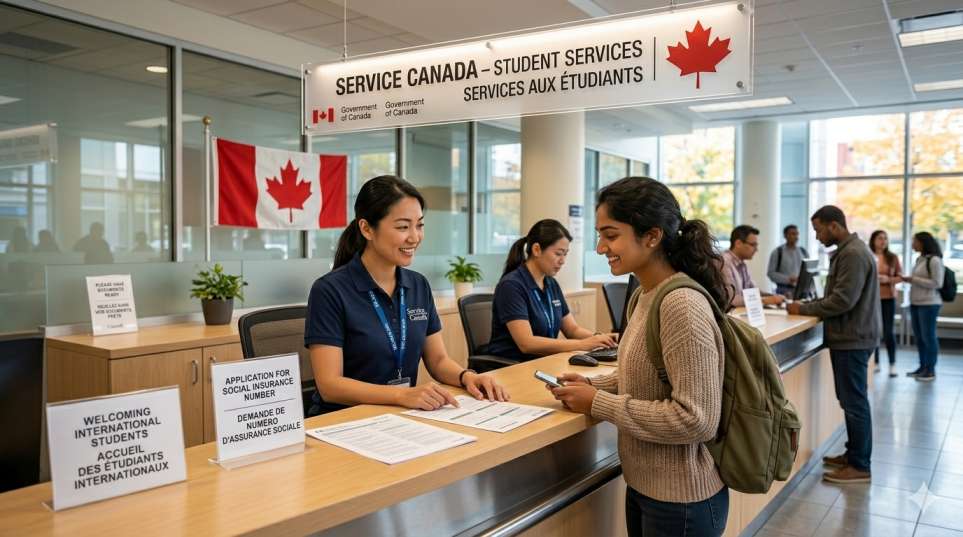
Before you start any job in Canada, you need a Social Insurance Number (SIN). This nine-digit number is your identifier for employment, tax reporting, and access to government benefits. Without it, your employer cannot legally pay you or remit taxes on your behalf.
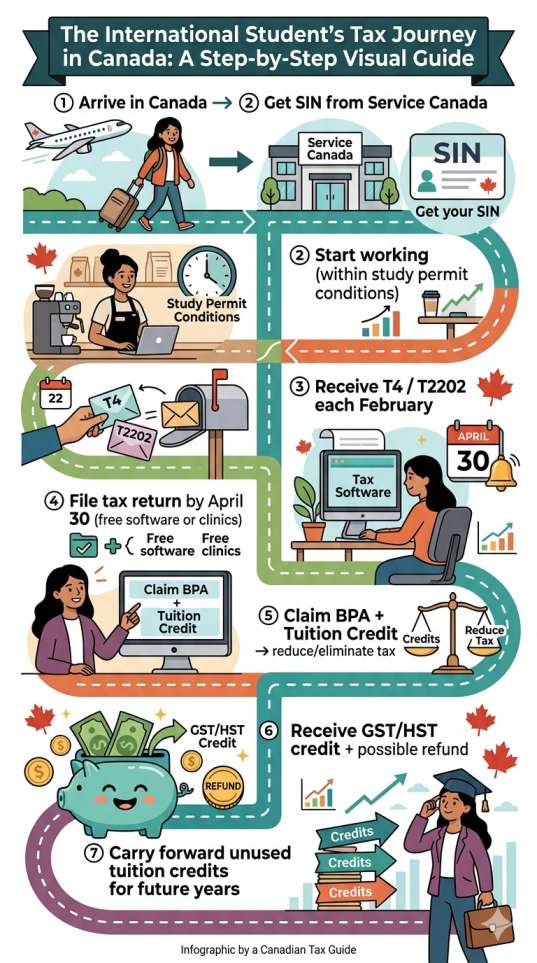
To get a SIN as an international student, visit a Service Canada office with your valid study permit (that includes the work authorization wording) and your passport. Processing is usually done the same day, and the SIN card is free. If you are not eligible for a SIN, you can apply for an Individual Tax Number (ITN) using CRA Form T1261 — this number is used solely for tax filing purposes.
Once you have your SIN, guard it carefully. CRA tax scams frequently target international students by impersonating the agency and demanding money or personal information by phone or email. The real CRA will never threaten arrest or demand immediate payment by phone.
How Canadian Income Tax Works for International Students
This is where things get a little more involved — but stay with us, because understanding this section could literally put money back in your pocket.
Residency Status for Tax Purposes — Not the Same as Immigration Status
Here’s a concept that surprises many students: for Canadian tax purposes, your residency status is determined by your residential ties to Canada, not your immigration status. Most international students who live in Canada for the full academic year are considered residents of Canada for tax purposes — even though they hold a temporary study permit.
What does this mean practically? It means you are taxed on your worldwide income, not just your Canadian income. If you earn money from a part-time job back home, or receive income from an investment in your home country, you may need to report it. However, Canada has tax treaties with dozens of countries that prevent double taxation — meaning you won’t necessarily pay full tax twice. Check whether your home country has a tax treaty with Canada on the CRA website.
A small number of students may be classified as non-residents for tax purposes (for example, if they spend only a few months in Canada and maintain strong ties to their home country). Non-residents are taxed only on Canadian-source income, but at a flat withholding rate. If you’re unsure of your status, the CRA’s residency determination process is the best place to start.
Canada’s Progressive Federal Tax System
Canada uses a progressive tax system — the more you earn, the higher the rate on each additional dollar. In 2025, the federal government introduced a notable change: the lowest income tax bracket was reduced from 15% to 14%, effective July 1, 2025 (making the blended effective rate 14.5% for the 2025 tax year, and a full 14% from 2026 onward). This is good news for students earning part-time wages.
Here are the 2025 federal income tax brackets:
TABLE 2: 2025 Federal Income Tax Brackets — Canada
Taxable Income Range | Federal Tax Rate (2025) | Notes |
$0 – $57,375 | 14.5% (blended) | Lowest bracket; rate cut to 14% starting 2026 |
$57,376 – $114,750 | 20.5% | Covers most full-time earners |
$114,751 – $158,519 | 26% | Upper-middle bracket |
$158,520 – $220,000 | 29% |
|
Over $220,001 | 33% | Top federal rate |
Source: Canada Revenue Agency / TurboTax Canada 2025. Provincial/territorial tax is additional and varies by province.
For most international students working part-time, your income will fall well within the first bracket. For example, a student earning $20,000 in a year at 24 hours/week would pay federal tax only on income above the Basic Personal Amount of $16,129 (the amount every Canadian resident can earn tax-free federally). That means your taxable income is only $3,871, and your federal tax owing is a small fraction of that.
What You’ll Actually Pay: Deductions and Tax Credits That Help Students
Here’s the good news: the Canadian tax system includes several credits and deductions specifically designed to reduce the tax burden for students. Many international students end up owing little to nothing — or even receiving a refund — once these are applied.
The Basic Personal Amount (BPA)
Every Canadian tax resident can earn up to $16,129 (federal BPA for 2025) completely tax-free. Each province and territory also has its own BPA. This means if your total annual income is below that threshold, you’ll pay zero federal income tax. For many students working part-time, this alone eliminates most or all of their federal tax bill.
The Tuition Tax Credit
This is one of the most valuable credits available to students. You can claim the tuition fees you paid to a Canadian DLI as a non-refundable tax credit. The credit is calculated at 15% of your eligible tuition (federal), reducing the taxes you owe. If your tuition credit exceeds your tax owing, you can carry forward the unused amount to future tax years — or transfer up to $5,000 to a supporting spouse or parent (subject to conditions). Your institution will provide a T2202 tax receipt showing your eligible tuition amount.
The Canada Employment Amount
If you were employed in Canada in 2025, you can claim the Canada Employment Amount on your return — a small federal credit of up to $1,433 (2025) that partially offsets work-related costs like uniforms or tools. This applies automatically to most employees.
GST/HST Credit
Even if you have very little income, filing your tax return makes you eligible for the GST/HST credit — a quarterly payment from the CRA that helps low-to-moderate income individuals offset the cost of the goods and services tax. For a single person, this can add up to a few hundred dollars a year. You don’t need to apply separately — the CRA automatically assesses your eligibility when you file.
CPP and EI Deductions from Your Paycheque
Your employer will automatically deduct Canada Pension Plan (CPP) contributions and Employment Insurance (EI) premiums from your paycheque. As an employee, you generally cannot opt out of these. The good news: you may be able to claim CPP and EI premium tax credits on your return. And while you likely won’t be in Canada long enough to collect CPP pension benefits in retirement, if you return to your home country after graduating, certain countries have social security agreements with Canada that may allow for some portability.

How to File Your Taxes as an International Student in Canada
Tax season in Canada runs from February to April 30 of each year (for the previous calendar year). The deadline to file your 2025 tax return is April 30, 2026. Missing this deadline when you owe taxes can result in a late-filing penalty of 5% of your balance owing, plus 1% per month for up to 12 months.
Documents You’ll Need
- T4 slip — from your employer, showing employment income and deductions (available from your employer or via CRA My Account)
- T4A slip — for scholarships, bursaries, or fellowships received from your university
- T2202 — Tuition and Enrolment Certificate from your institution (usually available on your student portal)
- Social Insurance Number (SIN) or Individual Tax Number (ITN)
- Records of any foreign income (if applicable under your residency status)
How to Actually File
You have several options, all of them accessible:
- Free certified tax software: The CRA provides a list of approved, free software for eligible individuals. Options like Wealthsimple Tax, TurboTax Free, and StudioTax are popular and beginner-friendly.
- Free tax clinics (CVITP): The Community Volunteer Income Tax Program offers free tax help from trained volunteers for individuals with modest incomes and simple situations. These clinics are held at community centres, libraries, and university campuses across Canada — especially active in March and April.
- University-affiliated help: Many Canadian universities offer tax-filing workshops specifically for international students, sometimes in partnership with the CRA.
- Paid accountants or tax preparers: For more complex situations (foreign income, self-employment, multiple T4s), hiring a Chartered Professional Accountant (CPA) is a worthwhile investment.
Tip: Once you have a SIN and have filed at least one return, create a CRA My Account online. It lets you track your return status, view tax slips, set up direct deposit for refunds, and access your Notice of Assessment.
A Real-World Scenario: What Does This Look Like in Practice?
Let’s walk through a realistic example to make this concrete.
Meet Priya, a second-year international student from India studying computer science at a university in Toronto. Her study permit includes the work authorization clause. During the school year, she works 20 hours a week as a barista off campus, earning $16.55/hour (Ontario minimum wage as of 2025). During the summer break, she picks up extra shifts and works full-time.
Her approximate annual income breaks down like this:
- Academic sessions (September–April, roughly 32 weeks): 20 hrs × $16.55 × 32 = ~$10,592
- Summer break (May–August, roughly 16 weeks): 40 hrs × $16.55 × 16 = ~$10,592
- Total annual income: approximately $21,184
At tax time, Priya claims the federal Basic Personal Amount ($16,129), reducing her taxable income to $5,055. She also receives a T2202 from her university with $12,000 in tuition. After applying just the BPA and a portion of her tuition credit, her federal tax owing is effectively reduced to zero. She also qualifies for the quarterly GST/HST credit, receiving quarterly payments from the CRA throughout the year.
The lesson here is that between the BPA and the tuition tax credit, many part-time earning international students end up owing very little or even receive a refund — but only if they file. Students who skip filing miss out on these benefits.

5 Actionable Tax Tips for International Students in Canada
- File your return even if you have no income. Filing establishes your tax residency status with the CRA, unlocks benefit eligibility (like GST/HST credits), and starts the clock on tuition credit carry-forwards.
- Never miss the April 30 deadline. If you owe taxes and file late, you’ll be charged a late-filing penalty and interest. Set a reminder every February to start gathering your tax documents.
- Keep every T-slip and tax document. Your T4, T4A, and T2202 are essential. Most are available digitally through your employer, university portal, or CRA My Account.
- Check for a tax treaty. Canada has tax treaties with over 90 countries. If you earn income in your home country while studying here, a treaty may reduce your Canadian tax on that income. Check the CRA’s list of tax conventions.
- Consider how your Canadian tax history supports your PR journey. If you plan to apply for permanent residency through Express Entry or the Canadian Experience Class after graduation, a clean record of tax compliance and legitimate Canadian work experience counts in your favour. Every T4 filed tells a story.
After Graduation: The Post-Graduation Work Permit and What Comes Next
Here’s one more tax-adjacent topic every international student should know: the Post-Graduation Work Permit (PGWP). Once you complete your program at an eligible DLI, you may be eligible to apply for a PGWP, which allows you to work full-time for any employer in Canada for up to three years, depending on your program length.
During your PGWP period, you’ll be fully employed in the Canadian labour market, paying full taxes, and building the Canadian work experience that powers pathways to permanent residency through programs like Express Entry or provincial nominee programs. All of that starts with the tax habits you build as a student. A clean filing history, documented income, and compliance with CRA requirements form the foundation of a credible immigration profile.
Conclusion: Work Smart, File Right, Build Your Future
Working in Canada as an international student is one of the smartest moves you can make — not just for the income, but for the experience, the connections, and the Canadian work history that will serve you well long after graduation. But to get the most out of it, you need to understand the rules.
Here’s a quick summary of the key takeaways from this guide:
- International students can work up to 24 hours per week off campus during academic sessions, and unlimited hours on campus or during scheduled breaks — no separate work permit required if you’re eligible.
- You must have a valid study permit with work authorization, be enrolled full-time at a DLI, and hold a SIN before starting any job.
- Most international students are considered tax residents of Canada and must file an annual tax return with the CRA by April 30.
- The Basic Personal Amount ($16,129 federal for 2025) and the Tuition Tax Credit are your best friends — they dramatically reduce or eliminate the tax owing for most part-time student earners.
- Even if you earn nothing, filing your return unlocks GST/HST credits and starts building your CRA profile — something that matters as you work toward permanent residency.
- Free tax clinics, approved software, and university tax workshops make filing accessible and affordable.
Canada wants international students to thrive — financially, academically, and professionally. Understanding how work and taxes intersect is one of the first big steps to doing exactly that. Now that you know the rules, go make the most of your time here.
DISCLAIMER
The information in this article is provided for general informational and educational purposes only and does not constitute legal, immigration, or tax advice. Immigration and tax rules in Canada change frequently, and individual circumstances vary. Readers should consult a qualified Chartered Professional Accountant (CPA) or a Regulated Canadian Immigration Consultant (RCIC) for advice specific to their situation. ArriveThenThrive.ca is not liable for any decisions made based on the information contained in this article. Always verify current rules directly with the Canada Revenue Agency (CRA) at canada.ca and Immigration, Refugees and Citizenship Canada (IRCC) at canada.ca/immigration before taking action.
Sources & References: Canada Revenue Agency (canada.ca) | IRCC — Work off campus (canada.ca) | TurboTax Canada 2025 | H&R Block Canada 2025 | CIC News | University of Waterloo International Experience | Fragomen Immigration
