


If you’re a newcomer to Canada with investments — whether stocks, real estate, or a business back home — you’ve probably heard the buzz about capital gains tax changes. And honestly, the last two years have been a rollercoaster. Rules proposed, then deferred, then cancelled, then partially reinstated. It’s enough to make any new investor’s head spin.
Here’s the good news: the dust has largely settled for 2026, and understanding where things stand right now could save you thousands of dollars — and a lot of anxiety.
This guide breaks down exactly what changed, what didn’t, and — most importantly — what it all means specifically for you as a newcomer investor building wealth in Canada. We’ll walk through real-world scenarios, smart strategies for registered accounts like TFSAs and RRSPs, and the unique rules that apply when you arrive (and potentially when you leave).
Let’s untangle it together.
What Is Capital Gains Tax — and Why Should Newcomers Care?
Before diving into the 2026 changes, let’s make sure we’re speaking the same language.
A capital gain is the profit you make when you sell an asset for more than you paid for it. Sell 100 shares of a company for $15,000 that you originally bought for $10,000? That’s a $5,000 capital gain. Sell an investment property in Ontario for $200,000 more than you paid? That’s a capital gain too.
In Canada, the government doesn’t tax 100% of your capital gain — it taxes a portion of it, known as the inclusion rate. That included amount is then added to your regular income and taxed at your marginal rate.
For newcomers, this matters in three major ways:
- You may have investments or assets from your home country that become subject to Canadian tax rules the moment you establish residency.
- You’ll be building new investments in Canada and want to do so as tax-efficiently as possible.
- If you ever leave Canada, you’ll face a “departure tax” — a deemed disposition of most of your assets. Understanding the rules now helps you plan for that possibility.
The Capital Gains Rollercoaster: A Quick Timeline
To understand where we are in 2026, here’s a brief recap of the turbulence that led us here:
- April 2024: The federal government proposed increasing the capital gains inclusion rate from 50% to 66.67% for corporations and trusts (on all gains), and for individuals on gains exceeding $250,000 annually.
- June 25, 2024: Original proposed effective date.
- January 31, 2025: The Department of Finance announced that the implementation date for the proposed increase in the capital gains inclusion rate would be deferred to January 1, 2026.
- March 21, 2025: The government announced that it would cancel the proposed inclusion rate increase altogether.
- 2026 (Current): The capital gains inclusion rate in 2026 remains at 50%.
So the dramatic hike that had investors scrambling? It’s gone — for now. But several other important changes did take effect, and newcomers especially need to know about them.
What’s Actually Different in 2026: The Key Changes
The Inclusion Rate Stays at 50%
After much uncertainty in 2024, the federal government confirmed that the capital gains inclusion rate will remain at 50% for now. Only half of a net capital gain is a taxable capital gain for regular income tax purposes.
In plain English: If you sell an investment and make a $100,000 profit, only $50,000 of that is added to your taxable income. The other $50,000 is yours, tax-free.
For example, if you sell an asset and realize a $500,000 capital gain, $250,000 is included in your income and taxed at your marginal tax rate. The other $250,000 is not taxed at all.
This is genuinely good news — and it’s especially relevant if you’re holding significant non-registered investments.

The Lifetime Capital Gains Exemption (LCGE) Got a Big Upgrade
While the inclusion rate stayed put, one major positive change did happen: starting in 2026, the LCGE is indexed to inflation. For the 2026 tax year, the indexed LCGE limit is $1,275,000.
The LCGE is a lifetime exemption that lets eligible Canadians shelter gains from the sale of qualifying small business corporation shares, or qualifying farm or fishing property, from capital gains tax entirely.
If you sell your qualified small business corporation shares and realize a capital gain of $1,275,000 or less in 2026, you could potentially pay zero capital gains tax on that entire amount. At the 50% inclusion rate and a combined federal-provincial marginal tax rate of roughly 53% (for top earners in Ontario), the LCGE could save you approximately $337,875 in taxes.
For newcomers who are entrepreneurs — who’ve built or are building businesses in Canada — this is a massive opportunity worth planning around from the very beginning.
The Alternative Minimum Tax (AMT) — Watch This One
One change that flew under the radar for many investors: the federal AMT rate increased to 20.5% (from 15%). The basic minimum tax exemption increased to the start of the fourth federal tax bracket, which is $177,882 for 2025 and is indexed annually for inflation.
The AMT is essentially a parallel tax calculation that ensures high-income earners who use lots of preferential deductions still pay a minimum level of tax. Capital gains and stock options are the main triggers.
If you’re a higher-income newcomer planning to claim the LCGE or realize large capital gains, consult a tax professional to model your AMT exposure. It won’t apply to most newcomers in their early years of building wealth — but it can catch people off-guard as assets grow.
TABLE 1: Capital Gains Tax Key Numbers at a Glance (2026)
| Item | 2025 Amount | 2026 Amount | Notes |
|---|---|---|---|
| Capital Gains Inclusion Rate | 50% | 50% | Proposed increase to 66.67% was cancelled |
| Lifetime Capital Gains Exemption (LCGE) | $1,250,000 | $1,275,000 (est.) | Now indexed to inflation annually |
| TFSA Annual Contribution Limit | $7,000 | $7,000 | Cumulative room ≈ $95,000 by 2026 for those eligible since 2009 |
| RRSP Contribution Limit | $32,490 | $33,810 | 18% of prior year earned income, up to max |
| AMT Exemption Threshold | $177,882 | Indexed | AMT rate now 20.5% |
| Principal Residence Exemption | Maintained | Maintained | Primary home sale remains tax-free |
Sources: Canada Revenue Agency, TD Canada Trust, Insight CPA
The Newcomer Advantage: Your First-Day Tax Reset
Here’s something that most general articles on capital gains tax miss entirely — and it’s one of the most powerful concepts for newcomers.
When you immigrate to Canada, you get a cost basis “step-up.”
When you immigrate to Canada, you are generally considered to have disposed of, and to have immediately reacquired, most properties that you own on the date you immigrate.
What this means in practice: if you owned shares in a company back home that were worth $50,000 when you arrived in Canada, your Canadian adjusted cost base (ACB) is set at $50,000 — regardless of what you originally paid for them. Only gains that accrue after you become a Canadian resident are subject to Canadian capital gains tax.
This is a hugely favorable provision. It means you don’t owe tax on the wealth you built before arriving. You’re starting fresh, in the best possible sense.
What Happens If You Sell Assets From Your Home Country?
Once you’re a Canadian resident, Canada taxes your worldwide income — including capital gains on assets located anywhere in the world. The CRA defines worldwide income as income from all sources inside and outside Canada during the period you’re a Canadian resident for tax purposes — employment income from foreign employers, business income from operations anywhere globally, investment income like foreign dividends and interest, rental income from properties abroad, pension income from foreign plans, capital gains from selling foreign assets.
So if you sell a property in your home country after becoming a Canadian resident, that capital gain is reportable on your Canadian tax return. However, Canada has tax treaties with many countries to prevent double taxation — if you paid capital gains tax to your home country, you may be able to claim a foreign tax credit to offset what you owe in Canada.
Before selling any assets from your home country, speak with a cross-border tax specialist. The interaction between Canadian rules and foreign tax systems can be complex, and the timing of your sale can make a significant difference.
💡 PRO TIP
The Departure Tax: What Newcomers Leaving Canada Need to Know
This topic might feel premature — you just arrived! But life is unpredictable, and understanding the departure tax rules gives you peace of mind and planning power.
When you leave Canada, you are considered to have sold certain types of property (even if you have not sold them) at their fair market value and to have immediately reacquired them for the same amount. This is called a deemed disposition and you may have to report a capital gain — also known as departure tax.
In other words: if you accumulated investments while living in Canada and then move back home (or to another country), the CRA treats it as though you sold everything the day you left. Any gains are subject to capital gains tax at the current inclusion rate (50%).
But there’s an important exception for recent newcomers:
Individuals who were residents of Canada for less than 60 months are subject to departure tax only on assets purchased during their Canadian tax residency period.
So if you leave within five years of arriving, any assets you brought with you are generally exempt from departure tax. Only assets you bought while in Canada would be subject to the deemed disposition.
Sophisticated tax planning can materially reduce departure tax exposure. If you’re ever considering leaving Canada, a 12-to-18-month head start on planning makes a substantial difference.
TABLE 2: Registered Accounts Comparison for Newcomer Investors (2026)
| Feature | TFSA | RRSP | FHSA |
|---|---|---|---|
| 2026 Contribution Limit | $7,000/year | $33,810 or 18% of income (lower of two) | $8,000/year (lifetime max $40,000) |
| Tax on Contributions | After-tax dollars (no deduction) | Pre-tax (deductible from income) | Pre-tax (deductible) |
| Tax on Growth | Tax-free | Tax-deferred | Tax-free |
| Tax on Withdrawal | Tax-free | Taxed as income | Tax-free (if used for first home) |
| Newcomer Eligibility | From year of arrival (with SIN, age 18+) | Once you have earned income in Canada | Canadian resident, first-time buyer |
| Capital Gains Inside Account | Not taxable | Not taxable until withdrawal | Not taxable |
| Best For | Flexible goals, lower income earners | Higher income earners, retirement | First home purchase |
Sources: TD Canada Trust, Moving2Canada, GovGuide.ca
Your Secret Weapon: Tax-Sheltered Accounts
Here’s where newcomers have a genuine edge — Canada’s registered account system is extraordinarily generous, and using it well is one of the most powerful ways to minimize your capital gains tax exposure.
TFSA: The Newcomer’s Best Friend
TFSAs work exactly the same way for newcomers to Canada as they do for those born in Canada. The only difference is that your contribution room as a newcomer only starts when you have a SIN and are a tax resident in Canada.
Any capital gains, dividends, or interest earned inside a TFSA are completely tax-free — forever. You never report those gains to the CRA, and you never pay a cent of capital gains tax on them, no matter how much your investments grow.
If you have never contributed to a TFSA and were 18 or older in 2009, your total cumulative TFSA room is approximately $95,000 by 2026. For newcomers, room accumulates from the year you arrive, so the earlier you get here and open an account, the better.
RRSP: Lower Your Tax Bill Today
Tax-deferred growth means you won’t pay taxes on the interest, dividends, or capital gains until you start withdrawing funds. Plus, contributions reduce your taxable income now — potentially moving you into a lower tax bracket in a year when you’ve realized significant capital gains outside the RRSP.
You can contribute up to 18% of your previous year’s earned income, with an annual maximum of $33,810 for 2026.
FHSA: The Best of Both Worlds for First-Time Buyers
If you’re a newcomer who hasn’t owned a home anywhere in the world in the last four years, you likely qualify for the First Home Savings Account. The First Home Savings Account gives you a tax deduction on contributions (like an RRSP) and tax-free withdrawals for a qualifying first home purchase (like a TFSA).

Real-World Scenario: Meet Priya
Priya arrived in Canada from India in January 2023 as a permanent resident. She brought $80,000 CAD worth of mutual funds from her home country. In 2026, she sells those funds for $95,000.
Here’s how her tax situation looks:
- Her Canadian ACB (cost base) was stepped up to $80,000 the day she arrived — that’s what the funds were worth when she became a resident.
- Her capital gain is $15,000 ($95,000 – $80,000).
- At the 50% inclusion rate, $7,500 is added to her taxable income.
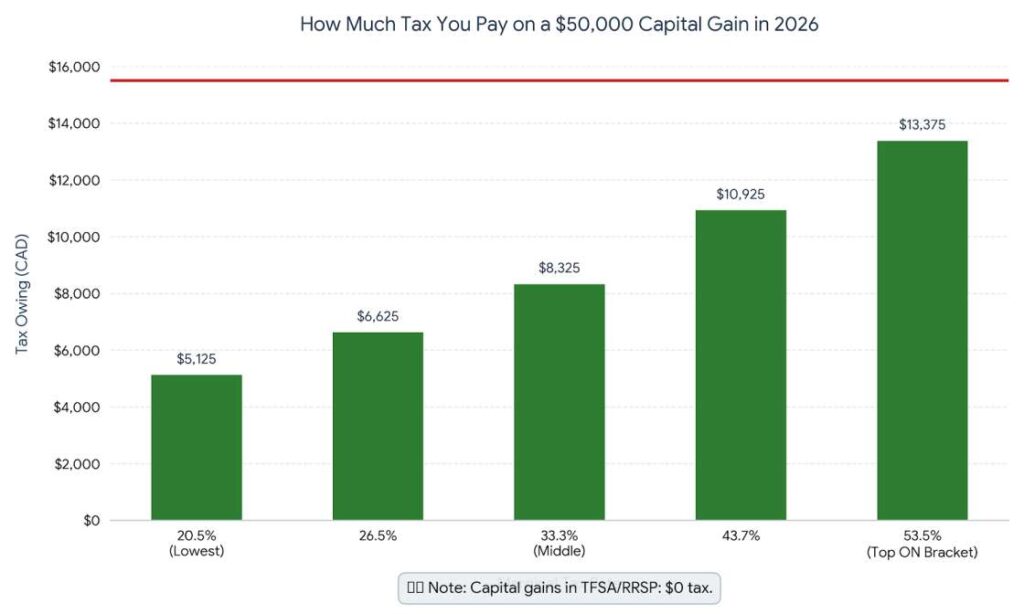
- If she’s in the 33% marginal tax bracket, she pays approximately $2,475 in tax on a $15,000 gain.
Now imagine if instead she had put $7,000 of new savings into her TFSA and invested in the same fund there. Any gains inside the TFSA? Zero tax.
The lesson: registered accounts are your most powerful tool. Use them first, always.
Smart Strategies for Newcomer Investors in 2026
1. Open Your TFSA the Day You Arrive
Seriously — week one. Newcomers get TFSA contribution room immediately in the year that they arrive in Canada. Every year you delay is room you never get back.
2. Hold Growth Assets Inside Registered Accounts
If you’re investing in stocks, ETFs, or any high-growth assets, prioritize holding them inside your TFSA or RRSP. Save your non-registered account for more tax-efficient investments like Canadian dividend-paying stocks (which get the dividend tax credit) or Canadian bonds.
3. Track Your Adjusted Cost Base (ACB) From Day One
Capital gains are calculated as the proceeds minus your ACB. If you don’t keep records of what you paid for investments (and when), you could accidentally over-pay — or under-report — your gains. Use a spreadsheet or a tool like Adjustedcostbase.ca.
4. Harvest Tax Losses Strategically
If you have investments that have dropped in value, selling them at a loss creates a capital loss that can offset capital gains in the same year — or be carried back three years or forward indefinitely. This is called tax-loss harvesting, and it’s completely legal and encouraged.
Important: The CRA does not look favourably on investors who sell low performers at a loss, only to then buy them back a few days later. This “superficial loss” applies to assets that the CRA would consider “identical.” You cannot sell a low-performing exchange-traded fund only to purchase a different one that tracks the same index within 30 days of the sale.
5. Get Cross-Border Tax Advice Before Selling Foreign Assets
If you have property, shares, or a business back in your home country, don’t sell them without consulting a tax professional familiar with both Canadian tax law and the tax rules of your home country. The interaction between the two systems can be tricky, and bad timing can cost you significantly.
Common Mistakes Newcomer Investors Make
Mistake 1: Assuming your home country tax rules apply here. They don’t. Canada has its own definitions of residency, capital gains, and reporting. Don’t assume that because you paid tax somewhere else, you’re covered in Canada.
Mistake 2: Not opening a TFSA right away. Every year of contribution room is worth potentially thousands of dollars in future tax savings. Don’t leave it sitting unused.
Mistake 3: Forgetting to report foreign assets. If you hold foreign property worth more than $100,000 CAD, you must file Form T1135 — the Foreign Income Verification Statement — annually. Penalties for failing to file can be severe.
Mistake 4: Misunderstanding the principal residence exemption. Your primary home is exempt from capital gains tax in Canada — but you still must report the sale to the CRA and designate it as your principal residence. Failure to report can cost you the exemption.
Mistake 5: Ignoring the departure tax when planning to leave. If you’ve built up significant investment gains in Canada and decide to move back home or relocate, departure tax can be a major surprise. Plan ahead — ideally well before you leave.
Key Takeaways
Here’s the short version you can bookmark:
- The 2026 capital gains inclusion rate is 50% — the proposed increase to 66.67% was cancelled. Good news.
- The LCGE is now $1,275,000 (indexed to inflation), great news for newcomer entrepreneurs selling a qualifying Canadian business.
- When you arrive, your cost basis resets — you’re only taxed on gains that accrue after you become a Canadian resident.
- TFSAs and RRSPs are your most powerful tools — max them out before investing in non-registered accounts.
- Canada taxes your worldwide income once you’re a resident — including gains from assets in your home country.
- Newcomers who leave within 60 months are only subject to departure tax on assets they acquired in Canada — not assets they brought with them.
- Track your ACB, file Form T1135 for foreign assets over $100,000, and report your home sale — the paperwork matters.
The Bottom Line
Canada’s tax system can feel overwhelming when you’re still figuring out where the nearest grocery store is, let alone navigating capital gains rules. But here’s what years of helping newcomers understand Canadian finances has taught us: the people who take time to understand the fundamentals early are the ones who build real, lasting wealth.
The 2026 landscape is actually quite favorable. The inclusion rate held at 50%, the LCGE grew, and Canada’s suite of registered accounts remains among the most generous in the world. If you’re a newcomer investor, your job is simple: open your TFSA, understand your ACB, report what needs to be reported, and get professional advice before making any major moves involving foreign assets or potential departure from Canada.
You’ve already done the hard part — you arrived. Now let’s thrive.
Sources & Further Reading
- Canada Revenue Agency — Capital Gains Guide T4037
- Government of Canada — Deferral of Capital Gains Inclusion Rate Change (January 2025)
- Scotia Wealth Management — Cancellation of Proposed Capital Gains Inclusion Rate Increase
- Insight CPA — Capital Gains Tax Canada 2026 Small Business Guide
- BDO Canada — Departure Tax and Reporting Requirements
- CRA — Dispositions of Property for Emigrants
- Moving2Canada — TFSAs Explained for Newcomers
- MoneySense — Investing for Newcomers to Canada
- TD Canada Trust — TFSA vs RRSP Comparison 2026
- Cardinal Point Wealth Management — Winter 2025–2026 Canadian Tax Highlights
⚠️ Disclaimer
The information provided in this article is intended for general educational and informational purposes only. It does not constitute legal, tax, or financial advice. Tax laws in Canada change frequently, and individual circumstances vary greatly. The scenarios and examples used in this article are hypothetical and simplified for illustrative purposes only.
ArriveThenThrive.ca is not a licensed tax advisor, financial planner, or legal professional. Before making any investment or tax-related decisions — especially those involving foreign assets, departure from Canada, or complex cross-border situations — please consult a qualified Canadian tax professional, chartered professional accountant (CPA), or financial advisor who is familiar with your specific situation.
All figures referenced in this article (TFSA limits, RRSP limits, LCGE amounts, marginal tax rates, etc.) are based on information available as of early 2026. These amounts are subject to change. Always verify current limits directly with the Canada Revenue Agency at canada.ca.
Links to third-party websites are provided for reference only. ArriveThenThrive.ca is not responsible for the content or accuracy of external sites.
