


You landed in Canada. You found an apartment, set up your bank account, maybe even started a new job. But somewhere between updating your address and figuring out which Tim Hortons order is your go-to, someone mentions that Canada taxes your worldwide income — and suddenly your stomach drops.
If you’ve recently arrived in Canada and still have income, investments, rental properties, or bank accounts back home, this guide is for you. Worldwide income reporting is one of the most misunderstood obligations for new Canadian residents, and getting it wrong — even unintentionally — can lead to serious penalties from the Canada Revenue Agency (CRA).
The good news? Once you understand the rules, it’s very manageable. This article breaks down exactly what you need to report, which forms to file, how tax treaties protect you from double taxation, and what practical steps to take before your first Canadian tax return deadline.
Let’s cut through the confusion.
What “Worldwide Income” Actually Means for New Canadian Residents
When Canada says “worldwide income,” it means exactly that — all income you earn from anywhere on the planet, from the moment you become a Canadian tax resident.
This includes:
- Employment income from a foreign employer (even if you still work remotely for your home country)
- Rental income from property you own abroad
- Investment income — dividends, interest, capital gains — from foreign accounts
- Pension income from your home country
- Business income earned through a foreign company you own or operate
- Freelance or self-employment income from international clients
Many newcomers assume they only need to report their Canadian income in their first year. This is a very common and costly misunderstanding.
When Does Your Tax Residency in Canada Begin?
Your obligation to report worldwide income doesn’t start when you file your taxes — it starts the day you establish tax residency in Canada. For most immigrants and permanent residents, that is the day you arrive and begin building your life here.
The CRA determines residency on a case-by-case basis, looking at what are called residential ties. The stronger your ties to Canada, the more clearly you are a resident for tax purposes.
Primary residential ties include:
- A home (owned or rented) in Canada
- A spouse or common-law partner in Canada
- Dependants living in Canada
Secondary residential ties include:
- Canadian bank accounts or credit cards
- A Canadian driver’s licence
- Provincial health insurance coverage
- Social ties like club memberships or professional associations
📌 Source: CRA – Determining your residency status

Your First Canadian Tax Return: The Part-Year Return
If you arrived in Canada partway through a calendar year — say, in March or August — your first return is called a part-year resident return. This is where things get nuanced.
On this return, you report:
- All income earned in Canada from the moment you arrived
- All worldwide income from any source, from the date of your arrival onward
- Pre-arrival foreign income — but only for the purpose of calculating certain federal tax credits (it doesn’t get taxed in Canada)
That third point is important. Your foreign income earned before you arrived in Canada is not taxable here. However, you are still required to report it on your return because the CRA uses it to calculate income-tested benefits like the GST/HST credit and the Canada Child Benefit.
A Real-World Scenario: Priya’s First Return
Priya arrived in Toronto from India on June 15th. Before leaving, she earned ₹600,000 (approximately CAD $10,000) in employment income. After arriving, she worked for a Toronto employer and also continued receiving rental income from an apartment she still owns in Mumbai.
On her first Canadian tax return:
- Her pre-June-15 Indian employment income is reported but not taxed in Canada
- Her post-June-15 Canadian employment income is fully taxable in Canada
- Her rental income from the Mumbai apartment (earned after June 15) is taxable in Canada, though she can claim a foreign tax credit if India also taxes that rental income
This scenario plays out for hundreds of thousands of newcomers every year. Understanding the split is foundational.
TABLE 1: What to Report — Pre-Arrival vs. Post-Arrival Income
| Income Type | Earned Before Arrival | Earned After Arrival |
|---|---|---|
| Foreign employment income | Report (not taxed in Canada) | Report + taxable in Canada |
| Canadian employment income | N/A | Report + taxable |
| Foreign rental income | Report (not taxed in Canada) | Report + taxable (FTC may apply) |
| Foreign dividends/interest | Report (not taxed in Canada) | Report + taxable (FTC may apply) |
| Foreign pension income | Report (not taxed in Canada) | Report + taxable (treaty rules may apply) |
| Capital gains from foreign property | Report (not taxed in Canada) | Report + taxable |
FTC = Foreign Tax Credit. Source: CRA Newcomers to Canada – canada.ca
Avoiding Double Taxation: Canada’s Tax Treaty Network
One of the biggest fears newcomers have is being taxed twice on the same income — once in their home country and again in Canada. Fortunately, Canada has an extensive network of tax treaties designed precisely to prevent this.
Canada currently has tax treaties with nearly 100 countries, including major source countries for immigrants such as India, the Philippines, China, the United Kingdom, the United States, Nigeria, Pakistan, and Mexico. These treaties do several important things:
- Eliminate or reduce double taxation by specifying which country has the primary right to tax different types of income
- Provide tie-breaker rules for individuals who may qualify as residents of both countries simultaneously
- Reduce withholding taxes on passive income like dividends, interest, and royalties flowing between treaty countries
- Enable a Mutual Agreement Procedure (MAP) if both countries claim taxing rights on the same income
📌 Source: Canada’s tax treaties – Department of Finance Canada
The Foreign Tax Credit: Your Key Protection Tool
Even when a tax treaty doesn’t fully eliminate double taxation, the Foreign Tax Credit (FTC) on your Canadian return can help. When you’ve already paid tax to a foreign government on income that Canada also taxes, you can claim a credit to reduce your Canadian tax by the amount paid abroad.
For example, if you earned rental income from a property in the Philippines and paid Philippine income tax of CAD $1,200 on that income, you can apply a foreign tax credit of up to $1,200 against your Canadian tax on the same income.
The FTC ensures that you don’t end up paying tax at a combined rate higher than Canada’s rate — in most cases, you simply pay the higher of the two countries’ rates, not both in full.
The T1135 Form: Reporting Foreign Assets Over $100,000
Beyond income, Canada requires residents to disclose foreign property holdings that exceed certain thresholds. This is done through Form T1135 – Foreign Income Verification Statement.
If at any point during the tax year you held specified foreign property with a total cost amount exceeding CAD $100,000, you must file Form T1135 along with your tax return.
What Counts as “Specified Foreign Property”?
- Foreign bank accounts and savings deposits
- Shares in foreign corporations (even if held through a Canadian brokerage)
- Foreign bonds, debentures, and debt instruments
- Foreign real estate held as an investment (not personal-use property)
- Foreign mutual funds and investment accounts
- Cryptocurrency held on foreign platforms
- Money owed to you by non-residents
What Does NOT Count:
- Personal-use property (vacation home you use yourself)
- RRSPs, TFSAs, and other registered Canadian plans — even if they hold foreign investments
- Shares of Canadian corporations
- Property used in an active business
An Important Exemption for Brand New Residents
Here’s a key detail that many newcomers don’t know: you are not required to file T1135 for the first tax year in which you become a Canadian resident. The CRA only requires T1135 reporting for the period you were actually a resident. This provides a brief window to reorganize your holdings.
However, from your second full tax year onward, the obligation kicks in fully if your foreign property exceeds the $100,000 threshold.
Penalties for Not Filing T1135
Failing to file T1135 — even if you had no income from the foreign property — carries serious consequences:
- $25 per day for each day the form is late (minimum $100, maximum $2,500)
- $500 per month for knowingly failing to file or gross negligence, up to a maximum of $12,000
- In severe cases, additional penalties of 5% of the cost of the unreported property
Recent court cases have reinforced that the obligation rests with the taxpayer, not just the accountant. In the 2025 Tax Court case Horner v. The King, the court reaffirmed that relying on a tax preparer — even a reputable cross-border accounting firm — does not automatically shield you from penalties if T1135 forms go unfiled.
TABLE 2: T1135 Reporting Thresholds and Requirements
| Total Cost of Foreign Property | Reporting Requirement | Detail Level |
|---|---|---|
| Under $100,000 CAD | No T1135 required | N/A |
| $100,000 – $249,999 CAD | T1135 Part A (Simplified) | Report total income and cost per property category |
| $250,000 CAD and above | T1135 Part B (Detailed) | Report each property individually (country, cost, income, gains) |
| First year of Canadian residency | Exempt from T1135 filing | Full obligation begins in second tax year |

Special Situations: What Newcomers Often Overlook
Remote Work for a Foreign Employer
Many newcomers continue working remotely for their previous employer in their home country after arriving in Canada. This income is fully taxable in Canada from the date of arrival — even though it’s paid in foreign currency, into a foreign bank account, by a foreign company. You must convert the income to Canadian dollars at the applicable exchange rate (the Bank of Canada’s average annual rate is commonly used).
Your home country may also want to tax this income, particularly if the source-country laws consider employment income sourced there. This is where the tax treaty becomes especially important — most treaties include tie-breaker clauses that establish Canada as your sole country of residence, which limits the other country’s right to tax your employment income.
Foreign Pensions
If you receive a pension from your home country — whether from a government scheme or a private employer — that income is generally taxable in Canada once you become a resident. The applicable tax treaty usually dictates which country has primary taxing rights. Under many treaties, government pensions and social security-type payments have specific rules: for example, under the Canada-U.S. Treaty, U.S. Social Security payments to a Canadian resident are taxable only in Canada (and only 85% of the benefit is included as income).
Deemed Disposition on Immigration
When you become a Canadian tax resident, Canada deems you to have disposed of and reacquired most of your property at its fair market value on the date you arrived. This is known as the immigration deemed disposition rule under Section 128.1 of the Income Tax Act.
What this means practically: the adjusted cost base (ACB) of your foreign investments is “reset” to their value on your arrival date. Any future capital gains are calculated from that arrival date value, not from your original purchase price. This is often a beneficial rule for newcomers who have appreciated assets, as it limits the Canadian capital gains exposure to only the appreciation that occurs after arrival.
📌 Source: CRA – Immigrants (Newcomers to Canada)

Practical Steps: What You Should Do Right Now
If you’re a new or recent Canadian resident with foreign income or assets, here’s your action plan:
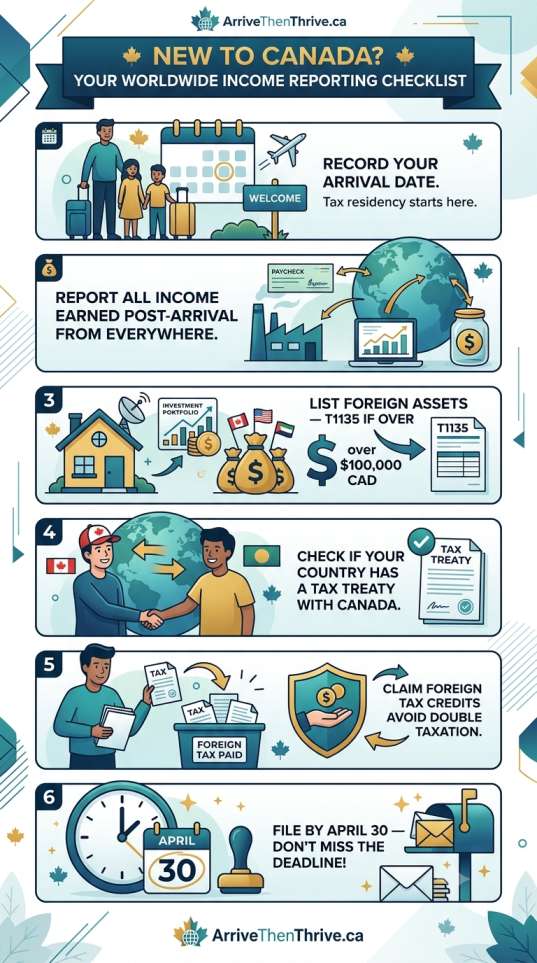
1. Document your arrival date. The CRA will use this to determine your first day of worldwide income reporting obligations. Keep copies of your entry stamp, landing record, or PR card.
2. Track all foreign income from your arrival date. Create a simple spreadsheet logging all income from foreign sources — amounts in the original currency and the Bank of Canada exchange rate used to convert to CAD.
3. Inventory your foreign assets. List every account, investment, property, or financial instrument you hold outside Canada. Note the original cost amount in CAD. This will determine whether you need to file T1135.
4. Identify if your home country has a tax treaty with Canada. Visit the Department of Finance Canada website and look up your country. If a treaty exists, understand its provisions for the types of income you have.
5. File on time. The standard filing deadline for individuals is April 30 of the year following the tax year. Self-employed individuals have until June 15, but any balance owing is still due April 30. T1135 follows the same deadline as your regular return.
6. Work with a cross-border tax professional. Your first tax return as a Canadian resident is arguably the most complex one you’ll ever file. The cost of a professional who specializes in newcomer or international taxation is well worth it relative to the penalties and missed credits that can result from errors.
📌 Source: CRA – Completing your return for newcomers to Canada
Frequently Asked Questions
Do I have to report foreign income if I never bring the money to Canada?
Yes. Canadian tax law is based on residency, not remittance. It doesn’t matter whether you transfer the money to a Canadian account or leave it sitting in a foreign bank — if you earned it while you were a Canadian tax resident, it must be reported.
What if I forgot to report foreign income in a previous year?
The CRA offers a Voluntary Disclosures Program (VDP) that allows taxpayers to come forward and correct past non-compliance. In many cases, penalties can be reduced or waived entirely if you self-report before the CRA contacts you. Acting proactively is always better than waiting to be audited.
📌 Source: CRA – Voluntary Disclosures Program
Does having a foreign bank account automatically mean I owe taxes?
No. Simply holding a foreign bank account is not a taxable event. However, any interest earned on that account is taxable in Canada from the date you became a resident. And if the account balance — along with other foreign assets — exceeds $100,000 CAD at any point in the year, it must be disclosed on Form T1135.
What exchange rate should I use to convert foreign income?
The CRA generally accepts the Bank of Canada’s average annual exchange rate for regular income, or the spot rate on the transaction date for one-time events like capital gains or property dispositions. The Bank of Canada publishes historical exchange rates on its website.
📌 Source: Bank of Canada – Exchange Rates
Conclusion: Knowledge Is Your Best Asset as a New Canadian
Navigating worldwide income reporting as a new Canadian resident can feel overwhelming — but it doesn’t have to be. The rules exist not to penalize newcomers, but to ensure Canada’s tax system is applied fairly based on where you live, not just where your money comes from.
The key takeaways to carry with you:
- Your worldwide income reporting obligation begins on your first day as a Canadian tax resident — not when you file your first return.
- Pre-arrival income is reported but not taxed in Canada; post-arrival income from all global sources is fully taxable.
- Canada’s network of nearly 100 tax treaties protects most newcomers from paying double taxes on the same income.
- Foreign Tax Credits are a powerful tool to reduce your Canadian tax when foreign taxes have already been paid.
- Form T1135 is mandatory if you held foreign property exceeding $100,000 CAD at any point in the year (exempt in your first year of residency).
- Penalties for non-compliance are real and can accumulate quickly — but voluntary disclosure options exist if you need to correct past filings.
You came to Canada to build a better life. Staying on top of your tax obligations is part of that foundation. Seek professional advice for your first few returns, stay organized, and don’t let tax anxiety be the thing that holds you back from thriving.
Welcome to Canada — now let’s make sure you keep what you’ve earned.
Additional Resources
- 🔗 CRA – Newcomers to Canada (Immigrants)
- 🔗 CRA – Determining Your Residency Status
- 🔗 CRA – Foreign Income Verification (T1135)
- 🔗 Department of Finance – Canada’s Tax Treaties
- 🔗 CRA – Voluntary Disclosures Program
- 🔗 Bank of Canada – Exchange Rates
Disclaimer
The information provided in this article is for general informational and educational purposes only and does not constitute professional tax, legal, or financial advice. Tax laws and CRA policies are subject to change, and individual circumstances vary significantly. ArriveThenThrive.ca and its contributors are not licensed tax advisors, accountants, or lawyers. Readers are strongly encouraged to consult a qualified Canadian tax professional — particularly one experienced in cross-border or newcomer taxation — before making decisions based on the information presented here. ArriveThenThrive.ca assumes no liability for errors, omissions, or outcomes resulting from reliance on the content of this article.
