
You’ve packed your life into suitcases, navigated visa paperwork, and finally landed in Canada. You’ve got a SIN number on the way, an address figured out, and a growing to-do list. And somewhere near the top of that list is three words that can feel surprisingly daunting: open a bank account.
Here’s the thing — Canada’s banking system is actually one of the most stable and well-regulated in the world. But it’s also layered. You’ve got the Big 5 banks dominating every major city corner, and then a growing number of online-only banks quietly offering deals that might make your jaw drop. So which do you choose?
In this guide, we break down exactly what Canada’s Big 5 banks and online banks each offer newcomers — including fees, newcomer programs, credit-building opportunities, and the smart strategy many new Canadians are quietly using to get the best of both worlds.
Understanding Canada’s Banking Landscape
Who Are the Big 5 Banks?
Canada’s banking sector is anchored by five major institutions — commonly called the “Big 5”:
- RBC (Royal Bank of Canada) — Canada’s largest bank, with over 1,100 branches and 4,000 ATMs nationwide
- TD (Toronto-Dominion Bank) — Over 1,000 branches, 2,500+ ATMs, and nearly 28 million customers worldwide
- BMO (Bank of Montreal) — Canada’s oldest bank (founded 1817), with nearly 2,000 branches and 5,700+ ATMs
- Scotiabank — Over 25 million customers across the Americas, with strong international ties
- CIBC (Canadian Imperial Bank of Commerce) — A national presence with broad newcomer support programs
You may also hear the term “Big 6,” which includes National Bank of Canada — a major institution with a strong foothold in Quebec and an increasingly competitive newcomer program.
Source: Wealthsimple — Best Banks in Canada Guide
The Rise of Online Banks in Canada
In the past decade, online-only banks — also called digital banks or direct banks — have reshaped what Canadians expect from banking. With no physical branches, these institutions pass their overhead savings directly to customers in the form of higher interest rates and $0 monthly fees.
The top online banks in Canada include:
- EQ Bank — The online arm of Equitable Bank, offering up to 2.75%+ interest on everyday chequing-savings hybrid accounts. Ranked #1 by Forbes in Canada (World’s Best Banks 2025)
- Tangerine — A wholly owned subsidiary of Scotiabank with nearly 2 million clients, offering no-fee chequing and competitive savings rates
- Simplii Financial — CIBC’s digital banking arm, offering no-fee chequing with access to 3,400+ CIBC ATMs
- Neo Financial — A fintech with high-interest savings and cashback rewards, serving 1.3 million+ clients
- KOHO — A hybrid fintech offering up to 3.5% interest on balances with strong budgeting tools
All major online banks mentioned are CDIC (Canada Deposit Insurance Corporation) members, protecting your deposits up to $100,000 CAD per eligible category. Source: CDIC — https://www.cdic.ca
Big 5 Banks vs Online Banks: A Head-to-Head Comparison
Let’s put the two options side by side across the factors that matter most to newcomers.
TABLE 1: Big 5 Banks vs Online Banks — Key Features for Newcomers to Canada
Feature | Big 5 Banks | Online Banks | Best For Newcomers? |
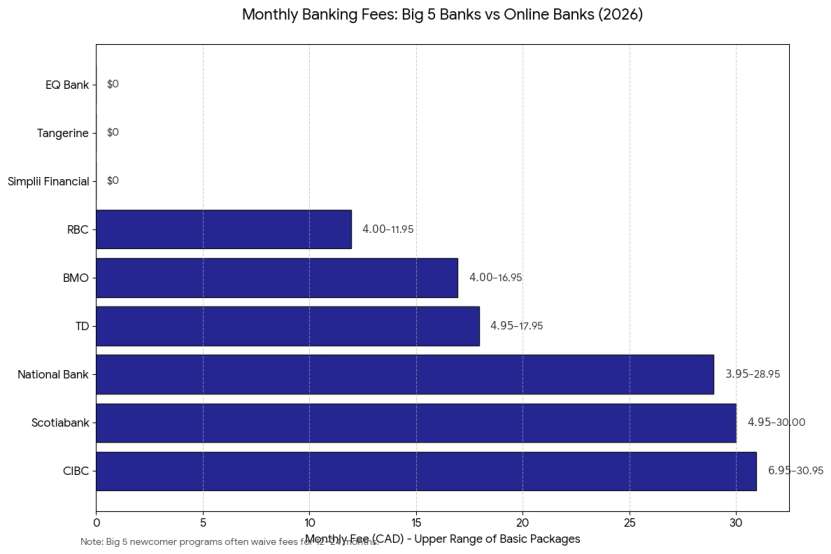
Monthly Fees | $4–$30.95/month | $0 (most) | Online Banks ✓ |
Savings Interest Rate | 0.05%–0.25% | 2.50%–3.50%+ | Online Banks ✓ |
Newcomer Programs | 6–24 months fee waiver | No dedicated programs (most) | Big 5 Banks ✓ |
Physical Branches | 1,000–5,000+ across Canada | None (digital only) | Big 5 Banks ✓ |
ATM Access | Extensive own network | Partner ATMs or fee-free nationwide | Tie |
Credit Building (no history) | Yes – newcomer credit cards | Limited | Big 5 Banks ✓ |
International Transfers | Moderate fees | Lower fees (e.g., EQ + Wise) | Online Banks ✓ |
Pre-Arrival Account Opening | Yes (most Big 5) | Varies | Big 5 Banks ✓ |
CDIC Insured | Yes | Yes (most) | Tie |
Mobile App Quality | Good | Excellent | Online Banks ✓ |
Sources: Wealthsimple, Savvy New Canadians, MoneySense, NerdWallet Canada, EQ Bank official website. Data current as of early 2026; always verify current rates with each institution.
The Newcomer Programs: What the Big 5 Are Actually Offering
Every major Canadian bank has a dedicated newcomer banking package, and they’re more competitive than you might expect. Here’s a bird’s-eye view:
TABLE 2: Newcomer Banking Programs at a Glance — Canada 2026
Bank | Program Name | Fee Waiver Duration | Credit Card Available? | Pre-Arrival? |
RBC | Newcomer Advantage | 12 months | Yes (up to $15,000 limit) | Yes |
TD | New to Canada Package | 12 months | Yes (3 card options) | Yes |
BMO | NewStart Program | 12 months+ | Yes | Yes |
Scotiabank | StartRight Program | 12 months | Yes | Yes |
CIBC | Smart Account for Newcomers | 24 months | Yes | Yes |
National Bank | Newcomer Banking Package | Up to 36 months | Yes (no credit history needed) | Yes (90 days before arrival) |
EQ Bank | N/A (open to all) | N/A – always $0 fees | No | Yes (online) |
Simplii Financial | N/A | N/A – always $0 fees | Yes (income req. applies) | Yes (online) |
Tangerine | N/A | N/A – always $0 fees | Yes (no annual fee) | Yes (online) |
Sources: Individual bank websites, Chexy.co, Spring Financial, MoneySense. Offers subject to change. Verify current terms directly with each institution.
Spotlight: CIBC — 24 Months Fee-Free
CIBC’s Smart Account for Newcomers stands out for its 24-month fee waiver — double what most competitors offer. You can open the account online before you arrive (through their Smart Arrival program), and you can earn up to $450 in bonuses by completing simple banking actions like setting up direct deposit. No Canadian credit history is required to apply for their newcomer credit card. (Source: CIBC New to Canada — https://www.cibc.com/en/personal-banking/ways-to-bank/newcomers-to-canada.html)
Spotlight: National Bank — Up to 3 Years Fee-Free
National Bank’s newcomer program is exceptional for its duration — up to 36 months with no fixed monthly fees, saving newcomers over $500 over the life of the program. The account can be opened 90 days before arriving in Canada. You also get access to a Mastercard credit card (no credit history needed) and a free year of phone assistance through their Assistance for Newcomers service, available 7 days a week. (Source: MoneySense — https://www.moneysense.ca/save/banking/the-best-banks-in-canada/)
Spotlight: Scotiabank StartRight — The International Bonus
Scotiabank’s StartRight program is especially well-suited to newcomers who need to move money internationally before and after arriving. You can open an international account online to transfer funds before you land. With over 4,000 ATMs and a potential value of up to $2,200 in bonuses in the first year, this is a strong option for those with existing international banking needs.
Why Online Banks Deserve a Spot in Your Banking Strategy
Once the newcomer fee-waiver period at your Big 5 bank ends, you’ll start paying $10–$30 a month just to keep your account open. That’s $120–$360 per year for the privilege of holding your money. Online banks, by contrast, charge nothing — ever.
The Interest Rate Gap Is Real
Here’s where online banks genuinely shine. As of early 2026:
- Big 5 savings accounts typically offer 0.05%–0.25% interest on balances
- EQ Bank’s Personal Account offers 2.75%+ interest — even on everyday chequing balances — when you set up a direct deposit
- Tangerine regularly runs promotional rates of 4%–5% for new customers on savings accounts
- KOHO’s hybrid account offers up to 3.5% interest depending on your subscription tier
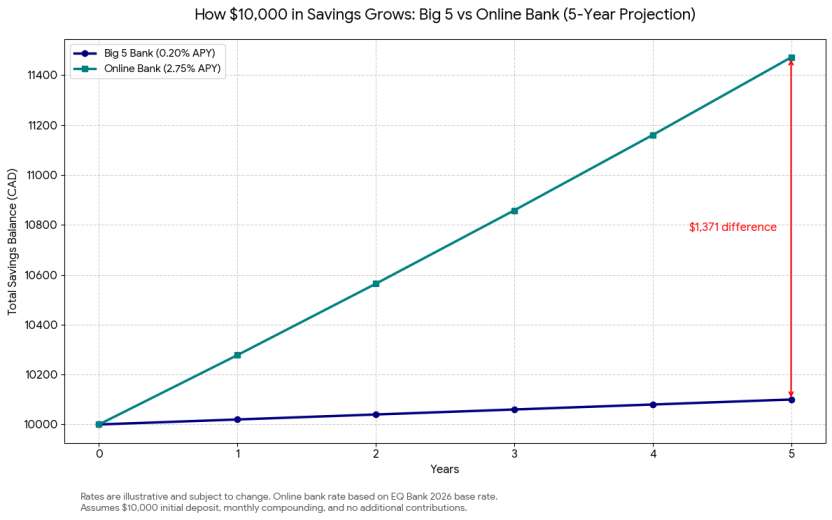
The math is simple: if you keep $10,000 in savings, a Big 5 bank might earn you $10–$25 in interest per year. EQ Bank at 2.75% earns you $275. Over five years, that difference compounds significantly.
Source: EQ Bank official website (https://www.eqbank.ca) and NerdWallet Canada — Best High-Interest Savings Accounts 2026
International Money Transfers — Lower Costs with Online Banks
Many newcomers regularly send money back home to family. This is another area where online banks gain ground. EQ Bank partners with Wise (formerly TransferWise) for international money transfers, consistently offering better exchange rates and lower fees than the Big 5’s standard wire transfer fees. According to EQ Bank’s own research (March 2025), their international transfer costs were substantially lower than those of Canada’s Big 5 banks when sending $500 CAD to India, the US, and France.
The Dual-Bank Strategy: What Smart Newcomers Are Doing
Here’s a practical secret that many financially savvy newcomers in Canada quietly figure out — usually after paying Big 5 fees for a year or two: you don’t have to choose just one bank.
The dual-bank strategy works like this:
- Open a Big 5 newcomer account first. Take advantage of the free banking period, use it to build a Canadian credit history with your newcomer credit card, and establish your direct deposit. These first 12–24 months are free anyway.
- Simultaneously, open an online bank account (EQ Bank, Tangerine, or Simplii). Park your savings there to earn significantly higher interest. Use it for bill payments and e-transfers where there are no fees.
- After your newcomer program ends, evaluate. By this point, you’ll understand your banking habits. Some newcomers keep both accounts indefinitely. Others consolidate to the online bank once their credit score is established.
This approach is endorsed by multiple Canadian personal finance sources including Savvy New Canadians and VisaVio Immigration Blog.
The underlying logic is sound: Big 5 banks give you legitimacy, branch access, and credit-building tools in your first critical months. Online banks give you better financial returns once you’re settled. You don’t have to sacrifice either.
Building Credit as a Newcomer: Why Your Bank Choice Matters

One of the most important financial moves you’ll make in Canada happens in your first 12 months: establishing a Canadian credit history. Without it, you can’t get a competitive mortgage rate, may struggle to rent an apartment without a co-signer, and will find loan applications difficult.
This is where the Big 5 banks have a clear structural advantage. Most of their newcomer programs allow you to apply for a credit card with no Canadian credit history required. These are real, unsecured credit cards — not secured cards that require a deposit — and they can come with credit limits of up to $15,000.
Credit-Building Tips for Newcomers
- Use your newcomer credit card for regular expenses (groceries, transit, phone) and pay it in full each month. This builds your score without accumulating interest.
- Keep your credit utilization below 30% — if your limit is $5,000, don’t carry more than $1,500 in balances.
- Set up automatic payments so you never miss a due date. Payment history is the single biggest factor in your credit score.
- After 6–12 months of good history, consider applying for a rewards credit card that earns points on everyday spending.
Online banks like EQ Bank and Tangerine generally don’t offer credit cards with newcomer-friendly underwriting, so for this specific goal, a Big 5 or National Bank newcomer program is hard to beat.
📌 For detailed guidance on building credit as a newcomer, see the Government of Canada’s financial literacy resources at: https://www.canada.ca/en/financial-consumer-agency.html
What to Watch Out For: Common Banking Pitfalls for Newcomers
Even with all the great newcomer offers available, there are a few traps that catch new Canadians off guard.
1. Forgetting to Track Your Free Period Expiry
Newcomer fee waivers last 12–24 months (or up to 36 months at National Bank). When the clock runs out, your account automatically starts charging monthly fees. Set a calendar reminder 2 months before your waiver expires to reassess your options.
2. Paying for a Chequebook You Don’t Need
Canadian banking still uses cheques in some contexts (paying rent, government payments), but many newcomers never actually need a full chequebook. If your bank charges $45–$85 for a cheque order, ask if there’s a digital alternative or if the occasional single cheque can be requested free.
3. Paying for International Transfers Without Comparing
If you’re regularly sending money home, always compare the total cost — not just the transfer fee, but the exchange rate markup. The Big 5 often add a 2.5%–3.5% markup to the mid-market exchange rate. Services like Wise, or EQ Bank’s Wise partnership, can save you meaningfully on each transfer.
4. Keeping Too Much in a Low-Interest Savings Account
With online banks offering 2.75%+ on everyday savings, keeping large cash balances in a Big 5 bank’s standard savings account (at 0.05–0.25%) is a quiet cost that adds up quickly over time. Once you’re settled, move your emergency fund and savings to a high-interest account.
Our Recommendation: A Practical Banking Plan for Your First Year in Canada
Based on what we know about newcomer needs, Canadian banking structures, and financial products available in 2026, here is our suggested approach:
- Before Arrival: Open a pre-arrival account with RBC, TD, Scotiabank, BMO, CIBC, or National Bank. You can do this online from your home country and have your debit card ready when you land.
- Week 1 in Canada: Get your SIN, set up direct deposit, and apply for your newcomer credit card. Use the card for daily expenses and pay it off each month.
- Month 1: Open a second account with EQ Bank, Tangerine, or Simplii Financial. Park your savings here to earn 10–50x more interest than the Big 5 rates.
- Month 6: Check your credit score (free via Borrowell or Credit Karma Canada). Open a TFSA (Tax-Free Savings Account) — ideally at your online bank where the interest rate is better.
- Month 12–24 (When Newcomer Waiver Ends): Decide whether to keep your Big 5 account (if you use branch services or prefer one institution), or consolidate fully to an online bank now that your credit history is established.
Final Thoughts: The Best Bank Is the One That Works for Your Life
There is no single “best” bank for every newcomer to Canada. Your ideal banking setup depends on how often you need in-person service, how much you’re saving, whether you’re regularly sending money abroad, and how quickly you want to build credit.
What we do know is this: the Big 5 banks give you infrastructure, legitimacy, and credit-building tools that are invaluable in your first year. Online banks give you better returns on your money and zero-fee banking once you’re settled. Used together, they form a financial foundation that can carry you well into your Canadian future.
Canada wants you here. Its banking system has adapted to welcome you. Now it’s your turn to make it work for you.
Key Takeaways
- Canada’s Big 5 banks (RBC, TD, BMO, Scotiabank, CIBC) offer dedicated newcomer programs with 12–36 months of fee waivers and credit cards requiring no Canadian credit history.
- Online banks (EQ Bank, Tangerine, Simplii) offer $0 monthly fees and interest rates 10–50x higher than Big 5 savings rates.
- The dual-bank strategy — Big 5 for credit building, online bank for savings — is widely recommended by Canadian personal finance experts.
- National Bank’s newcomer program (up to 3 years fee-free) and CIBC’s Smart Account for Newcomers (24 months fee-free) are among the strongest programs currently available.
- All major banks mentioned are CDIC-insured, meaning your deposits are protected up to $100,000 CAD.
- For international money transfers, online banks and services like Wise typically offer better rates than Big 5 banks.
⚠️ DISCLAIMER
The information provided in this article is for general informational purposes only and does not constitute financial, legal, or professional advice. Banking products, fees, interest rates, and promotional offers change frequently. Always verify current terms and conditions directly with the financial institution before making any banking decisions. ArriveThenThrive.ca is not affiliated with, sponsored by, or endorsed by any bank mentioned in this article. Readers are encouraged to consult with a licensed financial advisor for advice tailored to their individual circumstances.