


You’ve landed in Canada. You’ve found your footing — the apartment, the SIN card, the health card application. But somewhere between setting up your bank account and enrolling your kids in school, someone mentions you should “look into insurance.” And suddenly, you’re staring at terms like critical illness insurance and disability insurance, wondering what on earth the difference is — and whether you actually need either of them.
Here’s the honest truth: both types of insurance matter, but they serve very different purposes. And for newcomers especially, understanding the distinction can be the difference between financial security and a devastating setback if health strikes at the worst possible time.
In this guide, we break down critical illness vs. disability insurance in Canada, explain exactly how each one works, and help you figure out which makes the most sense for your situation as a newcomer — whether you arrived last month or five years ago.
What Is Critical Illness Insurance in Canada?
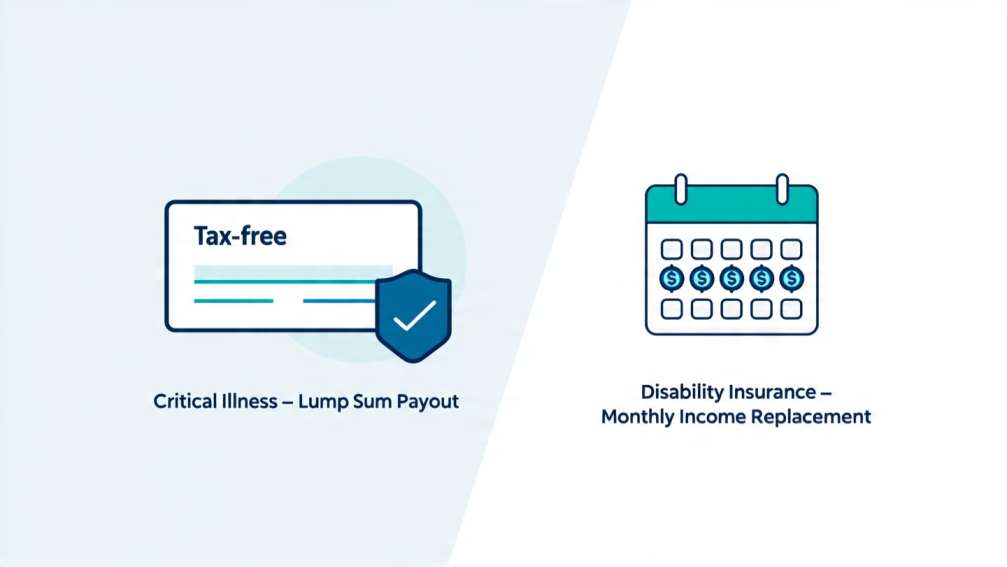
Critical illness (CI) insurance pays you a one-time, tax-free lump sum if you’re diagnosed with a serious medical condition covered under your policy — things like cancer, a heart attack, or a stroke. Crucially, it doesn’t matter whether you can still work or not. The moment you’re diagnosed with a covered condition and survive a waiting period (typically 30 days), the money is yours to use however you need.
Critical illness insurance pays you a tax-free lump sum benefit if you are diagnosed with one of the illnesses covered by the policy. That means you could use it to pay off debt, cover household bills, fund a trip back home to recover with family, or hire home care — whatever your situation demands.
What Conditions Are Typically Covered?
A typical critical illness insurance policy in Canada will cover around 20 serious conditions, such as stroke, cancer, organ failure, paralysis, loss of limb, multiple sclerosis, severe neurological conditions (ALS, advanced Parkinson’s), and heart attacks. Some basic plans cover only five conditions, while comprehensive plans may cover 25 or more.
The three conditions that drive the most claims in Canada are cancer, heart attack, and stroke. If your family has a history of any of these, CI insurance deserves serious consideration.
How Much Does Critical Illness Insurance Cost in Canada?
Premiums range from $15 for younger and healthier individuals to $385 per month for seniors with health issues. For most newcomers in their 30s and 40s who are in good health, the general range for non-smokers is $25 to $200 per month, with the biggest factor being your age.
One important stat worth knowing: over 80% of critical illness insurance policies are paid out, and that number is growing. That’s a remarkably high payout rate compared to most insurance products — meaning this isn’t a “just in case” product that rarely delivers. The odds are real.
What Is Disability Insurance in Canada?
Disability insurance is fundamentally different. Instead of a one-time payment, it provides ongoing monthly income replacement if an illness or injury prevents you from working. Think of it as a substitute paycheck.
Disability insurance is a contract where you pay premiums to an insurance company. In return, the insurer promises to pay you a fixed monthly benefit if you become disabled and can’t work. Disability insurance coverage has only one goal: to replace a portion of your monthly income if you cannot earn a paycheck because of injury or illness.
This is the coverage that keeps the lights on and the rent paid while you’re recovering — not just in the early weeks, but potentially for years.
What Does Disability Insurance Actually Cover?
Unlike critical illness insurance, disability coverage isn’t tied to a specific list of diagnoses. Disability insurance coverage is not based on a specific diagnostic list, but rather on your inability to work. This is a big deal. It means mental health conditions like severe anxiety, depression, and PTSD can be covered — conditions that critical illness insurance typically excludes.
Most employer policies are for short-term disability (6 to 12 months), whereas private policies in Canada cover long-term disability (years of payouts) for stronger financial protection.
How Much Does Disability Insurance Cost?
Costs vary widely based on your occupation, income, waiting period, and benefit period. For newcomers who are self-employed or work in physically demanding roles, expect to pay more. Generally, disability insurance tends to be pricier than critical illness insurance because payouts last much longer.
TABLE 1: Critical Illness vs. Disability Insurance — Side-by-Side Comparison
| Feature | Critical Illness Insurance | Disability Insurance |
|---|---|---|
| Payout Type | One-time tax-free lump sum | Monthly income replacement |
| Trigger | Diagnosis of a covered condition | Inability to work due to illness/injury |
| Payout Amount | $25,000 – $2,000,000 (you choose) | 60–85% of your gross income |
| Covers Mental Health? | Generally no | Yes (anxiety, depression, PTSD) |
| Must Stop Working? | No — you can still work and collect | Yes — inability to work is required |
| Waiting Period | ~30 days post-diagnosis | 30–120 days (elimination period) |
| Benefit Duration | One-time only | Months to age 65, depending on policy |
| Taxable? | No | No (if premiums paid personally) |
| Typical Monthly Cost | $25–$200 (non-smoker, age 30–45) | Varies; often higher than CI |
| Best For | Lump-sum needs (debt, recovery costs) | Ongoing income replacement |
Sources: PolicyMe, PolicyAdvisor, Dundas Life, RBC Insurance
Why Newcomers to Canada Are Uniquely Vulnerable
Most newcomers arrive in Canada in their working prime — energetic, motivated, and healthy. Insurance is the last thing on the mind. But there are specific financial vulnerabilities that make health protection more urgent for newcomers than for long-established Canadians.
No employment history = no group benefits. Employer-sponsored disability coverage is one of the most common sources of income protection in Canada. But if you’re just starting out, working contract roles, or building your own business, that safety net simply isn’t there yet.
No extended family support network. Long-established Canadians often have family nearby who can help during a health crisis — financially or practically. Most newcomers don’t have that. A serious illness can hit harder when you’re navigating it alone in a new country.
Limited savings cushion. The first few years in Canada are often about establishing credit, paying off relocation costs, and building an emergency fund. A prolonged illness during this phase could be catastrophic without insurance.
Provincial health insurance doesn’t cover everything. The average out-of-pocket expenses for cancer in Canada is around $400 a month. Government healthcare covers hospital and doctor visits — but not lost income, private nursing, home care, medications not on provincial formularies, or the cost of a family member flying in to help you recover.
iA Financial Group notes that nearly half of their new clients are newcomers like yourself, and they offer products specifically designed without requiring immigration documents for most applicants. The insurance industry has recognized this market — which means there are now more newcomer-friendly products than ever.
How Newcomers Can Actually Qualify
This is where many newcomers get discouraged — they assume their immigration status will disqualify them. In most cases, that assumption is wrong.
Most newcomers in Canada can get critical illness insurance. This is a type of insurance that pays you a lump sum of money if you develop a serious illness. But there might be some restrictions and rules.
iA Financial Group’s Superior Program offers disability insurance with no minimum income requirement — a rare feature in this market. It accommodates a broad spectrum of occupations and is particularly welcoming to newcomers to Canada, who often face barriers with more traditional underwriting.
Key things to know:
- Permanent residents typically qualify for the same coverage as Canadian citizens.
- Work permit holders can access most private insurance plans, though some limits may apply.
- International students can qualify for life insurance up to $500,000 in some cases, and can often access critical illness riders.
- Pre-existing conditions may cause exclusions or higher premiums — but not always full denial. Be honest on your application; non-disclosure can void future claims.
Real Scenarios: Which Insurance Would Have Helped?
Sometimes the best way to understand these products is to see them in action. Here are three realistic newcomer scenarios:
Scenario 1: Priya, Software Developer, Ontario (PR Holder)
Priya, 36, moved from Bangalore two years ago. She has no employer benefits at her startup job. Six months after arriving, she’s diagnosed with early-stage breast cancer. She can still work part-time but needs frequent medical appointments and has significant out-of-pocket medication costs.
What helps: Critical illness insurance. Even though Priya can work, her CI policy pays out a $100,000 lump sum that she uses to cover medications, hire a part-time assistant, and take unpaid leave for treatment without depleting her savings. Disability insurance alone would not have triggered because she can still work.
Scenario 2: Mohammed, Construction Worker, Alberta (Work Permit)
Mohammed, 42, hurt his back on a job site and cannot work for 14 months. His workers’ compensation covers some income, but gaps remain and he worries about what happens if the injury extends beyond the WCB period.
What helps: Disability insurance. His monthly benefit replaces 70% of his income during the recovery period, ensuring rent and groceries are covered. Critical illness insurance would not apply here — a back injury typically isn’t a listed “critical illness.”
Scenario 3: Jing, Restaurant Owner, BC (Permanent Resident)
Jing, 49, is self-employed with no group benefits. She has a heart attack and can’t run her restaurant for 8 months. She needs home care, has ongoing cardiac medications, and her business loses significant revenue.
What helps: Both. Her critical illness policy delivers a $150,000 lump sum immediately. Her disability policy replaces a portion of her business income during the 8-month recovery. Neither alone would have been sufficient for her situation.
Which One Should Newcomers to Canada Choose First?
There’s no universal answer, but here’s a practical framework based on your situation:
Choose disability insurance first if:
- You are employed (full-time, part-time, or contract) and your income is your household’s primary resource
- Your savings could not cover more than 3–4 months of expenses
- You work in a physical occupation where injury risk is real
- You are self-employed with no group benefits or EI coverage
Choose critical illness insurance first if:
- You have a family history of cancer, heart disease, or stroke
- You have an emergency fund that could handle ongoing monthly expenses but not large one-time medical costs
- You have a mortgage, dependents, or debt that would be at risk if you needed to stop working suddenly
- Your budget is tight — CI premiums are often lower than disability premiums for comparable coverage amounts
Consider both if:
- You are self-employed or run your own business
- You have dependents (especially children or an elderly parent)
- You are in your 40s or older, when risk of both disability and critical illness rises meaningfully
- You can afford combined premiums (bundling often comes with a discount)
TABLE 2: Which Insurance Fits Your Newcomer Profile?
| Your Situation | Recommended Priority |
|---|---|
| Self-employed, no group benefits | Disability insurance (primary) + CI if budget allows |
| Employed with basic group benefits | CI insurance to fill the lump-sum gap |
| Young, healthy, tight budget | CI insurance (lower premiums, high payout probability) |
| Family history of cancer or heart disease | CI insurance (priority) |
| Physical or demanding occupation | Disability insurance (priority) |
| Building savings / limited cash reserves | Disability insurance (monthly protection) |
| Permanent resident with mortgage/dependents | Both — stagger purchase if needed |
| International student / work permit holder | CI insurance (easier to qualify for) |
How to Apply for Insurance as a Newcomer
The process is simpler than most newcomers expect. Here’s how to approach it:
1. Gather your documents. Most insurers do not require immigration documentation. You’ll need government-issued ID, your SIN (if available), and health history information.
2. Be honest about your health history. Pre-existing conditions may affect your premiums or create exclusions — but dishonesty on an application can result in a claim being denied later, which is far worse. According to Munich Re’s 2024 Individual Insurance survey, 17% of critical illness insurance claims submitted between 2019 and 2023 were denied, and 71% of those denied claims were denied due to failure to meet the condition definition or because the claimed condition was not covered. Reading the fine print carefully matters enormously.
3. Compare at least three providers. Major providers offering newcomer-friendly plans include Canada Life, Sun Life, Manulife, RBC Insurance, iA Financial Group, and Desjardins. Broker platforms like PolicyAdvisor and PolicyMe let you compare quotes in one place.
4. Consider working with an advisor who specializes in newcomers. The nuances of coverage eligibility, immigration status rules, and policy riders are complex. An advisor familiar with newcomer financial planning can save you time and money.
5. Start small if budget is a constraint. Some coverage is always better than none. A $50,000 CI policy or a modest disability benefit is a meaningful safety net, even if it’s not your ideal coverage level.

Key Takeaways for Newcomers
Here’s what to walk away with from this guide:
- Critical illness insurance gives you a tax-free lump sum if you’re diagnosed with a covered condition. It doesn’t require you to stop working and is ideal for large one-time needs — debt, recovery costs, or replacing savings.
- Disability insurance replaces a portion of your monthly income if illness or injury stops you from working. It’s your most important safety net if you’re self-employed or have no employer group plan.
- Neither replaces the other. They cover different risks. A back injury won’t trigger CI; a cancer diagnosis may not trigger disability (if you can still work).
- Newcomers can qualify — even without years of Canadian credit history. Many insurers don’t require immigration documents for most products.
- Start early. Premiums are lower when you’re younger and healthier. Waiting until you “feel you need it” usually means paying more or getting excluded for a condition that’s already developed.
- Be honest on your application. Exclusions from pre-existing conditions are manageable. Denied claims from non-disclosure are devastating.
Conclusion: The Right Answer Depends on Your Life
There’s no single “better” option between critical illness and disability insurance for newcomers in Canada. The better question is: What financial risk can you least afford right now?
If losing your monthly income would mean not being able to pay rent, disability insurance should come first. If a serious diagnosis would drain your savings or force you into debt, critical illness insurance is your priority. And if you can manage both — even with modest coverage amounts — you’ll have built one of the most important financial foundations possible for your life in Canada.
You’ve already taken one of the hardest steps by moving here. Making sure your financial future is protected is the next step toward truly thriving.
To compare current quotes from licensed Canadian insurers, visit PolicyAdvisor, PolicyMe, or Ratehub.
Sources & References
- PolicyAdvisor – Critical Illness vs. Disability Insurance in Canada:
- PolicyMe – Critical Illness vs. Disability Insurance:
- Dundas Life – Critical Illness vs. Disability Insurance in Canada:
- RBC Insurance – Critical Illness vs. Disability Insurance:
- iA Financial Group – Newcomers Insurance:
- Munich Re – 2024 Individual Insurance Survey:
- HelloSafe – Best Disability Insurance in Canada:
- Ratehub – Critical Illness Insurance Quotes:
- CLHIA (Canadian Life and Health Insurance Association):
Disclaimer
The information provided in this article is for general informational and educational purposes only and does not constitute financial, legal, or insurance advice. ArriveThenThrive.ca is not a licensed insurance broker or financial advisor. Every individual’s situation is unique, and insurance eligibility, premiums, and coverage terms vary by provider, province, and personal circumstances. Please consult a licensed insurance advisor or financial professional before making any insurance purchasing decisions. Information is believed to be accurate as of the date of publication but may be subject to change. Always verify current terms and conditions directly with your insurance provider.
