


You’ve just arrived in Canada. You have a job lined up, a place to stay, and a world of possibilities ahead. But when you walk into a bank or try to rent an apartment, you hit an invisible wall: you have no Canadian credit history.
It’s a frustrating catch-22 that almost every newcomer faces — you need credit to get credit. But here’s the thing: this challenge is completely solvable, and thousands of immigrants do it successfully every single month.
In this guide, you’ll learn exactly how to build your credit score in Canada from zero, step by step, even if you’ve never had a Canadian credit card, loan, or bank account. Whether you’re a permanent resident (PR), an international student, or a temporary foreign worker, this roadmap is designed specifically for you.
It typically takes 3–6 months to establish your first Canadian credit score, and 12–18 months of consistent habits to reach the “good” range (700+). The sooner you start, the faster you get there. [Source: Scotiabank / Moving2Canada]
QUICK FACT
What Is a Credit Score in Canada — and Why Does It Matter?
Before diving into strategies, it’s worth understanding what you’re actually building. In Canada, your credit score is a three-digit number ranging from 300 to 900, calculated by two major credit bureaus: Equifax and TransUnion. The higher the number, the more trustworthy you appear to lenders, landlords, and even some employers.
Canada’s credit scoring system does not automatically recognize foreign credit histories. This means that even if you had a perfect credit record in India, the Philippines, Nigeria, or anywhere else, you’re starting at zero here. [Source: RBC]
Your credit score affects:
- Whether you can rent an apartment (many landlords require a credit check)
- Whether you qualify for a car loan — and at what interest rate
- Your eligibility for a mortgage when you’re ready to buy a home
- Access to credit cards with rewards, travel points, or cashback
- Occasionally, pre-employment checks in certain industries
TABLE 1: Canadian Credit Score Ranges and What They Mean
Score Range | Rating | What It Means for Newcomers |
300 – 559 | Poor | Very limited access to credit; high-risk flag for lenders |
560 – 659 | Fair | Basic credit products accessible; higher interest rates apply |
660 – 724 | Good | Qualifies for most loans and credit cards at reasonable rates |
725 – 759 | Very Good | Access to better rates; mortgage applications look strong |
760 – 900 | Excellent | Best rates, premium cards, and mortgage pre-approvals |
No File / 0 | New Entrant | Where most newcomers start — not ‘bad’, just unknown |
Source: Equifax Canada / TransUnion Canada
Step 1: Get Your Financial Foundations in Place
Open a Canadian Bank Account First
Before you can build credit, you need a bank account. This is your financial foundation in Canada. The good news: you can open a chequing account with just your passport and proof of status (such as your COPR, study permit, or work permit) — no credit history required.
Canada’s Big Five banks (RBC, TD, Scotiabank, BMO, and CIBC) all offer dedicated newcomer banking packages with reduced or waived fees. These programs are designed exactly for people in your situation, and many include a path to your first credit card without needing a Canadian credit score.
Walk into a branch, mention you’re a newcomer, and ask specifically about their “Newcomer Package.” These programs often include a no-fee chequing account, a secured or newcomer credit card, and access to a bilingual advisor who speaks your language.
💡 PRO TIP
Apply for a Social Insurance Number (SIN)
Your Social Insurance Number is required to work in Canada, access government benefits, and open credit accounts. Apply for it at a Service Canada centre (bring your passport and immigration documents) or online at canada.ca. Without a SIN, most credit applications won’t proceed. [Source: Government of Canada ]
Step 2: Get Your First Credit Product
Option A: Newcomer Credit Cards (Best Starting Point)
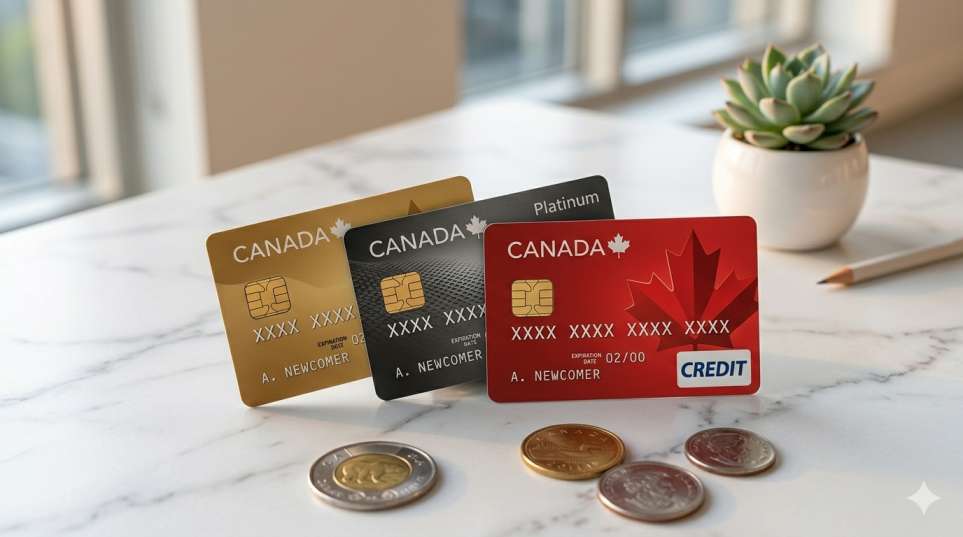
Several major banks offer credit cards specifically designed for newcomers who have no Canadian credit history. These are among the most accessible first products available to you:
- RBC Cash Back Mastercard for Newcomers — available through the RBC Newcomer Advantage package
- Scotiabank StartRight Program — includes the Scene+ Visa Card for newcomers
- TD New to Canada Banking Package — includes a TD Cash Back Visa Card
- BMO NewStart Program — includes a BMO cashback Mastercard for new residents
- CIBC Smart Account for Newcomers — pairs well with their CIBC Dividend Visa
These cards are specifically designed to allow approval without a Canadian credit history, removing the biggest barrier newcomers face.
Option B: Secured Credit Cards
If you’re not eligible for a newcomer card right away — or if you want a guaranteed approval — a secured credit card is your next best option. With a secured card, you deposit a refundable amount (typically $300–$1,000) that becomes your credit limit. You use the card like any other credit card, and the bank reports your payment behaviour to the credit bureaus, building your score.
Make sure the secured card you choose reports to both Equifax AND TransUnion. Some products only report to one bureau, which limits how widely your credit history is seen. Always confirm this before applying.
⚠️ Important
Option C: Credit-Builder Programs
Fintech companies like KOHO, Refresh Financial, and Borrowell offer credit-builder products that are ideal if you want to establish credit without a traditional bank account. KOHO’s Credit Building option, for example, charges a small monthly fee (around $10) and reports your on-time payments to credit bureaus. These can complement — not replace — a traditional credit card.
Step 3: Use Credit Wisely — The Habits That Build Your Score
Getting the credit card is the easy part. What you do with it determines how fast — and how high — your score climbs. Here are the most important habits to adopt from day one:
Always Pay On Time — No Exceptions
Payment history is the single most influential factor in your credit score, accounting for roughly 35% of the total calculation. Even one missed payment can stay on your credit report for up to six years and significantly drag down a score you’ve spent months building. [Source: Financial Consumer Agency of Canada ]
The simplest solution: set up automatic payments from your chequing account to pay at least the minimum amount due on your credit card each month. Ideally, pay the full balance to also avoid interest charges.
Keep Your Credit Utilization Below 30%
Credit utilization is the percentage of your available credit limit that you’re using at any time. If your credit card has a $1,000 limit, try to keep your outstanding balance below $300. High utilization — say, consistently sitting at 80–90% of your limit — signals financial stress to lenders and actively hurts your score.
Pro tip: Make multiple small payments throughout the month rather than waiting for the due date. This keeps your reported balance low, even if you’re spending regularly on the card.
Don’t Apply for Too Much Credit at Once
Every time you formally apply for a new credit product, the lender performs a “hard inquiry” on your credit file. Hard inquiries temporarily lower your score by a few points and remain visible for up to 12 months. Multiple applications in a short period can signal desperation to lenders and compound the effect.
The strategy: get one good credit product, use it well for 6–12 months, and only then consider adding a second product (like a retail credit card or small personal loan) to diversify your credit mix.
Step 4: Leverage ‘Hidden’ Credit-Building Opportunities
Beyond credit cards, Canada has several underutilized tools that newcomers can use to accelerate their credit-building journey.
Report Your Rent Payments
Rent is typically the largest monthly expense for newcomers, yet it doesn’t automatically appear on your credit report. Services like Borrowell Rent Advantage and FrontLobby allow tenants to register their rental address and have on-time rent payments reported to Equifax, building credit from a payment you’re already making. [Source: Borrowell]
Get a Postpaid Cell Phone Plan
Most major Canadian carriers (Rogers, Bell, Telus, and their subsidiaries like Fido, Koodo, and Freedom) report monthly postpaid plan payments to the credit bureaus. Signing up for a postpaid plan — as opposed to prepaid — and paying on time each month quietly adds positive payment history to your file.
Keep Your Oldest Account Open
The length of your credit history matters. Your first Canadian credit card should be kept open essentially forever — even if you rarely use it. Closing it removes years of history from your report and can cause your score to drop, especially in the early years when every month of history is precious.
Your First-Year Credit Building Timeline
Here’s a realistic roadmap that thousands of newcomers follow to go from no credit history to mortgage-ready in under two years:
TABLE 2: Newcomer Credit-Building Roadmap — Month by Month
Timeframe | Action | Expected Score Range | Key Milestone |
Month 1 | Open newcomer bank account; apply for first credit card or secured card | No File | Credit file created at Equifax/TransUnion |
Month 2–3 | Use card for small purchases; pay full balance each month; set up auto-pay | No File → ~300–560 | First score appears (usually around Month 3) |
Month 4–6 | Maintain low utilization (<30%); enroll in rent reporting if renting | 560–620 | Score is now visible to lenders — ‘fair’ range |
Month 7–12 | Add a postpaid phone plan; continue perfect payment history | 620–680 | “Good” credit territory; eligible for better cards |
Year 1–2 | Consider a second credit product (retail card or small loan); never miss a payment | 680–740+ | Pre-approved mortgage conversations become realistic |
Year 2+ | Apply for unsecured premium credit card; review annual credit report for errors | 740–800+ | “Very Good” to “Excellent” — full financial access |
Timeline estimates based on consistent, on-time payments and low credit utilization. Individual results vary. Sources: Paul Abraham IC | Scotiabank
Common Mistakes Newcomers Make (And How to Avoid Them)
Even well-intentioned newcomers can accidentally sabotage their credit score. Here are the most common pitfalls — and how to sidestep them:
- Applying for multiple credit cards at once — Each application is a hard inquiry. Stick to one product at a time, especially in your first year.
- Paying only the minimum balance — While this avoids late payment penalties, carrying a high revolving balance signals risk and raises utilization.
- Closing your first credit card — As mentioned above, this erases your credit history length. Keep it open, even with a $0 balance.
- Using more than 70–80% of your credit limit — High utilization is the #1 reason newcomers with perfect payment history still have low scores.
- Not monitoring your credit report — Errors happen. Request a free copy of your credit report from Equifax (equifax.ca) or TransUnion (transunion.ca) at least once a year, or use free monitoring tools like Borrowell or Credit Karma Canada.
- Ignoring a bill because it seems small — Even a single missed utility or phone bill can damage a thin credit file disproportionately.

Real-World Scenario: Priya’s Credit Journey
To make this tangible, let’s walk through a realistic newcomer story.
Priya arrived in Toronto from India in January on a post-graduate work permit. She had an excellent credit history back home, but in Canada, she was starting from zero. Here’s what she did:
- Week 1: Opened an RBC newcomer chequing account at a branch near her apartment.
- Week 2: Applied for the RBC Cash Back Mastercard for Newcomers — approved for a $1,000 limit, no Canadian credit history required.
- Month 2: Set up her phone with Fido on a postpaid plan (monthly payments started reporting to credit bureaus).
- Month 3: Used her credit card for groceries and transit only (~$200–$250/month). Paid the full balance each month. Her first score appeared: 612.
- Month 6: Enrolled in Borrowell Rent Advantage to report her $1,800/month rent. Score climbed to 658.
- Month 12: Score reached 701. She applied for the RBC Avion Visa Infinite card and was approved, gaining access to travel rewards.
- Month 18: With a score of 730+, Priya began conversations with a mortgage broker about pre-approval options.
Priya’s path wasn’t magic — it was consistency. No missed payments, no high balances, no unnecessary applications. If you follow the same principles, her outcome can be yours too.
Free Tools to Monitor Your Credit Score in Canada
You should check your credit score regularly — and the good news is, checking it yourself is a ‘soft inquiry’ and never hurts your score. Here are the best free options:
- Borrowell (borrowell.com) — Free weekly Equifax score updates; also offers rent reporting
- Credit Karma Canada (creditkarma.ca) — Free TransUnion score updates
- Equifax Canada (equifax.ca) — Free annual credit report; paid ongoing monitoring available
- TransUnion Canada (transunion.ca) — Free annual credit report access
- KOHO (koho.ca) — Free credit score with paid credit-building subscription
Conclusion: Your Credit Score Is Yours to Build
Starting your financial life in Canada from zero isn’t a disadvantage — it’s a clean slate. Every payment you make on time, every month you keep your balance low, and every year you maintain your accounts adds to a credit file that becomes one of your most valuable financial assets in Canada.
The system is more accessible to newcomers today than ever before, with dedicated bank programs, rent-reporting platforms, and fintech tools that didn’t exist a decade ago. You don’t need a perfect financial history from abroad — just consistent, informed habits from your first week here.
The most important thing? Start today. Open that bank account. Apply for that first card. Set up that auto-payment. Your future self — the one trying to rent a nicer apartment, finance a car, or buy a home — will thank you for the groundwork you lay right now.
In Canada, your credit score is not just a number. It’s a passport to financial opportunity. Treat it as one of the most important documents you’ll build in your new home.
🇨🇦 Remember
Key Takeaways
- Your foreign credit history does not transfer to Canada — you start fresh, regardless of your home country score
- Open a newcomer bank account and apply for a newcomer or secured credit card as your very first steps
- Pay your full balance every month and keep credit utilization below 30%
- Use rent reporting services and postpaid phone plans to build credit from existing expenses
- Avoid multiple credit applications; space them at least 6–12 months apart
- Monitor your credit score for free using Borrowell or Credit Karma Canada
- Expect your first visible score around Month 3, a ‘good’ score around Month 12, and mortgage-ready credit by Year 2
DISCLAIMER
The information provided in this article is for general informational and educational purposes only. It does not constitute financial, legal, or professional advice. Credit products, bank programs, interest rates, and eligibility criteria change frequently and may vary based on your individual circumstances, province of residence, and immigration status. Always consult a licensed financial advisor, credit counsellor, or your bank directly before making financial decisions. ArriveThenThrive.ca makes no representations or warranties of any kind regarding the accuracy, completeness, or timeliness of the information contained herein. Links to third-party websites are provided for convenience only and do not constitute an endorsement.
