


You’ve made it to Canada. You’re enrolled (or thinking about enrolling) in a program, and somewhere between calculating tuition and figuring out rent, someone mentions OSAP — the Ontario Student Assistance Program. A small flicker of hope lights up: could this help me?
It’s one of the most common questions international students ask when they arrive in Ontario, and honestly, it makes complete sense. OSAP is everywhere in conversation — Canadian-born classmates talk about it, it’s posted on university financial aid pages, and it sounds like exactly the kind of program that could take the edge off some very real financial pressure.
So let’s be direct, give you the full picture, and — importantly — make sure you walk away knowing exactly what your real options are, even if OSAP itself is off the table.
By the end of this article, you’ll understand what OSAP actually is, why most international students don’t qualify, who does qualify (the answer might surprise you), and a clear, actionable list of funding alternatives that are specifically designed for people in your situation.
What Is OSAP, Really?
Before getting into eligibility, it helps to understand what you’re actually dealing with.
OSAP — the Ontario Student Assistance Program — is a joint federal and provincial government financial aid program designed to help Ontario residents afford post-secondary education. When you apply, you’re automatically considered for two types of funding:
Grants — Money you never have to repay. These are based on financial need and can cover tuition, books, and living costs.
Loans — Borrowed money you repay after graduation. The federal portion accrues interest after you leave school, while the Ontario portion has been interest-free since April 2023.
The program is administered through the Ontario government’s official portal at ontario.ca/osap and assessed annually based on your income, family size, program, and course load.
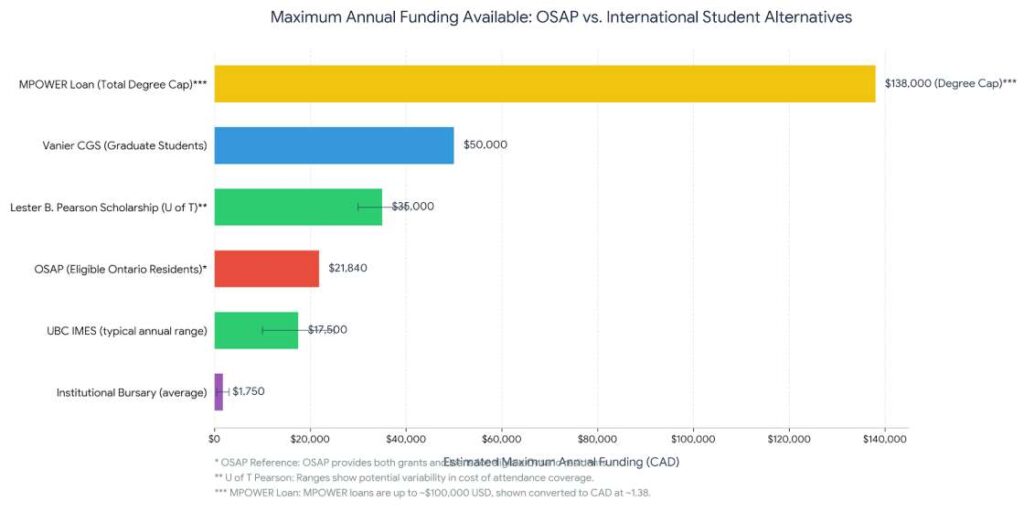
OSAP funding amounts are substantial. For the 2025–2026 academic year, single full-time students can receive up to $525 per week, while students with spouses or dependents may qualify for up to $865 per week. Over an eight-month academic year, that can translate to over $20,000 in combined grants and loans — real money that makes a material difference for eligible students.
Can International Students Apply for OSAP?
Here is the direct, unambiguous answer: No. International students are not eligible for OSAP.
This is confirmed across every official source. As stated directly on the University of Waterloo’s financial aid page and the Government of Ontario’s official OSAP documentation: to be eligible for OSAP, you must be a Canadian citizen, permanent resident, or protected person/convention refugee. International students studying on a study permit are explicitly excluded.
This isn’t a technicality or a fine-print issue — it’s a foundational eligibility requirement. No matter how long you’ve been in Canada, how high your GPA is, or how significant your financial need may be, a study permit alone does not make you eligible for OSAP.
TABLE 1: OSAP Eligibility by Immigration Status
| Immigration Status | OSAP Eligible? | Notes |
|---|---|---|
| Canadian Citizen | ✅ Yes | Must also meet Ontario residency requirements |
| Permanent Resident | ✅ Yes | Must have lived in Ontario 12+ consecutive months (not as a full-time student) |
| Protected Person / Convention Refugee | ✅ Yes | Eligible once Ontario residency is established |
| International Student (Study Permit) | ❌ No | Explicitly excluded from all OSAP funding |
| Visitor Visa | ❌ No | Not eligible |
| Work Permit Holder | ❌ No (generally) | May qualify if PR is also held |
| Refugee Claimant (pending) | ❌ No | Must have approved protected person status |
Sources: University of Waterloo Financial Aid, Government of Ontario – Learn About OSAP, Settlement.org
The Grey Area: When Immigration Status Changes Everything
Here’s where things get genuinely interesting — and where a lot of people get confused.
If you arrived in Canada as an international student but have since transitioned to permanent resident status, your relationship with OSAP changes completely. Permanent residents are fully eligible for OSAP, provided they also meet Ontario’s residency requirements.
What does Ontario residency mean for OSAP?
You need to have lived in Ontario for at least 12 consecutive months — and time spent as a full-time post-secondary student does not count toward that 12-month window. This is an important nuance. If you became a PR and then immediately enrolled full-time in college, that year of study doesn’t satisfy the residency clock.
However, if your spouse or common-law partner has lived in Ontario for 12 consecutive months (not as a full-time student), you may qualify through that relationship, even if you personally haven’t met the residency timeline.
Practical scenario: Maria came to Toronto on a study permit in 2022, graduated in 2024, and applied for PR through the Ontario Immigrant Nominee Program. She received her PR in early 2025 and spent a year working in Ontario before starting a graduate program in fall 2026. She would now meet both the citizenship and Ontario residency requirements for OSAP.
This is why it’s so important to understand your current immigration status — not just what you came in on.
Why Does OSAP Exclude International Students?
This question comes up constantly, and it deserves a real answer rather than a shrug.
OSAP is a publicly funded provincial and federal government program. Its mandate is to support Ontario residents — people who pay taxes here, plan to build their lives here, and contribute to Ontario’s long-term economic fabric. Funding is finite, and the program is designed with that residency-based social contract in mind.
That said, the policy isn’t without criticism. Canada relies heavily on international students to sustain its post-secondary institutions financially — international tuition rates are often three to four times higher than domestic rates — yet the same students face significant funding gaps with limited government support. It’s a tension that researchers and advocacy groups have noted frequently.
For now, though, the rules are clear. The focus for international students needs to shift quickly to what is available.
What Are Your Real Funding Options? (The Alternatives That Actually Work)
Not qualifying for OSAP doesn’t mean you’re on your own. There’s a legitimate ecosystem of financial support for international students in Canada — it’s just more decentralized and requires more proactive effort.
1. Institutional Scholarships and Entrance Awards
This is where the biggest opportunities often live, and many students underutilize them.
Canadian universities and colleges offer a significant volume of scholarships specifically for international students — some need-based, many merit-based. A few standout examples:
Lester B. Pearson International Scholarship (University of Toronto) — Covers full tuition, residence, books, and incidentals for four years. Only 37 students are selected globally each year. Extraordinarily competitive, but life-changing for those who receive it.
UBC International Major Entrance Scholarship (IMES) — Awards ranging from $10,000–$25,000 for 2025/2026. All international applicants to UBC are automatically considered.
UBC International Leader of Tomorrow Award — Need-and-merit-based, calculated to bridge the gap between your costs and your ability to pay.
Humber College President’s International Entrance Award — A $2,000 bursary available to qualifying new international students.

2. Government of Canada International Scholarships
The Canadian government, through Global Affairs Canada, administers several scholarship programs for international students via EduCanada. These programs are particularly robust for graduate-level research students and vary by bilateral agreements with specific countries.
3. Vanier Canada Graduate Scholarships
For graduate students, the Vanier CGS is among the most prestigious awards available — $50,000 per year for three years of doctoral study. It’s open to international students and highly competitive, awarded on the basis of academic excellence, research potential, and leadership.
4. Bursaries from Universities and Colleges
Bursaries differ from scholarships in that they’re almost exclusively need-based and don’t require academic achievement criteria. Many institutions offer them specifically for international students in financial hardship. Reach out to the financial aid office at your institution proactively — these funds are often not widely advertised.
5. Private Student Loans Through Canadian Banks
Major Canadian financial institutions offer student loans to international students, sometimes without requiring a Canadian cosigner. Interest rates and terms vary, so compare carefully. Some fintech lenders like MPOWER Financing specialize in loans for international students studying in Canada and the U.S., with no collateral or cosigner required.
6. Funding from Your Home Country
This option is underused and worth serious research. Many countries — including Sweden, the UAE, and others — offer government-issued grants and loans specifically for citizens studying abroad. Contact your home country’s ministry of education to find out what’s available. Combined with Canadian-side scholarships, this can make a meaningful dent.
7. Work During Your Studies
International students with a valid study permit can work up to 24 hours per week during academic sessions and full-time during scheduled breaks (this was updated from the previous 20-hour limit as of late 2023). On-campus work is often the most accessible starting point.
TABLE 2: Funding Alternatives for International Students in Canada (Comparison)
| Funding Source | Type | Repayment Required? | Need-Based? | Where to Apply |
|---|---|---|---|---|
| Institutional Scholarships (e.g., Pearson, UBC IMES) | Scholarship/Grant | ❌ No | Varies (some need+merit) | Your institution’s financial aid portal |
| Government of Canada International Scholarships | Grant | ❌ No | No (merit/bilateral) | EduCanada.ca |
| Vanier Canada Graduate Scholarships | Grant | ❌ No | No (academic merit) | Through your university |
| University/College Bursaries | Bursary | ❌ No | ✅ Yes | Financial aid office at your school |
| MPOWER Financing | Private Loan | ✅ Yes | No | mpowerfinancing.com |
| Canadian Bank Student Loans | Private Loan | ✅ Yes | Varies | Major Canadian banks (TD, RBC, etc.) |
| Home Country Government Aid | Varies | Varies | Varies | Your home country’s Ministry of Education |
| On-Campus/Part-Time Work | Income | N/A | N/A | Your institution’s career center |
| ScholarshipsCanada Database | Directory | N/A | N/A | ScholarshipsCanada.com |
If You’re Close to Permanent Residency — Plan Ahead
Here’s a practical tip that can make a significant difference: if you’re in the process of applying for PR and you plan to return to school, the timing of your enrollment matters for OSAP purposes.
Remember, you need 12 months of Ontario residency as a permanent resident (not as a full-time student) before you can access OSAP. If you receive your PR and immediately go back to school full-time, that academic year won’t count toward your residency clock.
If possible, work for a year after receiving your PR before enrolling in your next program. That 12-month window could make you OSAP-eligible for subsequent years — a difference that can translate to thousands of dollars in grants you’d never have to repay.
Common Mistakes International Students Make About Funding
A few patterns come up repeatedly that are worth calling out:
Assuming “no OSAP” means “no help.” The two aren’t synonymous. Many students who don’t qualify for OSAP still access substantial funding through scholarships, bursaries, and institutional aid.
Only applying for the big scholarships. The Vanier CGS and Lester B. Pearson awards are extraordinary, but the acceptance rates are razor-thin. Smaller awards under $2,000 often attract far fewer applicants — and stacking several of them adds up quickly.
Not contacting the financial aid office. Your school’s financial aid office likely knows about funds that aren’t published anywhere on the website. A 20-minute appointment can surface opportunities you wouldn’t otherwise find.
Ignoring home country resources. Whether it’s a government program, a community organization, or a diaspora association, many international students have untapped funding options in their home countries.
Missing deadlines. Canadian scholarship and bursary cycles run on strict timelines. Many awards close months before the academic year begins. Setting calendar reminders and maintaining a tracking spreadsheet can be genuinely consequential.
What About Micro-Credentials? A Note for Newcomers
Since 2021, OSAP expanded to include approved micro-credential programs — short, focused training programs offered by Ontario colleges, universities, and Indigenous Institutes. These are particularly relevant for newcomers who hold international credentials and need Canadian certification or upskilling.
However, the same citizenship/PR requirement applies. International students on study permits cannot access OSAP even for micro-credentials. Once PR is established, though, this becomes a meaningful and relatively accessible funding pathway.
The Big Picture: Funding as a Strategy, Not a Single Lottery Ticket
If there’s one mindset shift that separates students who successfully fund their education from those who feel like they’re constantly scrambling, it’s this: treat funding as a portfolio, not a lottery.
OSAP is a major resource for eligible residents — but even Canadian students rarely rely on OSAP alone. The same principle applies to international students with their own toolkit. Building a strategy that layers institutional scholarships, bursaries, part-time work income, and strategic use of private loans creates something much more stable than chasing a single source.
Start early. Apply broadly. Be specific in every application (generic essays are immediately detectable by scholarship committees). Maintain your eligibility by staying enrolled, keeping your GPA where it needs to be, and monitoring your immigration status carefully.
Key Takeaways
To bring it all together:
OSAP is not available to international students on study permits — this is a hard rule, not a grey area. The program requires Canadian citizenship, permanent resident status, or protected person designation, combined with Ontario residency of at least 12 consecutive months (not spent as a full-time student).
If you’re on a pathway to permanent residency, timing your return to school thoughtfully could make you OSAP-eligible in future years — a planning consideration worth building into your longer-term financial strategy.
The alternative funding landscape is genuinely robust for international students, but it requires proactive engagement: institutional scholarships, government grants, need-based bursaries, home country programs, private loans, and part-time work income each play a role.
The best approach is a layered one — multiple smaller funding sources assembled deliberately, rather than waiting on a single award.
Use your institution’s financial aid office as a resource, not just a paperwork processor. They often know about unadvertised funds.
Resources and Further Reading
- OSAP Official Portal: ontario.ca/osap
- OSAP Aid Estimator: ontario.ca/osap estimator
- EduCanada International Scholarships: educanada.ca
- ScholarshipsCanada Database: scholarshipscanada.com
- CIC News – Financial Aid for International Students: cicnews.com
- MPOWER Financing (International Student Loans): mpowerfinancing.com
- Windmill Microlending (for skilled immigrants): windmillmicrolending.org
Disclaimer
The information provided in this article is for general informational and educational purposes only and does not constitute financial, legal, or immigration advice. OSAP eligibility rules, funding amounts, and program details are subject to change by the Government of Ontario and the Government of Canada. Readers are strongly encouraged to verify current eligibility requirements directly through the official OSAP portal at ontario.ca/osap and to consult with a licensed financial advisor or regulated immigration consultant for advice specific to their personal circumstances. ArriveThenThrive.ca is an independent blog and is not affiliated with, endorsed by, or sponsored by the Government of Ontario, the Government of Canada, or any financial institution mentioned in this article.
