

You’ve made the decision. Maybe it’s a job overseas, retirement in a sunnier country, or simply a fresh start somewhere new. The flights are booked, the boxes are packed — but there’s one thing most Canadians forget to fully think through before they go: what actually happens to their financial accounts.
The short answer? It’s complicated. And getting it wrong can cost you thousands of dollars in penalties, unexpected taxes, and lost benefits.
Whether you have a TFSA, RRSP, a Canadian bank account, or you’re counting on CPP and OAS in retirement, each account has its own rules once you become a non-resident of Canada. Some accounts you can keep. Some become tax traps. And a few benefits simply stop the moment you cross that border and don’t come back.
This guide breaks it all down in plain language — what changes, what stays the same, and what you absolutely need to do before you leave.
First: What Does It Mean to Be a “Non-Resident” of Canada?
Before we dive into specific accounts, it’s important to understand how Canada defines non-residency — because it’s not as simple as just moving abroad.
The Canada Revenue Agency (CRA) determines your residency status based on your residential ties to Canada, not just where you physically live. According to the CRA’s guidelines on leaving Canada, the most significant ties include:
- A home in Canada (owned or leased)
- A spouse or common-law partner who remains in Canada
- Dependants (children, elderly parents) staying in Canada
Secondary ties also matter, including Canadian bank accounts, driver’s licences, provincial health insurance, and club memberships. The CRA looks at the full picture — not just how many days you’ve been gone.
There is no formal “exit form” with the CRA. However, you should notify your financial institutions that you are a non-resident, and you are required to file a Canadian tax return for the year you leave. You can also complete Form NR73 to get an official CRA determination of your residency status before you go.
💡 IMPORTANT
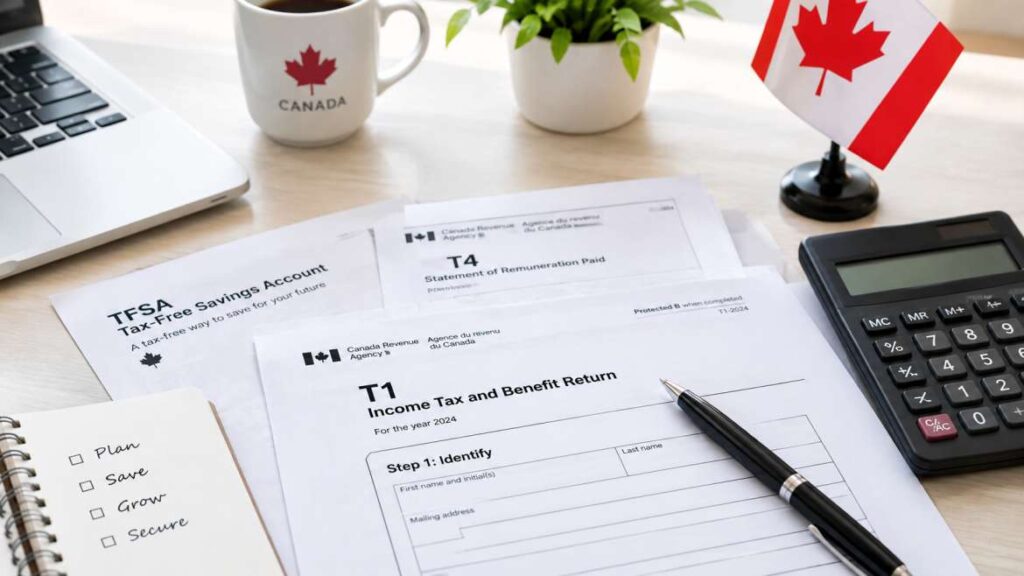
Your TFSA When You Leave Canada: Keep It, But Stop Contributing
The Tax-Free Savings Account is one of Canada’s most beloved financial tools — and the good news is you don’t have to close it when you leave. The bad news? The rules change dramatically, and one mistake can trigger a monthly penalty tax.
What You Can Still Do
According to the Government of Canada’s TFSA non-resident rules, as a non-resident you can:
- Keep your TFSA open
- Continue to benefit from tax-free growth on existing investments (for Canadian tax purposes)
- Make withdrawals from your TFSA without Canadian tax
What Changes Immediately
- You cannot contribute to your TFSA once you become a non-resident
- Your contribution room stops accumulating for any full year you’re a non-resident
- Any contributions made as a non-resident are subject to a 1% per month penalty tax until the funds are withdrawn — this adds up fast
- Withdrawals made as a non-resident are only added back as contribution room when (and if) you return to Canada and re-establish residency
The U.S. Exception (And Why It Matters)
If you’re moving to the United States, there’s an extra complication most people miss: the IRS does not recognize the TFSA as a tax-sheltered account. That means all income and gains inside your TFSA will be taxed annually by the U.S. as regular income. In this case, many cross-border tax advisors recommend collapsing the TFSA before you leave Canada, since the account essentially loses its core benefit.
Max out your TFSA contributions before your departure date. Once you’re abroad, your existing balance can still grow tax-free in Canada — you just can’t add to it.
💡 PRO TIP
Your RRSP as a Non-Resident: Tax-Deferred, With a Catch
Your Registered Retirement Savings Plan (RRSP) is exempt from Canada’s “departure tax” — meaning you don’t have to cash it out when you leave. You can keep it growing tax-deferred in Canada while living abroad. But there are important rules to know.
Contributions
Once you become a non-resident, making new RRSP contributions is generally off the table — your contribution room effectively freezes. However, one valuable strategy: contributing to your limit in your departure year can reduce your final Canadian tax bill, since you’re still a resident for part of that year.
Withdrawals as a Non-Resident
This is where things get expensive if you’re not careful. Any RRSP withdrawal as a non-resident is subject to a 25% Canadian withholding tax (Part XIII tax). If Canada has a tax treaty with your new country of residence, that rate may be reduced. For example:
- United States: The Canada-U.S. Tax Treaty may reduce the withholding tax to 15% on regular periodic payments
- Countries without a tax treaty: The standard 25% rate applies
Canada has tax treaties with over 90 countries, so it’s worth confirming the rate for your destination. You can check the CRA’s list of tax treaty countries.
While income in your RRSP grows tax-deferred for Canadian purposes, the Canada-U.S. Tax Treaty allows you to make an annual election to defer the U.S. tax on accrued income until withdrawal. However, this doesn’t apply in all U.S. states, so consult a cross-border tax advisor.
💡 Note for U.S. Movers
TABLE 1: What Happens to Your Registered Accounts When You Leave Canada
| Account | Can You Keep It? | Can You Contribute? | Withdrawals as Non-Resident | Departure Tax? |
|---|---|---|---|---|
| TFSA | ✅ Yes | ❌ No (1%/month penalty if you do) | Tax-free in Canada* | ❌ None |
| RRSP | ✅ Yes | ❌ Generally no | 25% withholding (may be reduced by treaty) | ❌ None |
| RRIF | ✅ Yes | N/A | 25% withholding (may be reduced to 15% by treaty) | ❌ None |
| FHSA | ✅ Yes (but loses key benefit) | ❌ No | Taxable as non-resident | ❌ None |
| RESP | ✅ Yes | ⚠️ Yes, but no CESG grants | Taxable (AIPs) + 20% penalty | ❌ None |
| Non-Registered Investments | ✅ Yes | ✅ Yes | Subject to withholding tax | ⚠️ Yes — deemed disposition |
*TFSA may be taxed in your country of residence (especially the U.S.)
FHSA: The Account That Loses Its Purpose When You Leave
If you have a First Home Savings Account (FHSA) and you leave Canada before buying a home, you’re in a tough spot.
The FHSA is designed specifically to help Canadians save tax-free toward their first home purchase. As a non-resident, you cannot make qualifying (tax-free) withdrawals to buy a home — that key benefit is simply gone. Any withdrawal you make becomes fully taxable. The contributions you made were deductible, which is the only silver lining, but the account’s primary purpose is lost.
The bottom line: If you’re planning to leave Canada before buying a home, consult a tax advisor about whether to collapse the FHSA before your departure date.
RESP: Government Grants Stop, But the Account Stays Open
If you have a Registered Education Savings Plan for a child, leaving Canada doesn’t automatically end the account — but it does change what you can get from it.
- You can keep the RESP open and continue contributing
- However, the Canada Education Savings Grant (CESG) and other government grants stop once the beneficiary (the child) is no longer a Canadian resident
- If the RESP is eventually collapsed without the funds being used for education, the accumulated income portion (called an Accumulated Income Payment or AIP) is taxed at your marginal rate plus an additional 20% penalty tax
If the child plans to attend a qualifying post-secondary institution (even internationally, in many cases), keeping the RESP can still make financial sense. Review the rules carefully with a financial advisor.
Canadian Bank Accounts: Keep Them, But Tell Your Bank
You are allowed to keep your Canadian bank accounts after you leave — and there are often good reasons to do so, especially if you’re receiving CPP, OAS, or rental income from a Canadian property.
However, according to Canada’s emigrant tax rules, you are legally required to notify your financial institutions that you are a non-resident. Once you do, they may:
- Withhold non-resident tax (25%, or reduced rate by treaty) on certain types of income deposited to the account, such as interest and dividends
- Report your income on an NR4 slip to the CRA
- In some cases, restrict certain account types or convert them to non-resident accounts
Some Canadian banks allow non-residents to hold accounts with minimal restrictions; others are less accommodating. Call your bank before you leave to understand their specific policies and ensure a smooth transition.
💡 PRACTICAL NOTE

CPP and OAS Abroad: Portable, But Taxed Differently
For retirees leaving Canada, understanding what happens to your pension benefits is critical.
Canada Pension Plan (CPP)
The good news: CPP is fully portable. You can receive your CPP pension anywhere in the world, with no residency requirement for payment. It can even be deposited directly into a foreign bank account in a foreign currency.
The withholding tax situation:
- Standard non-resident withholding is 25% under Part XIII of the Income Tax Act
- Most tax treaties reduce this to 15% — and for U.S. residents, the Canada-U.S. Treaty can reduce or even eliminate the withholding entirely
- You can apply for the reduced treaty rate by filing Form NR5 with the CRA before October 31 of the year prior
Old Age Security (OAS)
OAS is also portable, but with an important caveat: to receive OAS outside Canada, you must have lived in Canada for at least 20 years after age 18. If you don’t meet that threshold, your payments stop when you leave.
The standard 25% withholding tax applies, again reducible by tax treaty.
One more thing — the OAS clawback: As a non-resident, you’re still subject to the OAS recovery tax. For 2026, if your net world income exceeds approximately $95,323, your OAS begins to be clawed back at 15 cents for every dollar above that threshold.
Guaranteed Income Supplement (GIS): Gone After 6 Months
Unlike CPP and OAS, the GIS is not portable. If you leave Canada for more than six consecutive months, your GIS payments stop and do not resume until you return. This is a critical consideration for lower-income Canadians who rely on GIS.
TABLE 2: Non-Resident Withholding Tax Rates by Income Type
| Income Type | Standard Rate | With U.S. Treaty | With Most Other Treaties |
|---|---|---|---|
| CPP Pension | 25% | 0–15% | 15% |
| OAS Pension | 25% | 15% | 15% |
| RRSP Withdrawals (lump sum) | 25% | 25% | 25% |
| RRSP Withdrawals (periodic) | 25% | 15% | 15% |
| RRIF Withdrawals (periodic) | 25% | 15% | 15% |
| Canadian Bank Interest | 25% | 0% (treaty) | Varies |
| Canadian Dividends | 25% | 15% | 15% |
| Rental Income (gross) | 25% | Can elect S.216 | Can elect S.216 |
Sources: CRA Non-Residents and Income Tax (T4058); Canada.ca Before Applying – CPP International
Departure Tax: The Hidden Cost Most Canadians Miss
One of the most misunderstood aspects of leaving Canada is the concept of departure tax — and it can surprise people with a significant tax bill even if they haven’t sold anything.
When you leave Canada and become a non-resident, the CRA deems that you have disposed of (sold) most of your property at its fair market value on the date you left — even if you haven’t actually sold it. If those assets have increased in value since you bought them, you may owe capital gains tax on the paper gain.
Assets subject to departure tax typically include:
- Non-registered investment accounts (stocks, mutual funds, ETFs)
- Foreign property
- Shares in private companies
Assets exempt from departure tax:
- TFSA, RRSP, RRIF balances
- Canadian real estate (taxed separately when actually sold)
- CPP/OAS entitlements
- Personal-use property (furniture, vehicles)
The good news: you can often defer the departure tax by providing security to the CRA, especially if you expect to return to Canada. If the federal tax owing on the deemed disposition exceeds $16,500 (or $13,777.50 for Quebec residents), you must provide adequate security to the CRA — see Form T1244.
What You Should Do Before You Leave: A Pre-Departure Financial Checklist
Getting your accounts in order before your departure date can save you significant money and headaches. Here’s a practical action plan:
At least 6–12 months before leaving:
- Consult a cross-border tax specialist or CPA with international experience
- Review your non-registered investment accounts for unrealized capital gains (departure tax exposure)
- Consider timing of RRSP contributions to reduce your final-year Canadian tax bill
- Max out your TFSA contributions before your departure date
- Decide whether to collapse your FHSA if you’re not buying a Canadian home
1–3 months before leaving:
- Notify your bank, investment broker, and financial institutions of your upcoming non-resident status
- Set up a plan for CPP/OAS deposits (Canadian account or foreign bank account)
- File Form NR5 to apply for reduced treaty withholding rates on pension income
- Review your RESP — especially if the beneficiary child is also leaving Canada
At departure:
- Document the fair market value of all non-registered investments on your departure date (critical for departure tax calculation)
- Keep records of all Canadian residential ties you’re severing
- Consider completing Form NR73 for a formal CRA residency determination
After leaving:
- File your Canadian tax return for your departure year (using the package for your province on the date you left)
- File an NR4 annually if you receive Canadian-source income
- Keep the CRA informed of your foreign address
Real Scenarios: What This Looks Like in Practice
Scenario A: Maria, Moving to Portugal at Age 45
Maria has a $90,000 TFSA, a $220,000 RRSP, and a non-registered investment account worth $80,000 (with $30,000 in unrealized capital gains). She’s moving to Lisbon.
- Her TFSA stays open, grows tax-free in Canada, but she stops contributing. Portugal may tax the income depending on local rules — she needs to verify.
- Her RRSP stays open, growing tax-deferred. Any future withdrawals will be subject to 25% Canadian withholding (Portugal’s treaty rate may differ — she should confirm).
- Her non-registered account triggers a deemed disposition: she owes Canadian capital gains tax on $30,000 in gains even though she hasn’t sold anything. Half of $30,000 (= $15,000) is included as taxable income at her marginal rate.
Maria’s key action: Consult a cross-border CPA before leaving to potentially time the departure and structure her holdings to minimize departure tax.
Scenario B: David and Linda, Retiring to the U.S. at Age 67
David and Linda are moving to Florida. David has CPP of $800/month; Linda receives OAS of $650/month. Both have TFSAs and RRSPs.
- CPP: Under the Canada-U.S. Tax Treaty, David’s CPP withholding may be eliminated or significantly reduced. He files Form NR5 to apply the treaty rate.
- OAS: Standard 25% withholding applies, but the treaty reduces it to 15%. They file NR5 forms.
- TFSA: Both must stop contributing — and critically, the IRS will tax all TFSA income as regular income in the U.S. Their cross-border advisor recommends collapsing both TFSAs before leaving Canada.
- RRSP: They keep their RRSPs growing. Under the Canada-U.S. Tax Treaty, they can elect to defer U.S. tax on RRSP income until withdrawal.
David and Linda’s key action: Collapse TFSAs before departure, file NR5 for reduced treaty withholding, and engage a dual-qualified CPA (licensed in both Canada and the U.S.).
Key Takeaways
- Non-residency is determined by your ties to Canada, not just the number of days abroad. Notify the CRA and all financial institutions.
- TFSAs can stay open but no new contributions — any made as a non-resident trigger a 1%/month penalty. U.S. movers should consider collapsing the TFSA.
- RRSPs are flexible but withdrawals face 25% withholding, potentially reduced by tax treaties.
- FHSAs effectively lose their main benefit when you leave — collapsing before departure may be wiser.
- CPP is portable globally; OAS requires 20+ years of Canadian residency post-18 to receive abroad; GIS stops after 6 months outside Canada.
- Departure tax can hit your non-registered investments even if you haven’t sold them — plan carefully.
- Professional advice is essential. Cross-border tax rules interact in complex ways. A CPA with international and expatriate expertise is worth every dollar before you go.
Conclusion: Plan Before You Pack
Leaving Canada is an exciting chapter — but your financial accounts don’t automatically pack themselves neatly when you go. Each account has its own rules, its own risks, and its own window of opportunity to act before you become a non-resident.
The biggest mistake Canadians make is assuming their accounts will just keep working the same way from abroad. They won’t. But with the right planning — ideally 6 to 12 months before your move — you can protect your wealth, avoid unnecessary penalties, and set yourself up to thrive no matter where in the world you land next.
And if you found this guide helpful, ArriveThenThrive.ca has you covered with more practical, AI-powered advice for Canadians navigating life’s biggest transitions — whether you’re arriving somewhere new or building a frugal, financially confident life right here at home.
Frequently Asked Questions
Can I keep my Canadian bank account when I leave Canada? Yes. However, you are legally required to notify your bank of your non-resident status. Interest and other income deposited to the account will generally be subject to non-resident withholding tax.
Do I have to close my TFSA when I move abroad? No, but you must stop contributing. Any contributions made as a non-resident trigger a 1% per month penalty tax. If you’re moving to the U.S., strongly consider closing the TFSA before you leave, as the IRS taxes TFSA income.
What is departure tax in Canada? Departure tax refers to the capital gains tax triggered by a “deemed disposition” — the CRA treats you as having sold most of your non-registered assets at fair market value on the day you left Canada. Registered accounts (TFSA, RRSP) are generally exempt.
Can I still get CPP and OAS if I live outside Canada? CPP is fully portable with no residency requirement. OAS requires you to have lived in Canada for at least 20 years after age 18 to receive it abroad. GIS stops after 6 months outside Canada.
How do I reduce withholding tax on my Canadian pension income abroad? File Form NR5 with the CRA before October 31 of the year prior. If Canada has a tax treaty with your new country, this can reduce the standard 25% withholding rate — often to 15%.
DISCLAIMER
The information provided in this article is for general informational and educational purposes only and does not constitute professional tax, financial, legal, or investment advice. Tax rules and government regulations are subject to change, and their application depends on your individual circumstances, province of prior residence, destination country, and the specific terms of applicable tax treaties.
The scenarios and examples presented are illustrative only and may not reflect your personal situation. Before making any financial decisions related to leaving Canada, emigrating, or changing your tax residency status, you should consult a qualified Chartered Professional Accountant (CPA), cross-border tax specialist, or licensed financial advisor who can assess your specific situation.
ArriveThenThrive.ca makes no representations or warranties regarding the accuracy, completeness, or currency of the information contained in this article. Readers are encouraged to verify all information with the Canada Revenue Agency and other official sources, as tax laws and benefit rules may have changed since publication.
