Close Menu

    Subscribe to Updates

    Get the latest creative news from FooBar about art, design and business.

    What's Hot

    How Long Does It Take to Build a Good Credit Score in Canada?

    October 12, 2026

    What Happens to Your Canadian Accounts If You Leave Canada?

    September 29, 2026

    How the Canada Pension Plan (CPP) Works and How Much Newcomers Can Expect

    September 16, 2026
    Facebook X (Twitter) Instagram
    Facebook X (Twitter) Instagram
    Arrive Then ThriveArrive Then Thrive
    Subscribe
    • Home
    • Budget & Savings
      • Student Finance
      • Family Finance
    • Investing
    • Money Guide
      • Work & Income
      • Insurance
      • Banking
      • Building Credit
      • Taxes
    • Housing & Mortgages
    • News & Updates
    Arrive Then ThriveArrive Then Thrive
    Home»Building Credit»How Long Does It Take to Build a Good Credit Score in Canada?
    Building Credit

    How Long Does It Take to Build a Good Credit Score in Canada?

    Grace ValdezBy Grace ValdezOctober 12, 2026No Comments14 Mins Read5 Views
    Facebook Twitter Pinterest LinkedIn Tumblr Email
    confident. newcomer to Canada
    Share
    Facebook Twitter LinkedIn Pinterest WhatsApp Email

    You’ve landed in Canada. You’ve got your SIN card, you’ve opened a bank account, and you’re ready to build the life you came here for. Then someone mentions your credit score — and the confusion begins.

    If you’re new to Canada, a young adult just starting out, or even a long-time resident who’s never paid much attention to their credit, you might be asking: how long does it actually take to build a good credit score in Canada?

    The answer is both reassuring and honest: you can see your first credit score appear within a few months, reach a “good” score in 6 to 18 months, and achieve an excellent score over one to several years — depending entirely on how you manage your credit from day one.

    In this guide, we break down the exact timeline, the factors that speed things up or slow them down, and the most effective tools available to Canadians in 2025 — so you can stop guessing and start building.


    Why Your Credit Score Matters More Than You Think

    Your credit score in Canada is more than just a number. It’s essentially your financial reputation — a three-digit figure between 300 and 900 that lenders, landlords, insurers, and even some employers use to assess how reliably you manage money.

    Here’s what a good credit score can unlock for you in Canada:

    • Mortgage approval with competitive interest rates
    • Car loan approval without needing a large down payment
    • Rental apartment applications (many landlords check credit)
    • Lower interest rates on credit cards and personal loans
    • Better cell phone plan options (post-paid vs. prepaid)
    • In some industries, a clear credit check for employment screening

    According to the Financial Consumer Agency of Canada (FCAC), your credit score is calculated by two main credit bureaus: Equifax and TransUnion.

    Both bureaus use slightly different models and may produce scores that differ by a few points — but both follow the same general factors. The most widely used model is the FICO score, which is what most Canadian lenders refer to when making approval decisions.


    Understanding Canada’s Credit Score Ranges

    Before diving into timelines, it’s helpful to understand what the score numbers actually mean and what each range opens up for you financially.


    TABLE 1: Canadian Credit Score Ranges and What They Mean

    Score Range

    Rating

    What It Means for You

    Typical Timeline to Reach

    300–559

    Poor

    Very limited access to credit; higher deposits required

    Starting point for new arrivals

    560–659

    Fair

    Some lenders approve; higher interest rates apply

    3–6 months of active credit use

    660–724

    Good

    Approved for most products; decent rates

    6–18 months of responsible use

    725–759

    Very Good

    Better rates; wider product selection

    1–3 years of consistent habits

    760–900

    Excellent

    Best rates; premium product access; fast approvals

    3–7+ years of excellent management

    Source: Equifax Canada, TransUnion Canada.

    Credit score
    Checking credit score online.

    How Long Does It Take to Build Credit in Canada? The Real Timeline

    Let’s get straight to the numbers. The timeline varies based on your starting point, but here’s what most Canadians and newcomers can realistically expect:

    Stage 1: No Score to First Score (Month 0–3)

    When you first arrive in Canada or open your first credit product, you have no credit history. Canadian lenders have no way to assess your reliability — which is why newcomers often can’t get a standard credit card or loan right away.

    To generate your very first credit score, you need at least one account that has been open for three months and at least one account that has been reported to a credit bureau within the past six months. (Source: Credit Canada)

    Practical tip: get a secured credit card the moment you arrive. Use it for small purchases (groceries, transit), pay the full balance every month, and your first score will typically appear within 60–90 days.

    Stage 2: Fair Range — 560 to 659 (Month 3–6)

    This is the “just getting started” phase. Your score exists, but it’s still thin. You won’t qualify for the best products yet, but you’re building momentum. The most important habit here: never miss a payment, not even once.

    Even one missed payment can remain on your credit report for up to six years. (Source: immigration.ca)

    Stage 3: Good Range — 660 to 724 (Month 6–18)

    This is the threshold most Canadians aim for first. A score of 660 or higher is generally considered “good” by Equifax and is enough to qualify for most loans, rental applications, and standard credit cards.

    Reaching the 660+ mark typically takes 6 to 18 months of consistent responsible use — paying on time, keeping utilization below 30%, and not applying for too much credit at once. (Source: Wealthsimple)

    Stage 4: Very Good to Excellent — 725 to 900 (Year 2–7+)

    Getting from “good” to “excellent” is where patience really matters. This range is largely driven by the length of your credit history — one of the five factors in your credit score, and one you simply cannot rush.

    Most financial experts agree that achieving a consistently excellent score of 760+ takes anywhere from three to seven years of responsible, uninterrupted credit management. The oldest accounts in your file are like compound interest for your score.

    Borrowell notes that building an excellent score takes longer because length of credit history is a significant factor. (Source: Borrowell)


    💡 Real-World Scenario: Priya’s Credit Journey

    Priya arrived in Toronto from India in January 2024 with no Canadian credit history. In her first week, she applied for a secured credit card with a $500 deposit through her bank’s newcomer program. She used the card for groceries and her transit pass — roughly $200/month — and paid the balance in full every month. By April, her first Equifax score appeared: 512. By October, it had climbed to 668. By January 2026 (two years after arrival), Priya had a score of 718 and was approved for an unsecured card with a $5,000 limit and cash-back rewards. Her mortgage pre-qualification is now underway.

    The 5 Factors That Determine How Fast You Build Credit in Canada

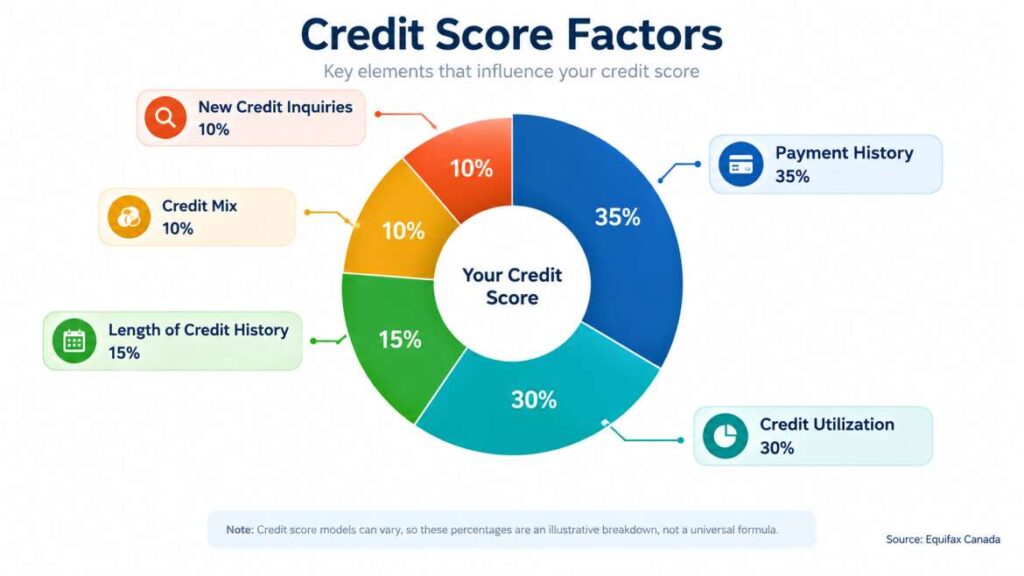
    Your credit score doesn’t appear randomly — it’s calculated from five well-defined factors, each carrying a different weight. Understanding these is the fastest shortcut to building your score intelligently.

    1. Payment History (35%) — The Most Powerful Factor

    This is the single biggest driver of your credit score. Every on-time payment adds a positive mark. Every missed or late payment can hurt significantly — and stays on your report for six years.

    Actionable tip: Set up automatic minimum payments for every account so you never accidentally miss a due date. Then pay off the full balance manually before the statement closes if you can.

    2. Credit Utilization (30%) — Keep It Below 30%

    Utilization is the percentage of your available credit that you’re using. If your credit card limit is $1,000 and you carry a $400 balance, your utilization is 40% — too high for optimal scoring.

    The golden rule: keep your utilization below 30% across all cards, and ideally below 10% for the best score impact. This alone can move your score significantly within one billing cycle.

    3. Length of Credit History (15%) — Time Is Your Friend

    The longer your accounts have been open and active, the better. This is why you should never close your oldest credit card, even if you rarely use it. One small purchase per year and a full payment keeps it active and working for you.

    4. Credit Mix (10%) — Variety Helps

    Having both revolving credit (credit cards) and installment credit (a car loan, student loan, or personal loan) shows lenders you can manage different types of debt responsibly. You don’t need to take on unnecessary debt for this — but having a mix naturally over time will help.

    5. New Credit Inquiries (10%) — Apply Sparingly

    Every time you apply for new credit, lenders do a “hard inquiry” on your file, which can temporarily lower your score by a few points. Multiple applications in a short period signal financial stress to bureaus. Space out any new credit applications by at least three to six months.


    The Best Tools to Build Your Credit Score in Canada (2025)

    Not all credit-building paths are equal. The right tool depends on your situation — whether you’re a newcomer, a student, someone rebuilding after financial difficulty, or simply new to credit products.


    TABLE 2: Credit-Building Products in Canada — Comparison Guide

    Product

    Best For

    Typical Requirements

    Credit Impact

    Secured Credit Card

    Newcomers, no credit history

    $300–$1,000 deposit

    High — builds payment history fast

    Credit-Builder Loan

    Thin credit files, rebuilders

    Steady income

    High — adds installment account

    Unsecured Student Card

    Students 18+

    School enrollment

    High — no deposit needed

    Authorized User (family)

    Those with a trusted sponsor

    Sponsor with good credit

    Medium — depends on sponsor habits

    Rent Reporting (Borrowell, FrontLobby)

    Renters with limited credit

    On-time rent payments

    Medium — adds payment history

    Post-paid Mobile Plan

    Anyone setting up in Canada

    ID + sometimes credit check

    Low-Medium — steady small history

    Secured Credit Cards: The Newcomer’s Best Friend

    A secured credit card requires a cash deposit (typically $300–$1,000) that acts as your credit limit. Because you’re essentially borrowing against your own money, banks are willing to issue them with no credit history. Every on-time payment builds your score.

    Most major Canadian banks — RBC, Scotiabank, TD, BMO, and CIBC — offer newcomer packages that include secured cards or low-limit starter cards. Scotiabank’s StartRight program, for instance, offers up to $15,000 in credit access for newcomers without a Canadian credit history.

    Rent Reporting: Unlock Credit from Your Biggest Bill

    Your rent is likely your largest monthly expense — but it doesn’t automatically show up on your credit report. Platforms like Borrowell and FrontLobby allow Canadian renters to have their on-time rent payments reported to Equifax and TransUnion, effectively turning rent into a credit-builder.

    KOHO users have reported an average credit score increase of +31 points within four months when using their credit-building tool. (Source: Loans Canada)

    Newcomer Banking Programs

    Several Canadian banks have dedicated programs for newcomers that include credit products without requiring Canadian credit history. These are worth researching as soon as you arrive, as they often waive standard requirements for the first year.

    Common Mistakes That Slow Down Credit Score Building

    Building credit is as much about what you don’t do as what you do. Here are the most common mistakes Canadians and newcomers make that delay their progress:

    • Closing old accounts: Closing your oldest card removes positive history and raises your utilization ratio — both hurt your score.
    • Carrying a high balance: Even if you pay on time, a high utilization ratio signals risk to bureaus. Keep balances low.
    • Applying for multiple cards at once: Each hard inquiry temporarily drops your score. Applying for five cards in one month could lower it by 20–40 points.
    • Assuming debit card use builds credit: Debit transactions are not reported to credit bureaus. Only credit products (cards, loans) build your score.
    • Missing even one payment: A single 30-day late payment can drop your score significantly and stays on your report for six years.
    • Not monitoring your credit: Errors on credit reports are more common than people think. Dispute any incorrect information directly with Equifax or TransUnion.

    According to the Financial Consumer Agency of Canada, credit scores typically adjust within 30 to 90 days after a significant event — such as paying off a large balance or opening a new account. This means your good habits start showing up in your score faster than most people expect. (Source: FCAC)

    💡 DID YOU KNOW

    How to Check Your Credit Score in Canada (For Free)

    Checking your own credit score is a “soft inquiry” and does not affect your score in any way. You should check it regularly — ideally monthly — to track progress and catch any errors.

    Free options to check your credit score in Canada:

    1. Borrowell — free Equifax score updates weekly; one of Canada’s most popular free tools
    2. Credit Karma — free TransUnion score; widely used with good tracking features
    3. Your bank’s app — RBC, Scotiabank, TD, BMO, and CIBC now offer free in-app score monitoring for account holders
    4. Directly from Equifax — free annual report available at consumer.equifax.ca
    5. Directly from TransUnion — free annual report available at transunion.ca


    For your full credit report (which includes detailed account history, not just the score), you’re entitled to one free copy per year from each bureau by mail, and you can access it online for a small fee anytime.

    Checking credit score online.

    Frequently Asked Questions About Building Credit in Canada

    Can I transfer my credit score from another country?

    No. Canadian credit history starts fresh when you arrive, regardless of your financial track record abroad. To a Canadian credit bureau, you have no credit — not bad credit, not good credit — just no credit. This is one of the most important things newcomers need to understand so they can start building immediately.

    Some lenders may consider international credit history as supporting documentation for certain applications, but it won’t directly influence your Canadian score.

    Does checking my own credit score lower it?

    Absolutely not. Checking your own score (called a soft inquiry) has zero impact on your credit score. Only hard inquiries — when a lender checks your credit as part of an application — temporarily affect your score. Monitor your score freely and often.

    Can my rent or utility payments help my credit score?

    They can, but only if you use a reporting service. Rent, cell phone, and utility payments are not automatically sent to credit bureaus in Canada. You need to actively sign up for a rent reporting platform (like Borrowell or FrontLobby) to have those payments count toward your credit history.

    What’s the fastest way to build credit in Canada?

    The fastest approach combines three things from day one: (1) a secured credit card with consistent, full monthly payments; (2) rent reporting through a platform like FrontLobby; and (3) keeping your utilization below 10%. With this combination, some newcomers have built a “Good” score in as little as six months.

    How long does it take to rebuild bad credit?

    Counterintuitively, rebuilding bad credit often takes longer than building credit from scratch. Negative items — missed payments, collections, bankruptcies — stay on your credit report for six to seven years. You’ll be building positive history while those negatives are still visible. Patience and consistency are key.


    Conclusion: Building Credit in Canada Is a Marathon — Start Your First Step Today

    Building a good credit score in Canada is not a mystery — it’s a system, and once you understand the rules, you can work with them deliberately.

    Here’s the bottom line: you can have your first credit score within 3 months, reach the “Good” range within 6 to 18 months, and achieve an excellent score in 3 to 7 years — provided you stay consistent, keep utilization low, never miss a payment, and use the right tools from the start.

    For newcomers especially, the advice is simple: don’t wait. Every month you delay is a month you’re not building. Your credit history doesn’t care how long you’ve been in Canada — it only cares what you do starting today.

    At ArriveThenThrive.ca, we believe that financial confidence is one of the cornerstones of truly settling into Canadian life. Whether you arrived last week or last decade, it’s never too late — and never too early — to take your credit score seriously.


    Key Takeaways:

    • Your first credit score appears within 3–6 months of opening a credit product
    • A “Good” score (660+) typically takes 6 to 18 months of responsible use
    • An “Excellent” score (760+) takes 3 to 7+ years — patience is non-negotiable
    • Payment history (35%) is the single biggest driver — never miss a payment
    • Secured credit cards and rent reporting platforms are the two fastest tools for newcomers
    • Monitoring your score regularly is free and does not hurt your credit


    Disclaimer

    The information provided in this article is for general informational and educational purposes only and does not constitute financial, legal, or investment advice. While ArriveThenThrive.ca makes every effort to ensure the accuracy and currency of the content, credit scoring models, lender requirements, and financial products in Canada may change at any time. Readers are encouraged to consult directly with a licensed financial advisor, credit counsellor, or banking professional before making any financial decisions. Credit score timelines referenced in this article are estimates based on publicly available data and individual results may vary based on personal financial circumstances. ArriveThenThrive.ca is not responsible for any actions taken based on the information provided herein.

    build credit Canada Canadian personal finance credit building tips credit history Canada credit score Canada credit score timeline Canada Equifax Canada financial tips for immigrants how to improve credit score Canada newcomers to Canada secured credit card Canada TransUnion Canada
    Share. Facebook Twitter Pinterest LinkedIn Tumblr Email
    Previous ArticleWhat Happens to Your Canadian Accounts If You Leave Canada?
    Grace Valdez
    • Pinterest
    • Instagram

    Grace Valdez is a Toronto-based blogger dedicated to helping and navigating life in Canada. She writes practical, easy-to-follow guides on everything from frugal living, settling into Canadian banking and budgeting, to understanding visa pathways, PR applications, and provincial settlement resources. Grace's warm, no-jargon writing style has made her a trusted online resource for thousands of readers building in Canada.

    Related Posts

    How the Canada Pension Plan (CPP) Works and How Much Newcomers Can Expect

    September 16, 2026

    Best Online Banks in Canada for Newcomers: EQ Bank, Tangerine & More

    September 9, 2026

    How to Open a TFSA Online in Canada: 5 Easy Steps for Newcomers

    August 30, 2026
    Leave A Reply Cancel Reply

    Demo
    Latest Posts

    How Long Does It Take to Build a Good Credit Score in Canada?

    October 12, 20265 Views

    What Happens to Your Canadian Accounts If You Leave Canada?

    September 29, 202614 Views

    How the Canada Pension Plan (CPP) Works and How Much Newcomers Can Expect

    September 16, 202616 Views

    Best Online Banks in Canada for Newcomers: EQ Bank, Tangerine & More

    September 9, 202615 Views
    Stay In Touch
    • Facebook
    • Twitter
    • Pinterest
    • Instagram
    • YouTube
    • Vimeo
    Don't Miss

    How Long Is the OHIP Waiting Period for Newcomers in Ontario?

    By Grace ValdezMarch 30, 2026

    You’ve landed in Ontario. You’re unpacking boxes, enrolling the kids in school, and navigating a…

    Cost of Living in Canada by City in 2026: Toronto vs Vancouver vs Calgary vs Ottawa

    March 12, 2026

    Banking for International Students in Canada: Best Accounts in 2026

    March 21, 2026

    Subscribe to Updates

    Get the latest creative news from SmartMag about art & design.

    Demo
    About Us
    About Us

    You Arrived. Now Let's Make Your Money Work in Canada.

    Email Us: admin@arrivethenthrive.ca

    Facebook X (Twitter) Pinterest YouTube WhatsApp
    Our Picks

    How Long Does It Take to Build a Good Credit Score in Canada?

    October 12, 2026

    What Happens to Your Canadian Accounts If You Leave Canada?

    September 29, 2026

    How the Canada Pension Plan (CPP) Works and How Much Newcomers Can Expect

    September 16, 2026
    Most Popular

    How Long Is the OHIP Waiting Period for Newcomers in Ontario?

    March 30, 2026503 Views

    Cost of Living in Canada by City in 2026: Toronto vs Vancouver vs Calgary vs Ottawa

    March 12, 2026417 Views

    Banking for International Students in Canada: Best Accounts in 2026

    March 21, 2026369 Views
    © 2026 ThemeSphere. Designed by ThemeSphere.
    • Home
    • About Us
    • Privacy Policy
    • Disclaimer
    • Contact Us

    Type above and press Enter to search. Press Esc to cancel.

    Powered by
    ►
    Necessary cookies enable essential site features like secure log-ins and consent preference adjustments. They do not store personal data.
    None
    ►
    Functional cookies support features like content sharing on social media, collecting feedback, and enabling third-party tools.
    None
    ►
    Analytical cookies track visitor interactions, providing insights on metrics like visitor count, bounce rate, and traffic sources.
    None
    ►
    Advertisement cookies deliver personalized ads based on your previous visits and analyze the effectiveness of ad campaigns.
    None
    ►
    Unclassified cookies are cookies that we are in the process of classifying, together with the providers of individual cookies.
    None
    Powered by