


You just landed in Canada. You’ve got your SIN, a new address, and a thousand things on your to-do list. Opening a savings account probably feels like something you can handle later — once life settles down a bit.
Here’s the thing: every day you wait to open a TFSA is a day of tax-free growth you’ll never get back.
That’s not a sales pitch. That’s just how compound interest works when the government has promised not to touch your earnings — ever.
The Tax-Free Savings Account (TFSA) is arguably the most powerful savings tool the Canadian government offers, and it’s available to you from the moment you become a tax resident. The challenge is that most newcomers either don’t know about it, or feel intimidated by Canadian financial products and put it off for months — even years.
In this guide, I’m going to cut through the confusion and walk you through exactly how to open a TFSA online in Canada in five straightforward steps. You’ll also learn how much you can contribute as a newcomer, which platforms are worth considering, and what mistakes to avoid so you don’t end up paying unnecessary penalties.
Let’s get your money working for you.
What Is a TFSA and Why Does It Matter for Newcomers?
Before we get to the how, let’s make sure the why is crystal clear.
A Tax-Free Savings Account (TFSA) is a registered savings account offered by the Canadian government that lets your money grow completely tax-free. That means any interest, dividends, or capital gains you earn inside the account are not taxed — and when you withdraw the money, you pay nothing to the CRA either. (Source: Canada.ca)
Despite the word “savings” in the name, a TFSA is far more than a regular savings account. Inside it, you can hold:
- Cash (high-interest savings)
- Guaranteed Investment Certificates (GICs)
- Mutual funds
- Stocks and bonds
- Exchange-Traded Funds (ETFs)
For newcomers specifically, the TFSA has one standout advantage over the RRSP (Registered Retirement Savings Plan): you don’t need any Canadian income history to open or contribute to a TFSA. With an RRSP, your contribution room is based on your prior year’s Canadian income — so in your first year or two, your RRSP room may be minimal or zero. The TFSA, by contrast, welcomes you right away.
TFSA vs RRSP: A Quick Comparison for Newcomers
TABLE 1: TFSA vs RRSP — What Newcomers Need to Know
| Feature | TFSA | RRSP |
|---|---|---|
| Contributions tax-deductible? | No | Yes |
| Withdrawals taxed? | Never | Yes (as income) |
| Income required to contribute? | No | Yes (prior year earned income) |
| Ideal for newcomers in Year 1? | ✅ Yes | ⚠️ Limited (low room) |
| Annual 2026 limit | $7,000 | 18% of prior year income (max $32,490) |
| Contribution room starts | Year you become a Canadian resident (18+) | Year after you earn Canadian income |
| Withdrawals affect OAS/GIS? | No | Yes |
| Unused room carries forward? | Yes, indefinitely | Yes, indefinitely |
Sources: Canada Revenue Agency, RBC
The bottom line? Start with the TFSA. It’s the most flexible, accessible, and immediately useful registered account for anyone newly arrived in Canada.
Who Is Eligible to Open a TFSA in Canada?
To open a TFSA, you must meet three conditions (Source: Canada.ca):
- Be 18 years of age or older (19 in provinces where that is the age of majority, such as British Columbia, Nova Scotia, and New Brunswick — but unused room from age 18 still accumulates and can be contributed once you reach 19)
- Be a Canadian resident for tax purposes
- Have a valid Social Insurance Number (SIN)
Notably, there is no requirement to be a citizen or permanent resident. Temporary residents — including those on work permits or study permits — are eligible to open and contribute to a TFSA. However, contributions made while you are a non-resident of Canada are subject to a 1% monthly penalty, so it’s critical to maintain your Canadian tax residency while contributing. (Source: Canada.ca)
How Much Can You Contribute? Understanding TFSA Room for Newcomers
This is where newcomers often get confused — and sometimes make costly mistakes.
Your TFSA contribution room does not start from 2009 (the year TFSAs were introduced). It starts from the year you become a Canadian tax resident with a valid SIN, assuming you were 18 or older at that point. (Source: Canada.ca)
The 2026 annual TFSA contribution limit is $7,000, the same as in 2024 and 2025. For Canadians who have been eligible since 2009 and have never contributed, the total cumulative room is now $109,000. (Source: Questrade)
If you arrived more recently, here’s what your room looks like:
TABLE 2: TFSA Cumulative Contribution Room for Newcomers by Year of Arrival (as of January 1, 2026)
| Year Arrived in Canada | Total TFSA Room Available (Jan 1, 2026) |
|---|---|
| 2019 | $41,500 |
| 2020 | $35,500 |
| 2021 | $27,500 |
| 2022 | $27,000 |
| 2023 | $20,500 |
| 2024 | $14,000 |
| 2025 | $7,000 |
| 2026 | $7,000 |
Note: Figures assume the individual was 18 or older upon arrival and became a Canadian tax resident in that year. Exact room depends on individual circumstances. Always verify your contribution room through your CRA My Account.
How to Open a TFSA Online in Canada: 5 Steps for Newcomers
Step 1: Get Your Social Insurance Number (SIN)
Your SIN is the foundation of your Canadian financial life. Without one, you cannot open a TFSA or any other registered account in Canada.
If you haven’t applied yet, do it as soon as possible:
- Online: Apply through Service Canada’s online portal if you hold a valid work or study permit
- In person: Visit a Service Canada office (bring your immigration documents and ID)
- By mail: Download and submit the application form
Once you have your SIN, you’re eligible. Keep it safe — it’s your gateway to all registered accounts, government benefits, and the CRA’s My Account portal.
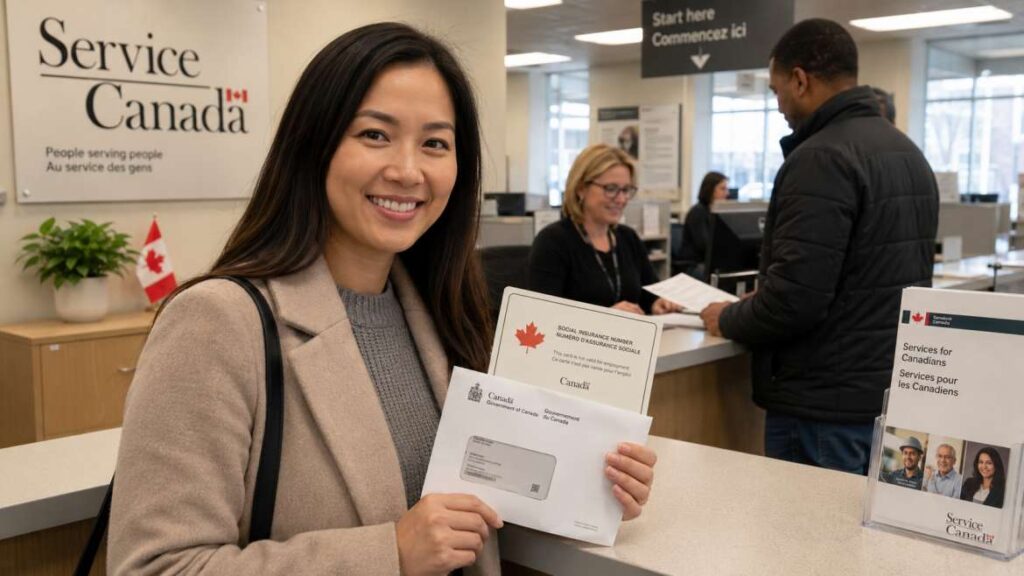
Apply for your SIN on your first week in Canada. Processing is typically fast (in-person applications may be same-day), and it unlocks everything else on your financial checklist.
💡 PRO TIP
Step 2: Register for a CRA My Account
Before or shortly after opening your TFSA, register for a CRA My Account. This free online portal lets you:
- View your exact TFSA contribution room
- Check that your financial institution’s reports match CRA records
- Avoid over-contribution penalties
One important caveat: CRA updates its records based on information submitted by financial institutions, and this data is often not refreshed until mid-year. (Source: Canada.ca) Always cross-reference your CRA account with your own transaction records — never assume the portal reflects your most recent contributions.
Step 3: Choose the Right TFSA Platform for You
TFSAs are offered by nearly every Canadian financial institution. Your choice depends on your goals:
Big Five Banks (TD, RBC, Scotiabank, BMO, CIBC)
- Best for: Newcomers who want in-person support, multilingual advisors, and bundled banking
- Pros: Branch access, established trust, newcomer-specific packages
- Cons: Often lower interest rates on savings; may charge management fees
Online Banks (EQ Bank, Tangerine, Simplii Financial)
- Best for: Savers who want competitive interest rates with no fees
- Pros: Higher HISA rates inside TFSA, no monthly account fees
- Cons: No in-person branches
Online Brokerages / Robo-Advisors (Wealthsimple, Questrade)
- Best for: Newcomers ready to invest in ETFs, stocks, or use a managed portfolio
- Pros: Commission-free ETF trades (Questrade); automated investing (Wealthsimple); very low fees
- Cons: No physical branches; requires a bit more financial confidence
Many newcomers start with a high-interest TFSA savings account at a no-fee online bank while they get settled, then later open a self-directed investment TFSA for long-term growth. You can have multiple TFSAs at different institutions — just remember that your contribution room applies across all of them combined.
💡 PRO TIP
Step 4: Apply Online and Provide Your Documents
Once you’ve chosen your institution, opening a TFSA online typically takes 10–20 minutes. Here’s what you’ll generally need:
- Social Insurance Number (SIN)
- Date of birth
- Government-issued ID (passport, provincial driver’s licence, or PR card)
- Canadian address
- Immigration documents (some institutions may request these from newcomers — such as your work permit, study permit, or PR card, in addition to standard ID)
Most online institutions will ask you to fill out a short form, upload or confirm your ID, and link a bank account for funding. (Source: Canada.ca)
Once your account is open and verified, you can make your first contribution immediately via electronic funds transfer.
Start small if needed. Even a $50 or $100 initial contribution gets the account open and establishes your history with the institution. You can always add more as your finances stabilize.
💡 PRO TIP
Step 5: Fund Your TFSA and Choose Your Investments
This is the step most guides skip over — but it’s arguably the most important one.
Simply opening a TFSA and leaving cash in it without directing it into any investment means you’re earning minimal interest. Depending on your goals and timeline, consider:
- Short-term (0–2 years): High-interest savings within your TFSA; GICs for locked-in higher rates
- Medium-term (2–5 years): Conservative ETF portfolios or balanced mutual funds
- Long-term (5+ years): Growth ETFs (e.g., broad Canadian and global index funds); diversified stock portfolios
You don’t need to be an investment expert. Platforms like Wealthsimple offer managed portfolios where you answer a few questions and they handle the investing for you — completely within your TFSA.

Avoid These Common TFSA Mistakes as a Newcomer
Even well-intentioned newcomers make costly TFSA errors. Here are the ones to watch out for:
Over-contributing: If you contribute more than your available room, the CRA charges a 1% penalty per month on the excess amount until you withdraw it. (Source: Questrade) Always know your exact room before depositing.
Re-contributing a withdrawal in the same year: If you withdraw $5,000 in June 2026, that room is only restored on January 1, 2027 — not immediately. Putting it back in the same calendar year will trigger an over-contribution penalty. (Source: TD Canada Trust)
Assuming the CRA’s records are current: As mentioned, financial institutions report TFSA data to the CRA with a delay. Don’t rely solely on your CRA My Account balance when making contribution decisions mid-year.
Contributing as a non-resident: If you leave Canada and lose your tax residency status, any contributions made to your TFSA while abroad are penalized at 1% per month. Your TFSA stays open, but you can’t contribute to it. (Source: Canada.ca)
Confusing TFSA room with investment growth: Your TFSA contribution room is not reduced by investment gains. If you contribute $7,000 and it grows to $9,000, you haven’t “used up” extra room — the gain is simply inside the account, growing tax-free. (Source: Canada.ca)
A Real-World Example: Newcomer TFSA Growth
Consider Priya, who arrived in Canada from India in March 2022 and received her SIN in April of that year. She opened a TFSA in January 2023 — having accumulated $13,000 in room ($6,500 for 2022 + $6,500 for 2023).
Rather than waiting until she had a large lump sum, Priya set up an automatic monthly transfer of $300 into a Wealthsimple managed TFSA portfolio. By January 2026, she had contributed approximately $10,800 over three years. With investment growth, her TFSA balance had grown to over $12,500 — every dollar of gain completely tax-free.
More importantly, she still has unused TFSA room from prior years she can deploy as her financial situation improves. Her TFSA balance now serves as both an emergency fund buffer and a long-term investment vehicle.
The key lesson: you don’t need to maximize your TFSA right away to benefit from it enormously. Consistency and starting early matter far more than the size of your initial contribution.
What Happens to Your TFSA If You Leave Canada?
This is a question many newcomers think about — and rightly so.
If you leave Canada permanently:
- Your TFSA remains open and continues to hold your investments
- Your contribution room stops accumulating while you’re a non-resident
- Earnings and withdrawals from your Canadian TFSA may be taxable in your new country of residence
- Contributions made as a non-resident are penalized 1% per month
When you return to Canada and re-establish tax residency, your TFSA room begins accumulating again, and any withdrawn amounts during your absence are added back to your room when you return. (Source: RBC)
Frequently Asked Questions: TFSA for Newcomers
Do I need to file a tax return to open a TFSA? No. Unlike the RRSP, a TFSA has no income requirement and you don’t need to have filed a Canadian tax return to open one or contribute to it.
Can I open a TFSA before I get a job in Canada? Yes. There is no earned income requirement for a TFSA. You can open and contribute to one the day you become a Canadian tax resident, even with $0 in employment income.
Can I have multiple TFSAs? Yes, you can hold TFSAs at multiple financial institutions. However, your contribution limit applies across all of them combined. (Source: Questrade)
What if I’m a refugee claimant or on a temporary permit? If you have a valid SIN and are a Canadian tax resident, you are generally eligible for a TFSA. However, if there is significant uncertainty about your residency status, consult a financial advisor or tax professional before opening one.
Can I transfer my TFSA from one institution to another? Yes. A direct transfer between TFSA issuers does not affect your contribution room, as it is treated as a qualifying transfer (not a withdrawal). Request a direct transfer through your new institution.
Quick Action Checklist: How to Open a TFSA Online in Canada
[IMAGE 6 — 5-step checklist graphic with maple leaf checkmarks]
Here’s your complete newcomer TFSA to-do list:
- Apply for your Social Insurance Number (SIN) at Service Canada
- Register for CRA My Account to check your contribution room
- Choose your TFSA provider (bank, online bank, or brokerage)
- Complete the online application with your SIN, ID, and Canadian address
- Make your first contribution — any amount to start
- Set up automatic monthly contributions (even $50–$100 builds the habit)
- Select your investments inside the TFSA based on your timeline and goals
Conclusion: Start Small, Start Now
Opening a TFSA online in Canada as a newcomer is one of the smartest financial moves you can make — and it’s simpler than many people think. The five steps outlined above can realistically be completed in a single afternoon: get your SIN, register for CRA My Account, pick a platform, apply online, and fund the account.
The most important thing is to start. Your TFSA contribution room is accumulating right now, whether you use it or not. Every year you delay is a year of tax-free growth that you can’t recapture.
Whether you begin with $100 or $10,000, the act of opening the account and building the habit of contributing is what creates wealth over time. Canada offers you one of the most generous tax-sheltered savings vehicles in the world. Take advantage of it.
For more guides on Canadian personal finance as a newcomer, explore the rest of ArriveThenThrive.ca — from RRSP basics to the First Home Savings Account (FHSA) and how to navigate your first Canadian tax return.
Sources & Further Reading
- Canada Revenue Agency — Tax-Free Savings Account Overview
- Canada Revenue Agency — Opening a TFSA
- Canada Revenue Agency — Calculate Your TFSA Contribution Room
- Canada Revenue Agency — Before You Contribute to a TFSA
- RBC — TFSA for Newcomers
- Questrade — TFSA Contribution Limits 2026
- TD Canada Trust — TFSA Contribution Room and Withdrawal Rules
- TFSAhelper.ca — Newcomers to Canada
- Moving2Canada — TFSAs Explained for Newcomers
- CRA My Account Portal
⚠️ Disclaimer
The information provided in this article is for general educational and informational purposes only and does not constitute financial, tax, investment, or legal advice. While every effort has been made to ensure accuracy and currency of the information presented, tax laws, contribution limits, and government programs are subject to change. The content on ArriveThenThrive.ca is not tailored to any individual’s specific financial situation, goals, or circumstances.
Readers are strongly encouraged to consult with a qualified financial advisor, tax professional, or investment advisor before making any financial decisions, including opening a TFSA or making contributions. The Canada Revenue Agency (CRA) is the authoritative source for all TFSA rules and regulations — always verify current rules at canada.ca.
ArriveThenThrive.ca is not affiliated with, endorsed by, or sponsored by any financial institution mentioned in this article. All product or platform mentions are for informational purposes only.
