You landed in Canada, got your SIN card, started working — and then someone casually mentioned “tax season.” Suddenly, words like marginal rate, basic personal amount, and T4 slips are everywhere. If your eyes glazed over, you’re not alone.
Here’s the truth most guides won’t tell you: the Canadian tax system is actually one of the more logical ones in the world — once someone explains it in plain English instead of government jargon.
This article does exactly that. By the time you finish reading, you’ll understand:
- What “tax brackets” actually mean (and the big myth most people believe)
- How federal and provincial taxes work together
- A real-world example with numbers
- The credits and deductions newcomers often miss
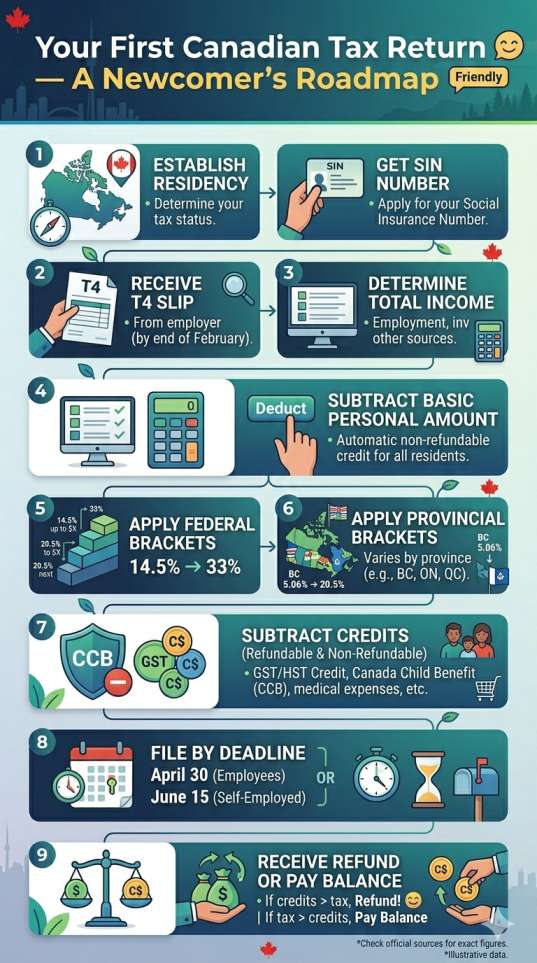
- Exactly what to do for your first tax filing
Whether you arrived last month or a year ago, this guide is your starting point. Let’s make taxes simple.
What Is a Tax Bracket, Really?
Before we dive into Canadian specifics, let’s bust the most common misconception about tax brackets — one that costs people real stress and confusion.
The myth: “If I earn more and jump into the next tax bracket, all my income gets taxed at the higher rate.”
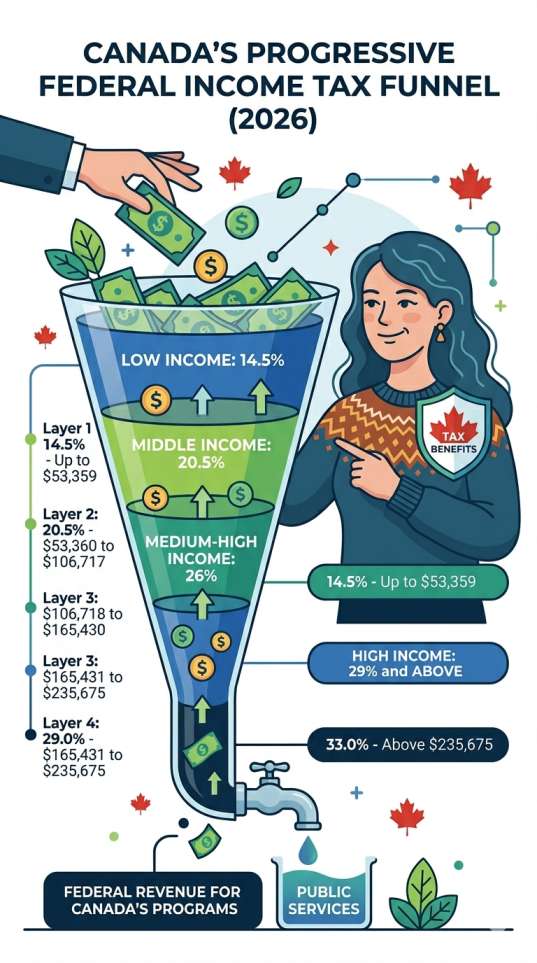
The truth: Absolutely not. Canada uses a progressive (or graduated) tax system, which means only the portion of your income that falls within a bracket gets taxed at that bracket’s rate. Think of it like filling buckets of water — each bucket (bracket) fills up at a certain rate before spilling into the next one.
A Simple Analogy
Imagine the government has set up three water buckets:
- Bucket 1 holds up to $57,375 — every dollar here is taxed at 14.5%
- Bucket 2 holds the next chunk up to $114,750 — that portion is taxed at 20.5%
- Bucket 3 and beyond — taxed at progressively higher rates
If you earn $65,000, you don’t pay 20.5% on everything. You pay 14.5% on the first $57,375, and only 20.5% on the remaining $7,625. That’s it. Earning more never makes you “worse off” — you always take home more money as your income grows.
In many countries, tax systems work very differently — flat rates, one-size-fits-all calculations, or informal collection. Canada’s bracket system is designed so that your tax burden scales fairly with what you earn.
💡 Key Insight for Newcomers
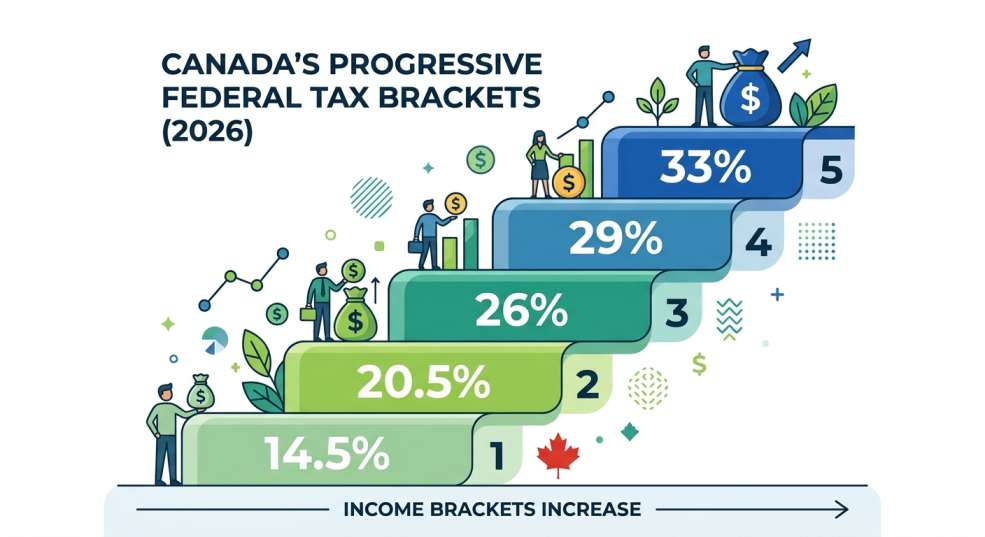
Canada’s Federal Tax Brackets for 2025
Canada’s federal government sets one set of brackets that applies to every Canadian, in every province. Here are the official 2025 rates from the Canada Revenue Agency (CRA):
SOURCE: Canada Revenue Agency — Taxtips.ca 2025 Federal Rates | H&R Block Canada
TABLE 1: 2025 Federal Income Tax Brackets — Canada
| Taxable Income Range | Federal Tax Rate |
|---|---|
| $0 – $57,375 | 14.5% |
| $57,375 – $114,750 | 20.5% |
| $114,750 – $177,882 | 26% |
| $177,882 – $253,414 | 29% |
| Over $253,414 | 33% |
Source: Canada Revenue Agency (CRA), 2025 tax year. taxtips.ca
Important note for 2025: The lowest federal bracket dropped from 15% to an effective 14.5% this year (because the rate cut from 15% to 14% was applied starting July 1, 2025). Starting in 2026, it becomes a flat 14%. This is a meaningful tax cut for lower and middle-income earners — including most newcomers in their first working years.
The Basic Personal Amount — Your Free Pass
Before you pay a single dollar of federal tax, the CRA gives everyone — newcomers included — a Basic Personal Amount (BPA) of $16,129 for 2025. This is the amount of income you can earn completely tax-free at the federal level.
This means if you earned $16,129 or less in 2025, you owe zero federal income tax. Most newcomers who work part of the year (because they arrived mid-year) will find this especially valuable.
Federal Tax Is Just Half the Story — Meet Provincial Tax
Here’s something many newcomers discover (sometimes with a surprise): you pay two sets of income tax in Canada — one to the federal government, and one to the province or territory where you live as of December 31 of that tax year.
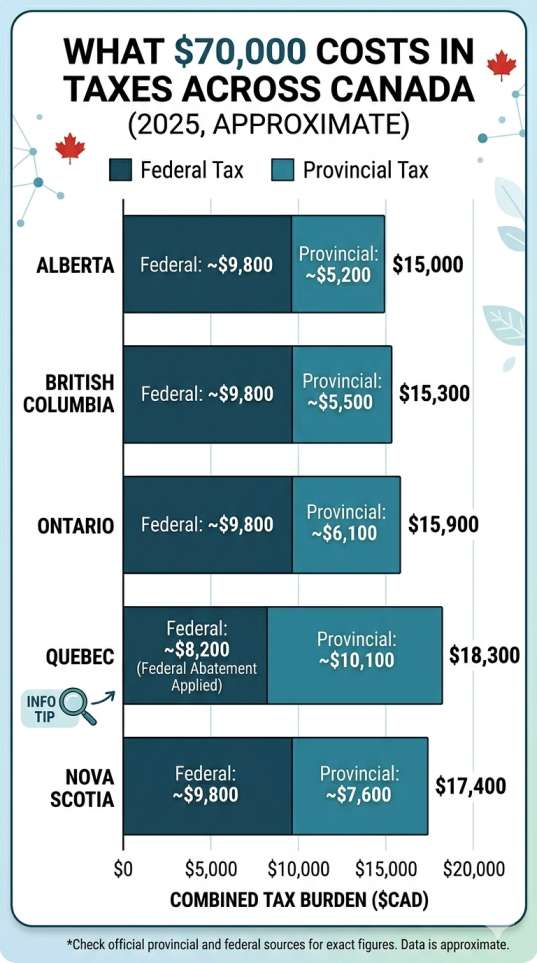
Both levels use the same progressive bracket logic, but provinces set their own rates and thresholds. This is why a $70,000 salary looks different in Ontario versus Alberta versus British Columbia.
Why Provinces Tax Separately
Canada’s constitution divides responsibilities between the federal and provincial governments. Provinces fund things like healthcare, education, and social services — and income tax is one of their main revenue tools. So when you file your tax return, your T1 General Return calculates both federal and provincial tax in one go. You don’t file twice. The CRA handles the coordination (except in Quebec, which has its own separate provincial return through Revenu Québec).
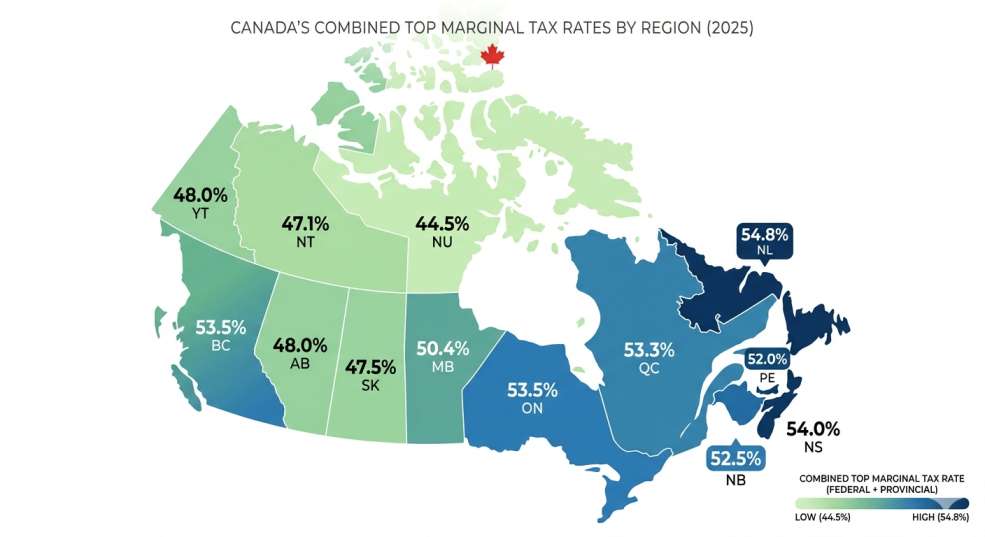
TABLE 2: Combined Top Marginal Tax Rates by Province (2025) — Major Provinces Compared
| Province | Provincial Top Rate | Combined Fed + Prov. Top Rate | Notes |
|---|---|---|---|
| Ontario | 13.16% | ~53.53% | Surtax applies above certain thresholds |
| British Columbia | 20.5% | ~53.50% | 7 provincial brackets |
| Alberta | 15% | ~48.00% | Lowest top rate of major provinces |
| Quebec | ~25.75% | ~53.31% | Files separate provincial return |
| Nova Scotia | 21% | ~54.00% | Highest combined rate in Atlantic Canada |
Sources: CalcTax.ca | PwC Canada Tax Summarie
These “top” combined rates apply only to income above ~$253,000 (federal) and the provincial top bracket. Most newcomers will be in significantly lower combined brackets.
⚠️ Note
A Real Newcomer Tax Example — Step by Step
Theory is good. Numbers are better. Let’s walk through a realistic scenario.
Meet Priya — A Newcomer’s First Tax Year in Canada
Background: Priya arrived in Ontario from India in April 2025. She found a job in July 2025 earning $65,000 annually (prorated — she earned approximately $32,500 for the remaining months of the year she worked).
Step 1 — Determine taxable income: Priya earned $32,500. She has no RRSP contributions or other deductions this year.
- Federal BPA deduction: $16,129
- Net taxable income (federal): $32,500 – $16,129 = $16,371
Step 2 — Apply federal brackets: Her entire $16,371 falls within the first bracket (up to $57,375).
- Federal tax: $16,371 × 14.5% = ~$2,374
Step 3 — Apply Ontario provincial tax: Ontario’s basic personal amount is $12,747. Net taxable income provincially: $32,500 – $12,747 = $19,753.
- Ontario’s first bracket rate: 5.05% on up to $52,886
- Provincial tax: $19,753 × 5.05% = ~$998
Total tax owed: ~$3,372 Effective tax rate: ~10.4%
Priya doesn’t pay 14.5% or even 20.5% on everything. Her effective rate — what she actually pays as a percentage of total income — is just over 10%. That’s the power of the bracket system working in her favour.
If you arrived partway through the year, you only report income earned after establishing Canadian tax residency. You are not taxed on your full annual salary equivalent — only what you actually earned in Canada. (CRA Newcomers Guide)
💡 NEWCOMER TIP
Credits and Deductions Newcomers Often Miss
Filing taxes isn’t just about what you owe — it’s about what you’re owed. Canada has a generous system of credits and deductions, many of which newcomers qualify for immediately.
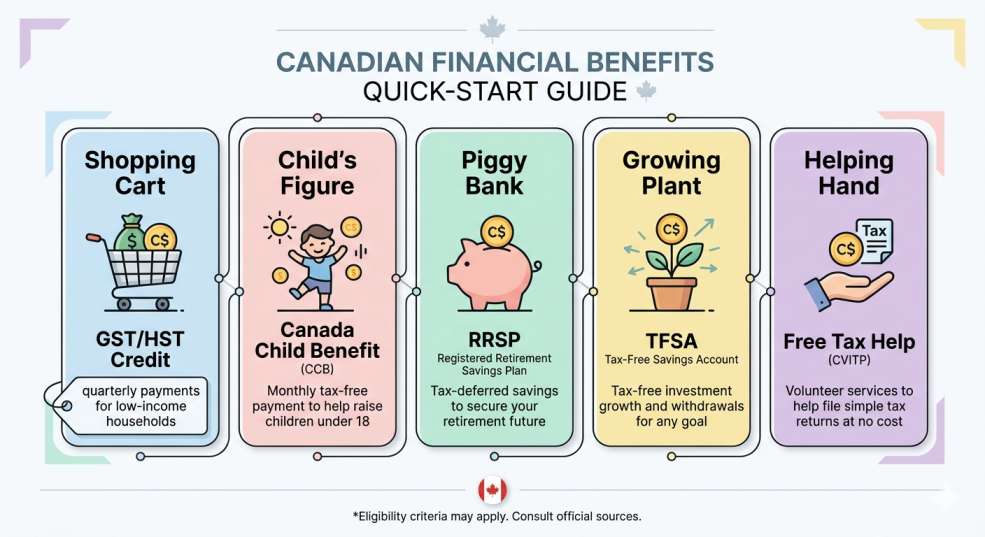
The GST/HST Credit
Once you file your first tax return, the CRA automatically assesses whether you qualify for the GST/HST credit — a quarterly, tax-free payment to offset consumption taxes. For 2025, eligible individuals can receive hundreds of dollars annually depending on income and family size. You don’t apply separately — just file your return and the CRA determines eligibility.
Canada Child Benefit (CCB)
If you have children under 18, the Canada Child Benefit could be one of the most significant financial benefits available to your family. It’s a monthly, tax-free payment, and the amount depends on your income and number of children. Many newcomer families are surprised to learn how substantial this benefit can be.
RRSP Contributions
A Registered Retirement Savings Plan (RRSP) is one of Canada’s most powerful tax tools. Contributions you make reduce your taxable income dollar-for-dollar. If Priya from our example above had contributed $5,000 to an RRSP, her taxable income would have dropped to $11,371, reducing her federal tax further.
Your RRSP contribution room is 18% of your previous year’s earned income, up to an annual maximum. As a newcomer, you typically begin accumulating RRSP room after your first year of Canadian income.
TFSA — The Tax-Free Savings Account
A Tax-Free Savings Account (TFSA) doesn’t reduce your taxes on the way in, but any investment growth or withdrawals are completely tax-free. Newcomers who become residents of Canada at age 18 or older can begin contributing immediately. As of 2025, the annual contribution limit is $7,000, with cumulative room that builds each year.
Free Tax Help — CVITP
The Community Volunteer Income Tax Program (CVITP), offered through the CRA, provides free tax preparation help to eligible individuals — including newcomers with modest incomes. Local settlement agencies, community centres, and libraries often host CVITP clinics during tax season.
Source: CRA CVITP Program
When and How to File Your First Canadian Tax Return
Key Dates to Know
- T4 slips (employment income summary) must be issued by employers by the last day of February
- Filing deadline: April 30 for most individuals
- Self-employed: June 15 to file, but any balance owing is still due April 30
- Newcomers who arrived mid-year still file a return for that year — even if you only earned income for a few months
Filing late when you owe money triggers penalties: 5% of the balance owing, plus 1% per month for up to 12 months. (CIBC Newcomer Tax Guide)
How to Actually File
Canada makes tax filing fairly accessible. Options include:
- NETFILE-certified tax software (many are free for simple returns): TurboTax, SimpleTax/Wealthsimple Tax, H&R Block Online
- Paper return: Download from the CRA website and mail in
- Tax professional or accountant: Ideal for complex situations (multiple income sources, foreign assets, self-employment)
- CVITP clinics: Free, in-person help at community locations
What You’ll Need for Your First Filing
- Social Insurance Number (SIN)
- T4 slip(s) from employer(s)
- Date you established Canadian residency
- Any foreign income earned before moving (may need to disclose)
- Banking information for direct deposit of refunds
Common Mistakes Newcomers Make at Tax Time
Even well-prepared newcomers sometimes stumble. Here’s what to watch for:
1. Assuming you don’t need to file because your income was low. Even with no income, filing can unlock benefits like the GST credit and CCB. Always file.
2. Not declaring foreign income. Canada taxes residents on worldwide income. If you had investment income, rental income, or other earnings in your home country after becoming a Canadian resident, it generally needs to be reported. There may be tax treaty protections — consult a tax professional.
3. Missing your arrival date on the return. Your T1 return includes a field for your date of entry into Canada. This affects how prorated credits are calculated.
4. Confusing marginal rate with effective rate. Your marginal rate (the rate on your last dollar) is NOT what you pay on your entire income. Your effective rate is almost always lower.
5. Not setting up direct deposit with the CRA. Register your bank account through CRA My Account to receive any refunds and benefits faster — directly into your account.
Practical Takeaways — Your Tax Checklist as a Newcomer
Here’s a quick-reference summary of everything you need to do:
Get your SIN number (Service Canada)
Keep records of your Canadian arrival date
Understand the two-layer system: federal + provincial tax
Know your Basic Personal Amount ($16,129 federally for 2025)
File your return by April 30 — even if income was minimal
Apply for GST/HST Credit and Canada Child Benefit (by filing)
Explore RRSP contributions in your second year
Open a TFSA as soon as you become a resident
Look for a free CVITP tax clinic in your community
Register for CRA My Account online
Conclusion: Taxes Are a Sign You Belong Here
Canada’s tax system might look intimidating at first glance, but once you understand the logic, it’s genuinely designed to be fair. The progressive bracket structure means you’re only taxed heavily on the income you’ve truly earned above certain thresholds. The benefits system — CCB, GST credits, TFSA, RRSP — is robust enough that many newcomers actually receive more from the government than they owe in their first year.
More importantly, filing taxes in Canada is your gateway to the full suite of programs this country offers. It’s how the government knows you’re here, how you access healthcare subsidies, how you build credit history and financial standing as a new resident.
You came to Canada to build a better life. Understanding how your money works — including how you’re taxed and what you get back — is one of the most practical steps toward doing exactly that.
Welcome to Canada. Now go file that return.
⚠️ DISCLAIMER
The information provided in this article is for general educational and informational purposes only and does not constitute tax, legal, or financial advice. Tax laws, rates, and credits are subject to change annually by the Government of Canada and provincial governments. Every individual’s tax situation is unique — factors such as residency status, immigration category, foreign income, marital status, dependents, and province of residence can significantly affect your tax obligations and benefits.
ArriveThenThrive.ca strongly recommends consulting a qualified Canadian tax professional or accountant for advice specific to your personal circumstances, especially in your first year of Canadian residency. You can also consult the Canada Revenue Agency (CRA) directly at canada.ca/cra or by calling 1-800-959-8281.
This article reflects information available as of April 2026 for the 2025 tax year. Readers should verify current rates and thresholds with the CRA or a tax professional before filing.